Painter fills a Lower East Side gallery with the clothing of Iran’s imprisoned women
Haleh Atabeigi also holds roughly 100 handmade objects bought out of Evin prison, which she has painted.

Haleh Atabeigi also holds roughly 100 handmade objects bought out of Evin prison, which she has painted.
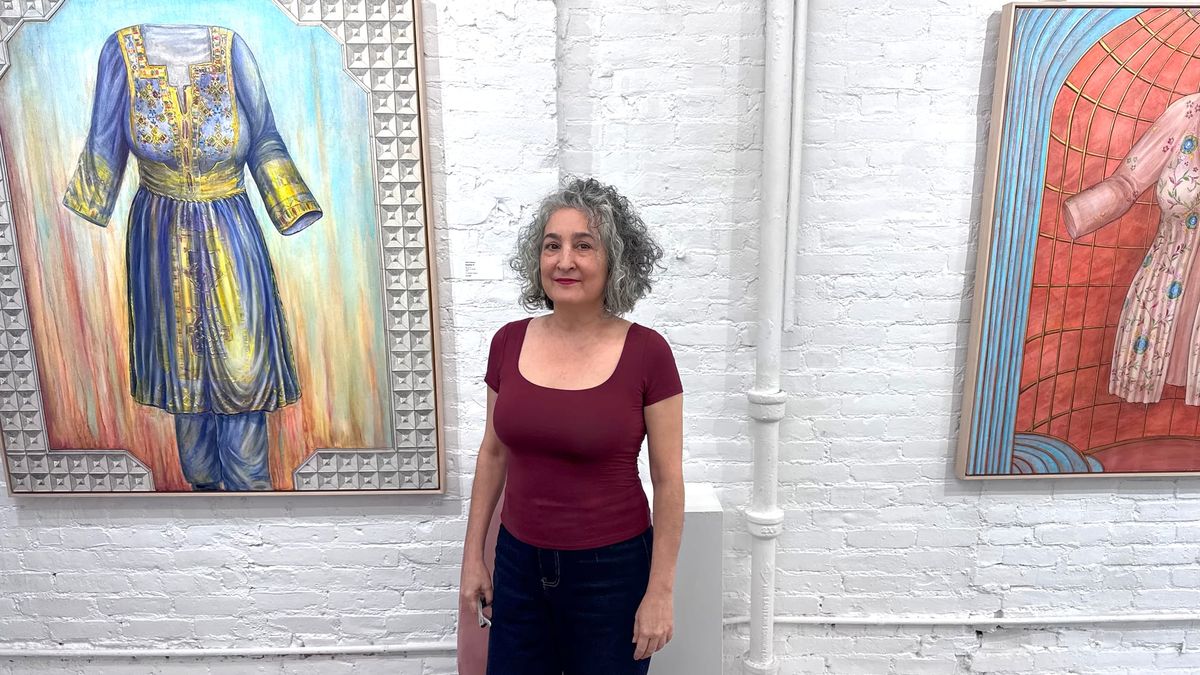
Ten paintings of empty garments by Iranian-born artist Haleh Atabeigi hang at New York gallery Collective Z. Each one is the clothing of a specific woman imprisoned in Iran.
Atabeigi was born in Iran in 1968 and left for the United States in 1984. She has returned three times, most recently in 2018.
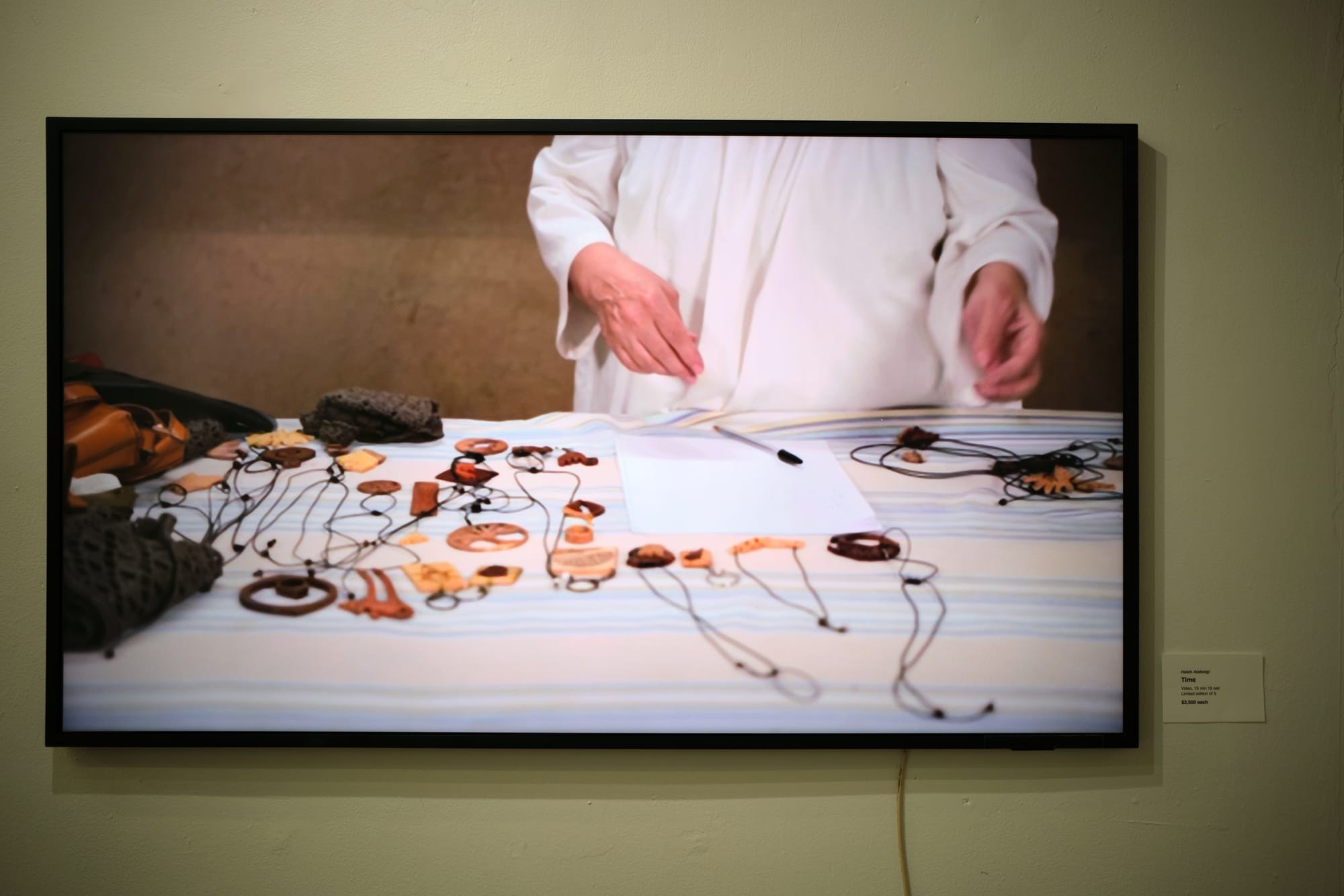
Her show, “Conviction,” which runs through August 1, also includes 27 small canvases of handmade objects made by women inside Tehran’s notorious Evin prison, and a 15-minute video filmed in Iran.
Nine women are represented across the ten garment paintings. The labor-rights writer Sepideh Gholian has two.
The others are Nobel Peace Prize laureate Narges Mohammadi; journalists Niloufar Hamedi, Elaheh Mohammadi and Vida Rabbani; dissident Fatemeh Sepehri; Kurdish prisoner Zeynab Jalalian; singer Zara Esmaeili; and social worker Sarvenaz Ahmadi.
Narges Mohammadi collapsed in prison and was hospitalized May 1 after a cardiac crisis. Her foundation said she was discharged from Pars Hospital in Tehran on May 17 and remains at home under medical observation, with 18 years left on her sentence.
In the exhibit, Narges Mohammadi's blush pink coat, embroidered with small blue and pink flowers, is depicted inside a gold birdcage against a burnt orange ground. It is the largest canvas in the show at 48 by 44 inches, and the image on the exhibition catalog's cover.
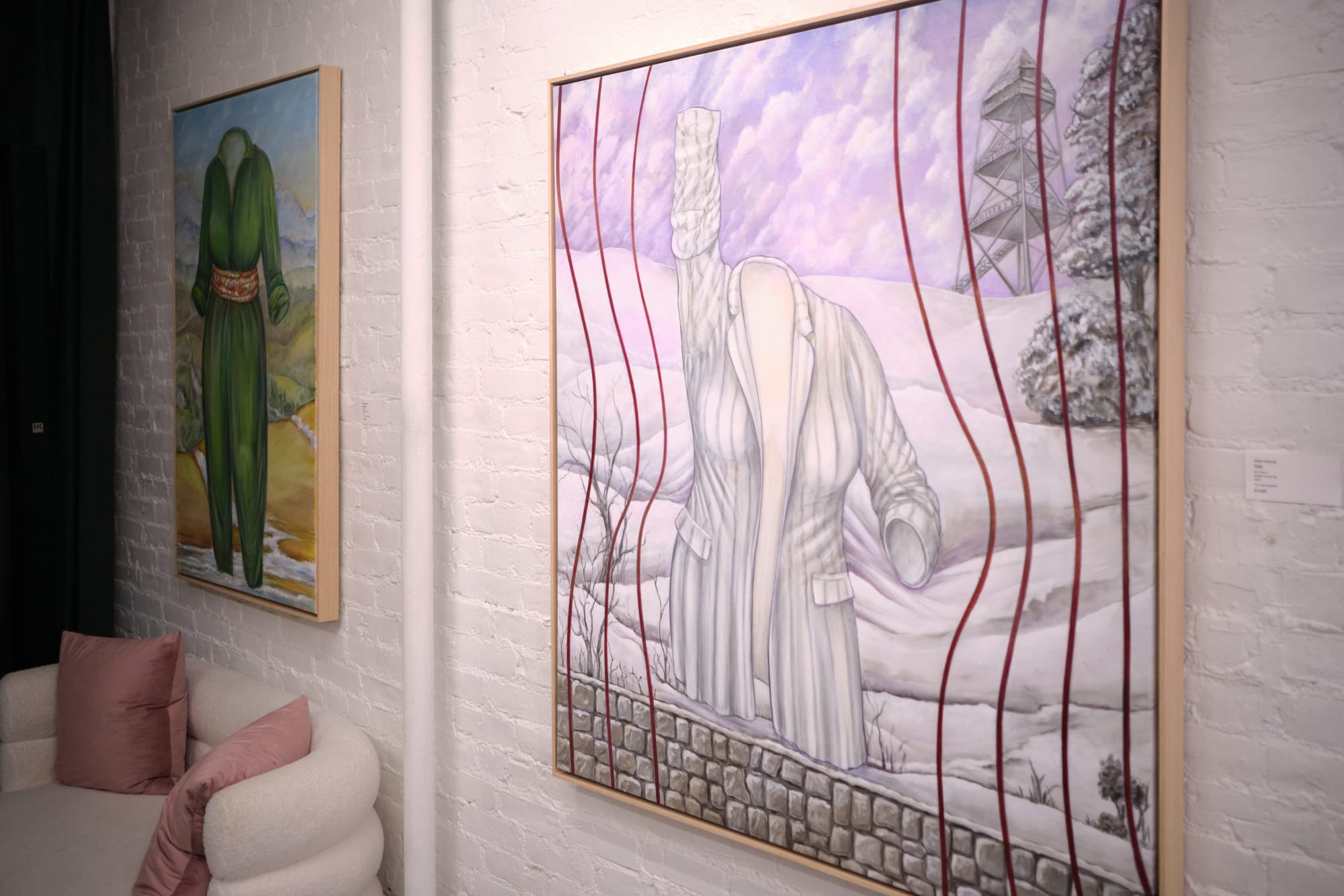
Rabbani's white coat stands in a snowfield under a lattice watchtower, a stone wall running along the bottom edge and dark red lines falling down the canvas like bars.
Gallery materials compiled from the Iran Prison Atlas list Sepehri as held in Vakilabad Prison in Mashhad, gravely ill and denied medical care. Her chador, gray-green and scattered with orange blossoms, hangs in a single tall drape, the opening for her face left empty.
Jalalian, arrested in 2008 and serving a life sentence after a conviction for moharebeh, or enmity against God, is entering her nineteenth year in custody. The Kurdistan Human Rights Network reported in May that officials at Yazd Central Prison were blocking her transfer for specialist care, citing wartime restrictions.
Atabeigi painted her olive work suit, belted with an embroidered sash, standing in a mountain landscape above a stream.
Hamedi and Elaheh Mohammadi, who broke the story of Mahsa Amini’s death in 2022, were pardoned in February 2025.
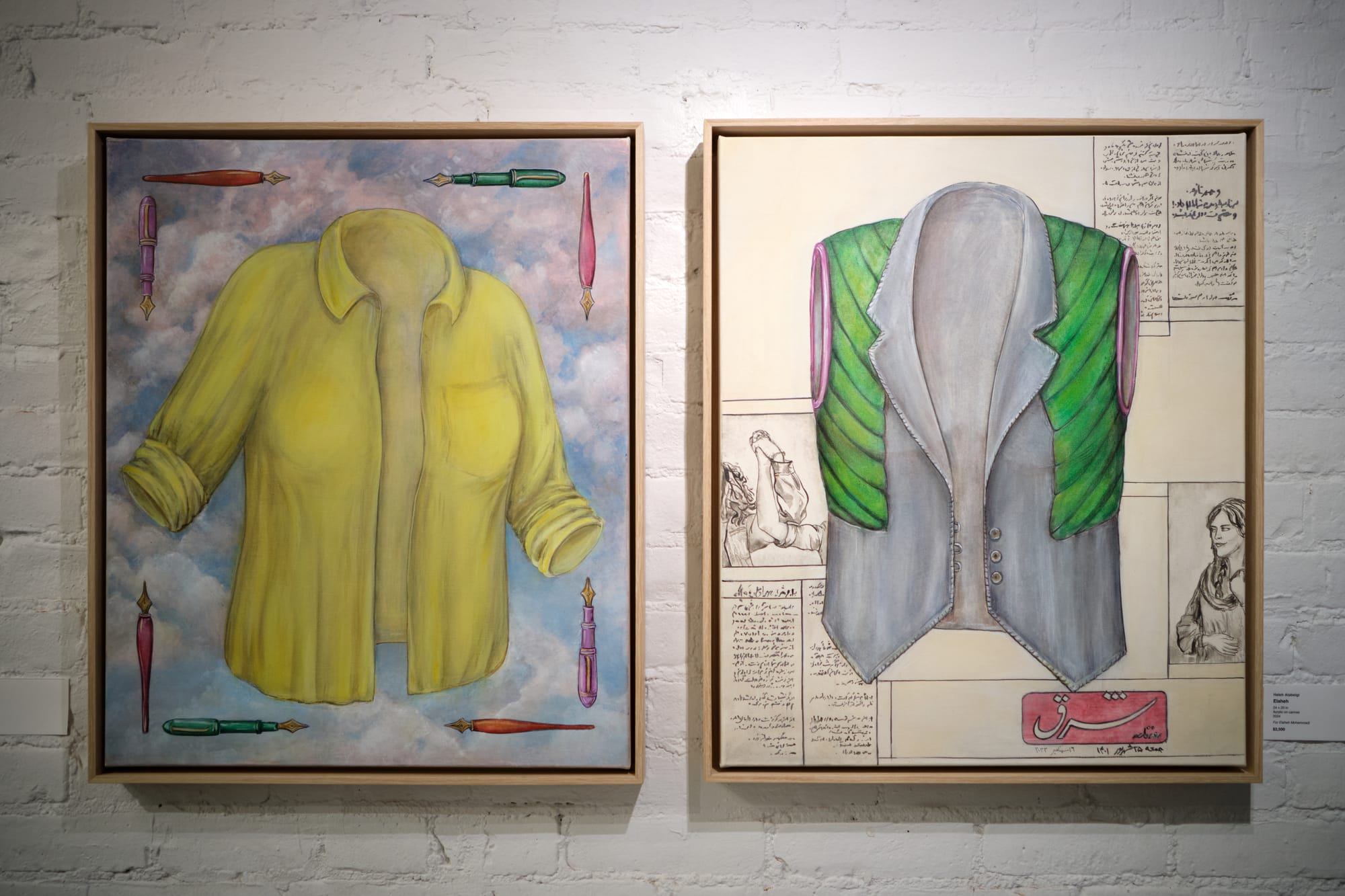
Hamedi's yellow shirt, sleeves rolled, floats in a cloudy sky ringed by fountain pens while Elaheh Mohammadi's gray vest hangs against the pages of Ham-Mihan, the newspaper she wrote for. The text is not legible. "I wanted it to be visual," Atabeigi said.
Gholian was released May 30 from Vakilabad after six months of a five-year sentence, Front Line Defenders documented. She had been arrested December 12, 2025, at a memorial for the human rights lawyer Khosrow Alikordi in Mashhad, alongside Narges Mohammadi.
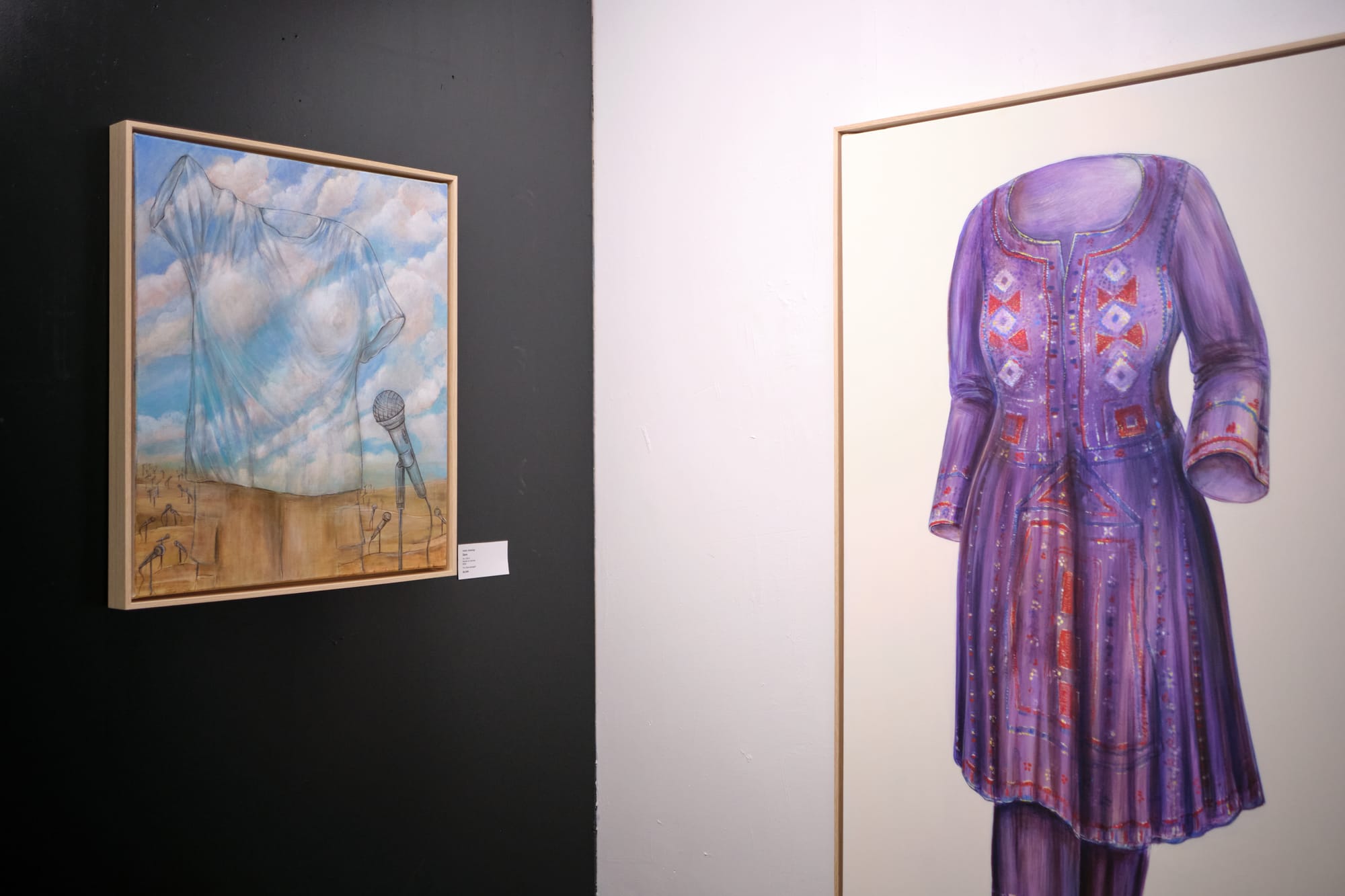
Her two paintings are both traditional dresses of the kind worn in southern Iran. The 2024 canvas is navy and gold, framed by a border of white studded tile. The 2026 one is violet, worked in red and silver, against bare gray.
Ahmadi, a children's rights advocate, was conditionally released in December 2024. Her garment was painted against the UNICEF emblem.
And Esmaeili, a singer arrested in 2024 for performing unveiled in public, is out and living outside Iran. In videos of her singing in Iran shared with Urgent Matter, she was wearing a T-shirt with a cloud design on it. Atabeigi painted the shirt to blend in with clouds in the sky behind it, and it is placed amid a surreal landscape with microphones on stands.
“The idea that women should have the choice to wear whatever they want and not be limited that way is a really, really big thing,” Atabeigi said, calling the control of that choice a “tool that’s used to keep women down and oppress them.”
Atabeigi painted their clothing rather than their faces.
“Every one of them is every woman,” she said. “They don’t need to have a face. They don’t need to have a portrait.”
Gholian’s was the first canvas, in 2024. Atabeigi said she was drawn by the beauty of the traditional embroidered dress from southern Iran that she wore.
“She came out of prison after a few years and kept wearing that outfit,” Atabeigi said. “Right away she started screaming slogans and didn’t give up. They put her right back into prison. She didn’t even make it home. They took her from the car she was in from the prison.”
Atabeigi said she is now in contact with some of the women. She reached out to Gholian while she was out of prison, she said, and they began texting.
The background of the Rabbani painting is a replica of a work Rabbani made on a bedsheet showing the view from Evin.
“So we sort of talked to each other as painters, and she’s also an amazing writer and activist, but she also happens to be an excellent painter,” Atabeigi said.
Asked what the women have said about the paintings, Atabeigi said she would cry through the answer and asked to be ignored while she did.
“The greatest feedback is gratitude,” she said.
The death of Mahsa Amini, a 22-year-old woman who was detained in September 2022 by Iran’s morality police over her headscarf, spurred widespread pro-democracy protests in Iran and the Woman Life Freedom movement.
“She was murdered because she had too many strands of hair showing,” Atabeigi said.
Iran has denied she was beaten and has pointed to a childhood medical condition. A U.N. fact-finding mission concluded in March 2024 that her death was unlawful and caused by physical violence in state custody and dismissed the medical explanation.
But in the interview, Atabeigi resisted dating the imprisonments to Amini.
"They've been putting people in political prisons for 47 years," she said. "But these are the recent ones."
The 27 smaller canvases hang in a grid on a separate wall. Each is eight inches square. Each depicts a leather bag, a keychain, a pendant, an apron or another object made by a woman inside Evin.
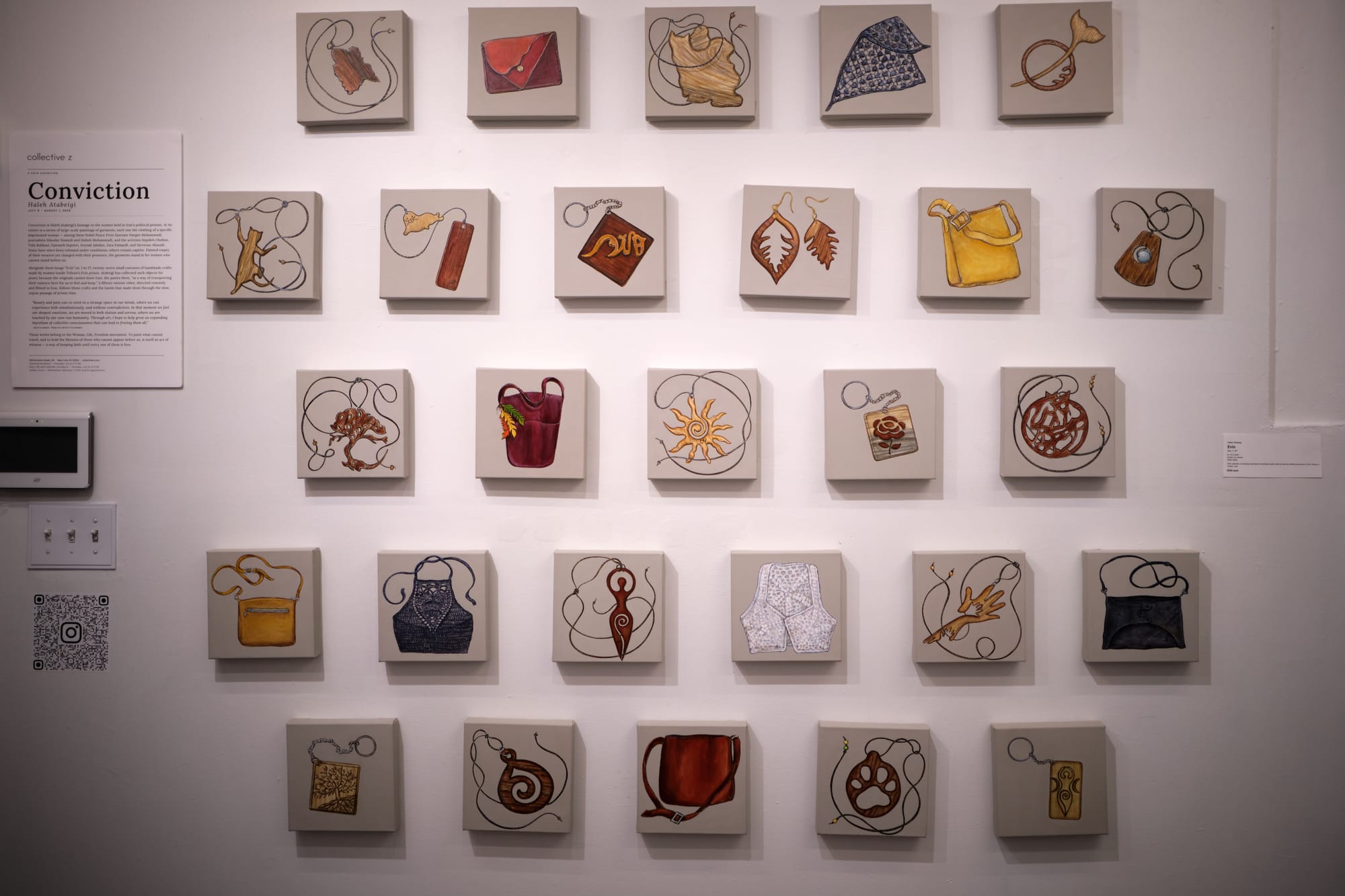
The objects themselves are not in the gallery. They cannot leave Iran, so Atabeigi painted them.
“I painted them because nobody can have those,” she said. “You can have these.”
Atabeigi has been buying the objects for several years and said she has collected about 100 of them.
She said she also holds a separate group of roughly 30 pieces that she describes as the last to come out before the prison was struck. Women inside the prison had fought hard for the leather workshop, but it is now gone.
“They give you less than the minimum you need to do anything,” Atabeigi said. “This way they’d make a little money. This way, I got to send them a little bit of money in prison.”
Israeli airstrikes hit Evin on June 23, 2025, killing at least 71 people by Iran’s own judiciary count, including staff, detainees and visiting family members. The Iran Human Rights Network reported that U.S. and Israeli rockets struck the prison again in early March 2026, destroying parts of its walls. Atabeigi did not specify which strike ended the workshop.
Buying objects made by women in prison relies on personal networks.
“There’s a system where you have to know someone who knows someone to buy them,” she said. “I’ve had some friends help me.”
Asked where the objects are kept, she said, “I can’t tell you.” She said she has a list of who made what, and that the makers asked her not to identify them.
The show opened July 9, five months into a war that began with joint U.S. and Israeli strikes on Iran on February 28.
“Generally, the people of Iran have become overshadowed by the war,” Atabeigi said. “What’s happening to them, nobody talks about.”
She said she does not expect the show to open a cell door.
“These women are there, they’re fighting, and they’re suffering, and they’re not to be pitied,” she said. “They’re heroes. They don’t want pity. They don’t need pity.”
Urgent Matter is reader-supported. Please consider subscribing to support independent arts journalism.