Jazz pianist Bill Buchman opens first New York solo show at 79
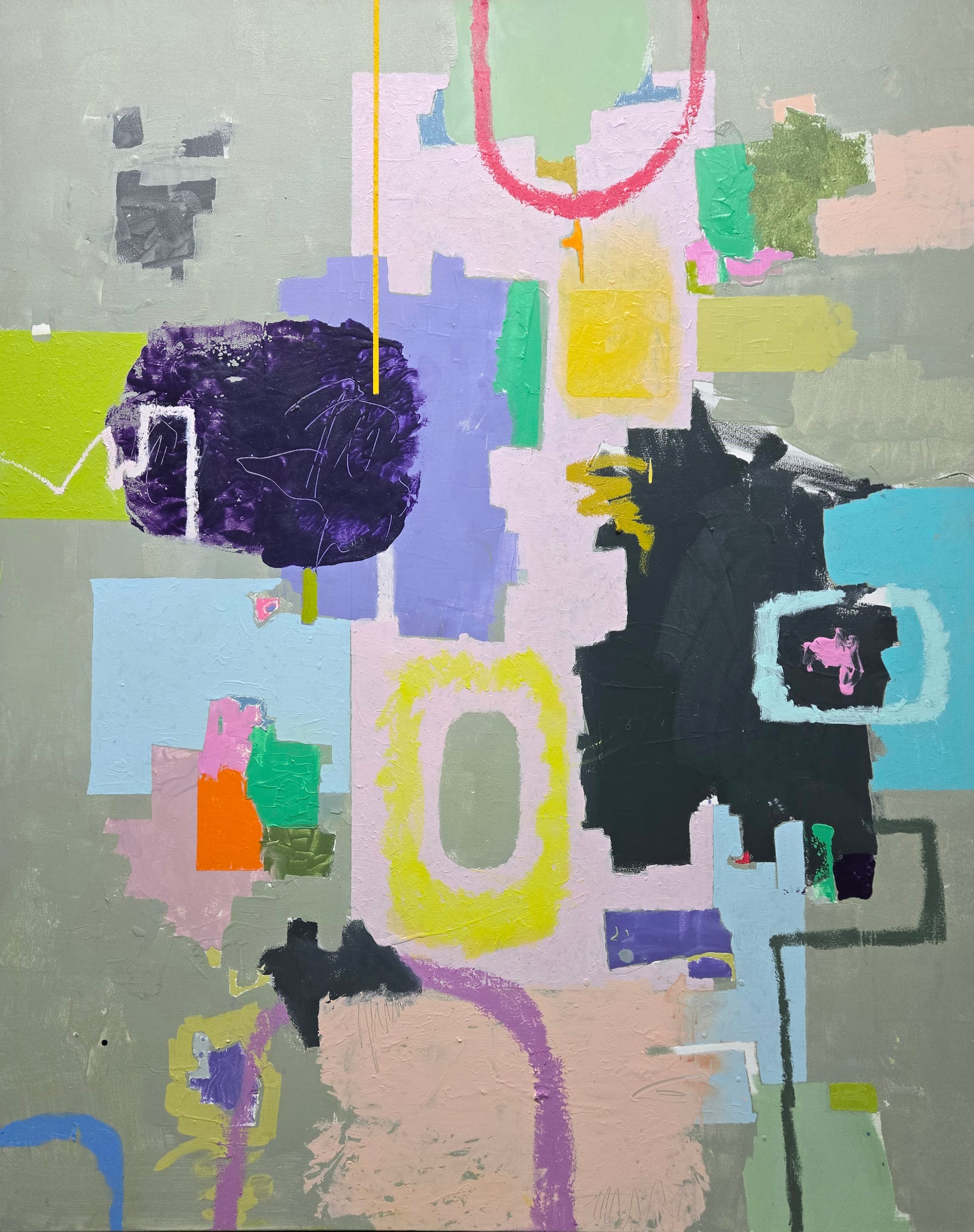
“Infinite Oasis” runs from prints Buchman made as a Cornell student in 1965 to the oil-stick canvases he calls “Visual Jazz.”
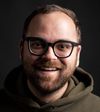
“Infinite Oasis” runs from prints Buchman made as a Cornell student in 1965 to the oil-stick canvases he calls “Visual Jazz.”
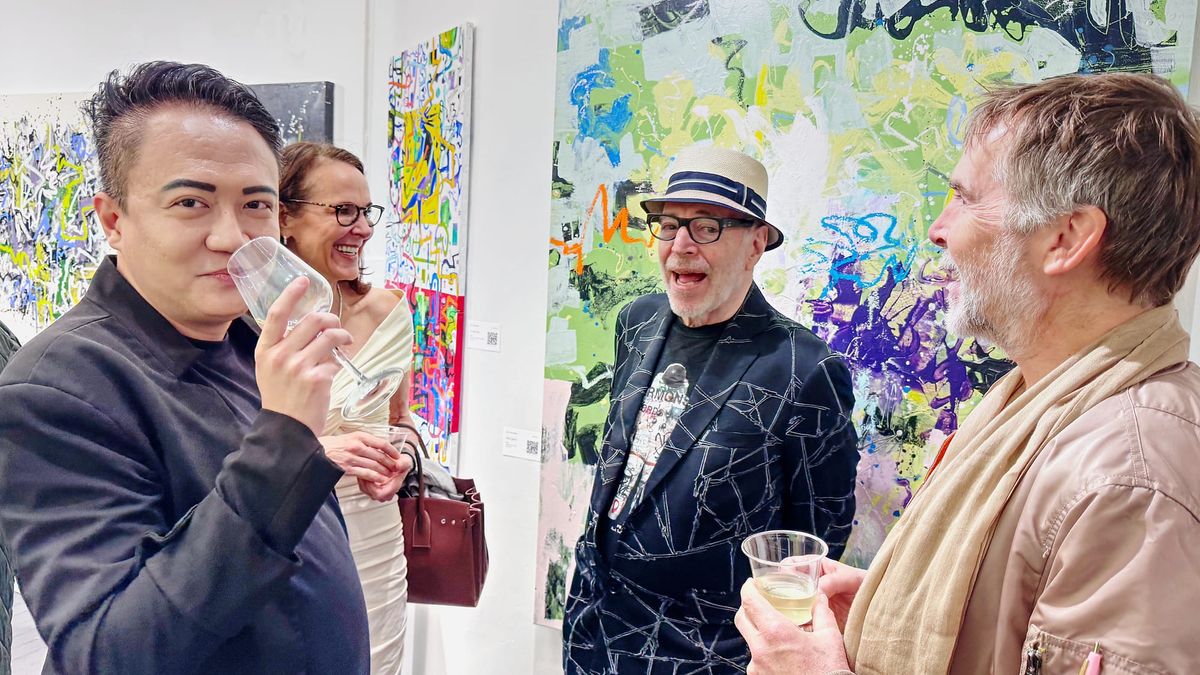
Painter and jazz pianist Bill Buchman, 79, opened his first solo exhibition in New York on Thursday at Lower East Side gallery Collective Z, featuring work spanning six decades.
The show, “Infinite Oasis,” runs through November 7 and includes acrylic and oil-stick paintings finished this year, as well as prints and mixed-media work from Buchman’s student years at Cornell University in the mid-1960s.
The show takes its name from a line of Buchman’s that the gallery quotes in the release: “The realm of mind is an infinite oasis, where we can always stop for a drink.”
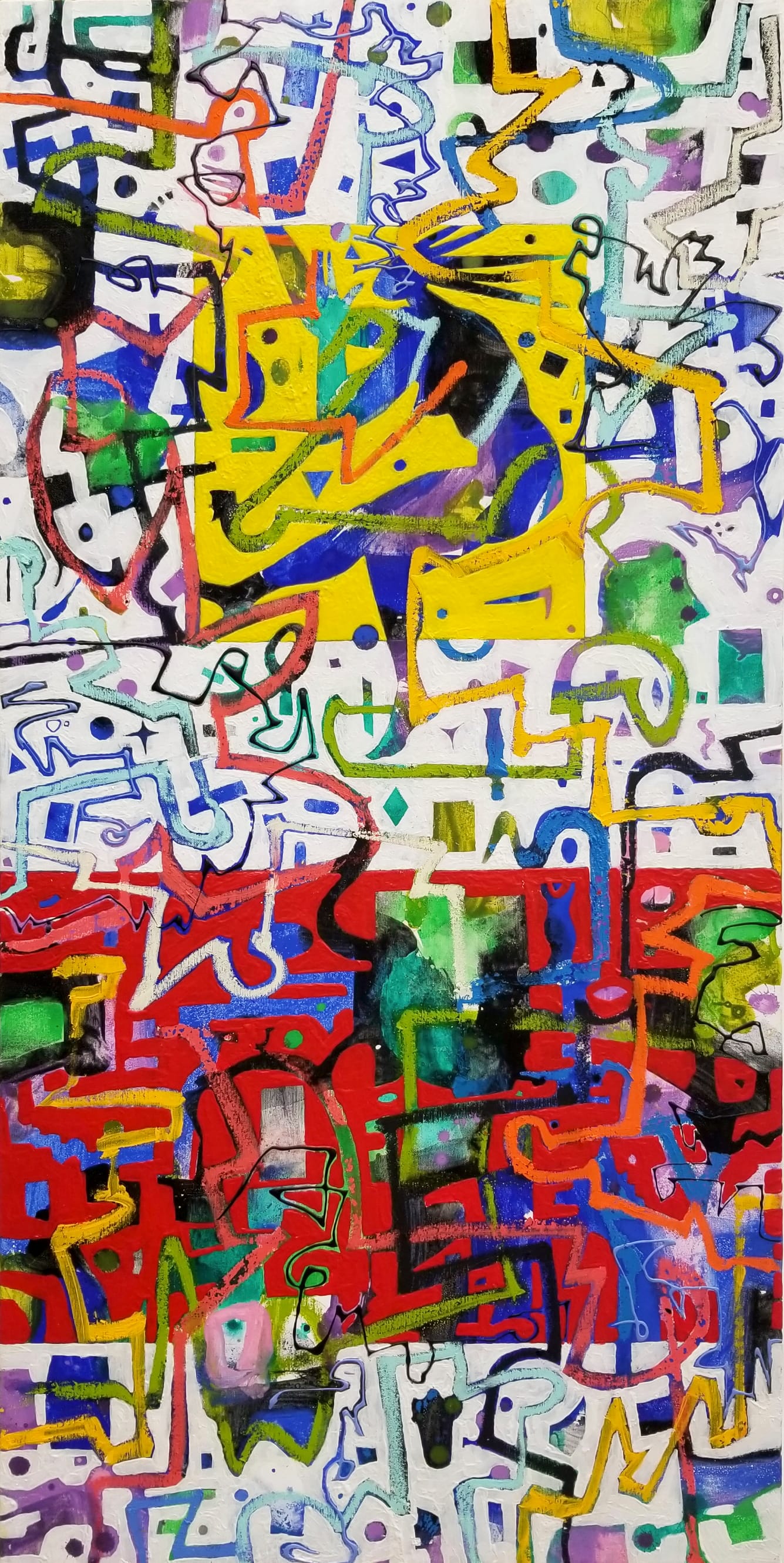
Buchman calls his recent abstract paintings “Visual Jazz.” At the opening reception, he told Urgent Matter that color is “the most important element” in the work, and that his colors are “like notes to me, and chords and harmonies.”
He said he studied color for years and taught classes on it.
“It’s one area of physics where they still don’t have answers,” Buchman said. “It’s not unusual for me to spend an hour on each color I mix.”
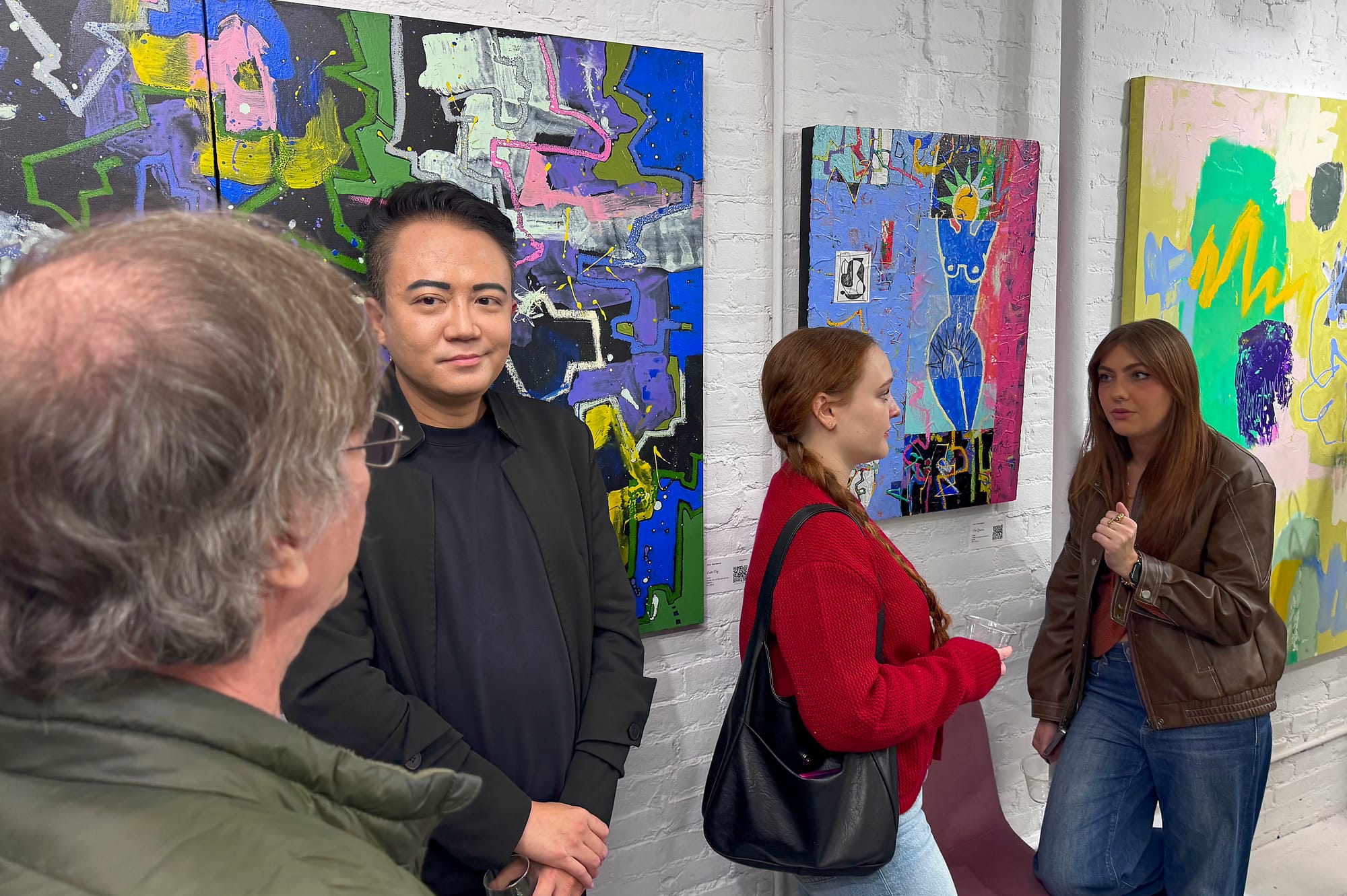
The oil sticks are the one exception. They come in unusual colors that can’t be blended, so he uses them as they come, he said. He tests his colors ahead of time to avoid fixing them on the canvas.
“My whole thing is based on spontaneity, like a jazz improvisation,” Buchman said. “I try to avoid having to do any repairs.”
Asked how that works when jazz is improvised but still follows rules, Buchman said improvisation in jazz, outside free jazz and other avant-garde styles, happens within “a very systematic language.” He said there is “a way to do it and a way not to do it,” and he feels the same way about his painting.
“Within the language that you create for yourself, you have to be true to that language, just like you would be in jazz,” he said.
He said the process is similar in both.
Painting can happen over time, Buchman said, while jazz is “immediate and live in real time.” He called both terrifying but said music is more terrifying.
Buchman trained as a painter first. As a teenager, he studied with Victor D’Amico, the Museum of Modern Art’s longtime director of education. At Cornell’s School of Fine Arts he studied under the Abstract Expressionist Robert Richenburg, the release said.
At Cornell in 1965, he played in what has been described as a “more or less Rolling Stones cover band” called The Mojos, which performed a few dates in New York City before splitting up. The band’s drummer later became a figure in the punk and glam scene.
Buchman dropped out of college twice when music teachers in Boston offered to mentor him. He later earned bachelor’s and master’s degrees in the New England Conservatory’s Third Stream program with Ran Blake and Jaki Byard.
“I was surrounded by real artists for the first time in my life,” Buchman said of the conservatory.
“I actually set out to be a painter,” he said. “I went to art school at Cornell, and that was what I wanted to do. So I tried to put the music on the back burner, and it would never stay there.”
He said he grew “a bit disillusioned” once he entered “the playing world.” Private study in Los Angeles with David Pacheco brought him back to the studio.
Buchman keeps the two practices apart. “I don’t paint on the days that I play,” he said.

When asked whether painting or jazz comes first, Buchman chose painting, with a caveat.
“If I was forced to make a choice tomorrow, which might be the easiest way to determine the answer, I would be a painter,” he said. “But I’m not forced to make that choice. And I love them both.”
He called jazz “painting with sounds,” then said “music is so central in my life that I might be wrong about that.”
Asked whether his work carries a political message, Buchman said choosing jazz is political in itself.
“Being a jazz musician is a political choice because you choose not to follow the standard route in life and live a different kind of life that is not built around becoming rich, famous, successful, or even having a normal life,” he said.
“You’re lucky if you can figure out enough of the economics of this world to sustain yourself reasonably,” he said.
In New York, he said, the sacrifice is greater because “this is an expensive city.” He also knows jazz musicians “on all sides of the political spectrum.”
Buchman said he isn’t inspired by any living artist he knows and credits his teachers instead. He recalled something a famed jazz drummer once told him.
“He said, you will find, Bill, in time, that you are the people you played with,” Buchman said. “And I would say it’s the same with painting.”
Alex Z. Wang, Collective Z’s founder and director, said Buchman was in the gallery’s first group show after it opened in February, which is when Wang first saw his work.
Urgent Matter previously reported on “Conviction,” the gallery’s summer show of Haleh Atabeigi’s paintings of jailed Iranian women political prisoners.
“He’s been at it for six decades, and I like how he has two sides of his life and career, the jazz music side and the painting side, and how the most recent work actually merges the two,” Wang said.
Wang said the music comes through most in the oil-stick lines, which Buchman puts down last.
“If you really zone in on the line work, you can see the rhythm forming as they travel through the canvas,” Wang said. “It almost looks like a composed music sheet.”
Wang said that Buchman put color first, “I think that’s what always happens when you’re so deep in as an artist in your own work.”
Buchman said people often tell him his lines look like graffiti. Asked whether he has a graffiti background, he said, “Absolutely not. And I wish I did.”
“I have a few real graffiti artist friends who I just admire so much because of the toughness that it takes to be a real New York graffiti artist,” he said.
He called Jean-Michel Basquiat the ultimate example of graffiti art and said Basquiat is “still not even an acquired taste for many people.”
The show also covers Buchman’s figure work. He wrote Expressive Figure Drawing, which Watson-Guptill published in 2010.
“Usually, the figures get into my paintings from drawings that I like so much,” Buchman said. “And I just feel it has a further life beyond the drawing.”
Asked why the show reaches back to the figure work, he said, “Because if I don’t, I’m not sure I’m showing who I am, since I’ve been a figurative artist.”
“Most of the abstract artists I’ve admired had a strong background in figurative art,” he said.
Wang pointed to self-portrait prints from the 1960s, including White Sky, the show's smallest work. Wang called a gouache in the show “an in-between piece that captures that transition” from figure work to abstraction.
Buchman moved to Europe in 1981. He lived in Amsterdam and Paris, then spent about 16 years in Copenhagen. Gallerihuset in Copenhagen showed his work almost every year from 1993 to 2012, and he exhibited at the U.S. Embassy in Copenhagen in 1998 and 2000.
He returned to the United States in 2001 and settled in Sarasota, Florida. He taught at Ringling College’s Longboat Key Center for the Arts and at the Venice Art Center before moving to New York.
Buchman said he has been in “eight or nine group shows over the past six years.” The Washington Square Park Conservancy lists him as teacher of “Park Open Studio: Jazz Mixed Media,” a free drop-in class where people make abstract works on paper inspired by music.
In New York, he said, he now plays “with the greatest musicians of my life all the time.”
Asked how he felt walking into the opening, Buchman said, “Happy. Just happy.”
“You’re not the same artist after every exhibition because it affects you,” he said. “It always pushes you to a little bit of a next level.”
Urgent Matter is reader-supported. Please consider subscribing to support independent arts journalism.