Fiber artist who rarely exhibits brings four decades of handmade books to the Michener
Barbara Moon Boertzel, who made paper from tropical plants on Guam, opens her first solo museum show.

Barbara Moon Boertzel, who made paper from tropical plants on Guam, opens her first solo museum show.
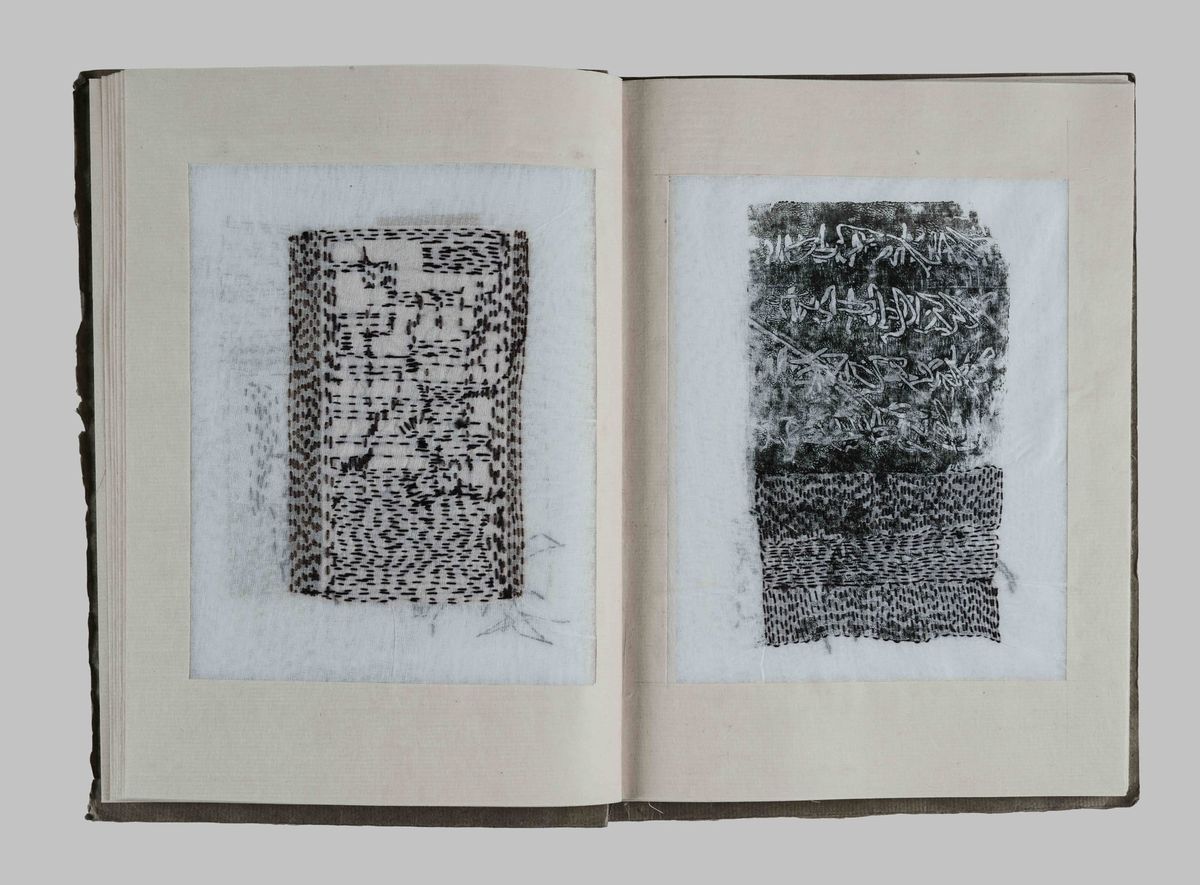
Barbara Moon Boertzel has made paper, stitched cloth and handbound books for over four decades. She has rarely exhibited them, but has invited people to her studio to handle her work.
One of those studio visits led to her first solo museum show, “Barbara Moon Boertzel: Listening to Time,” which opens October 24 at the Michener Art Museum in Doylestown, Pa.
Boertzel told Urgent Matter that books and textiles “beg to be touched.”
“I never liked sending off my work only to have it come back a month later with no connection to people,” she said. “So I’ve been inviting people to my studio.”
Boertzel invited the Michener’s chief curator, Laura Turner Igoe, for a studio visit, said Abi Lua, the museum’s assistant curator who organized the exhibition. Lua said Igoe was drawn to the intimate, carefully made pieces and saw them fitting the museum’s smallest gallery.
Visitors cannot touch the 16 works on view. Boertzel said she will bring pieces for smaller groups to handle at two public programs listed for February 10 and March 10, 2027.
“That’s the way I enjoy sharing my work,” she said.
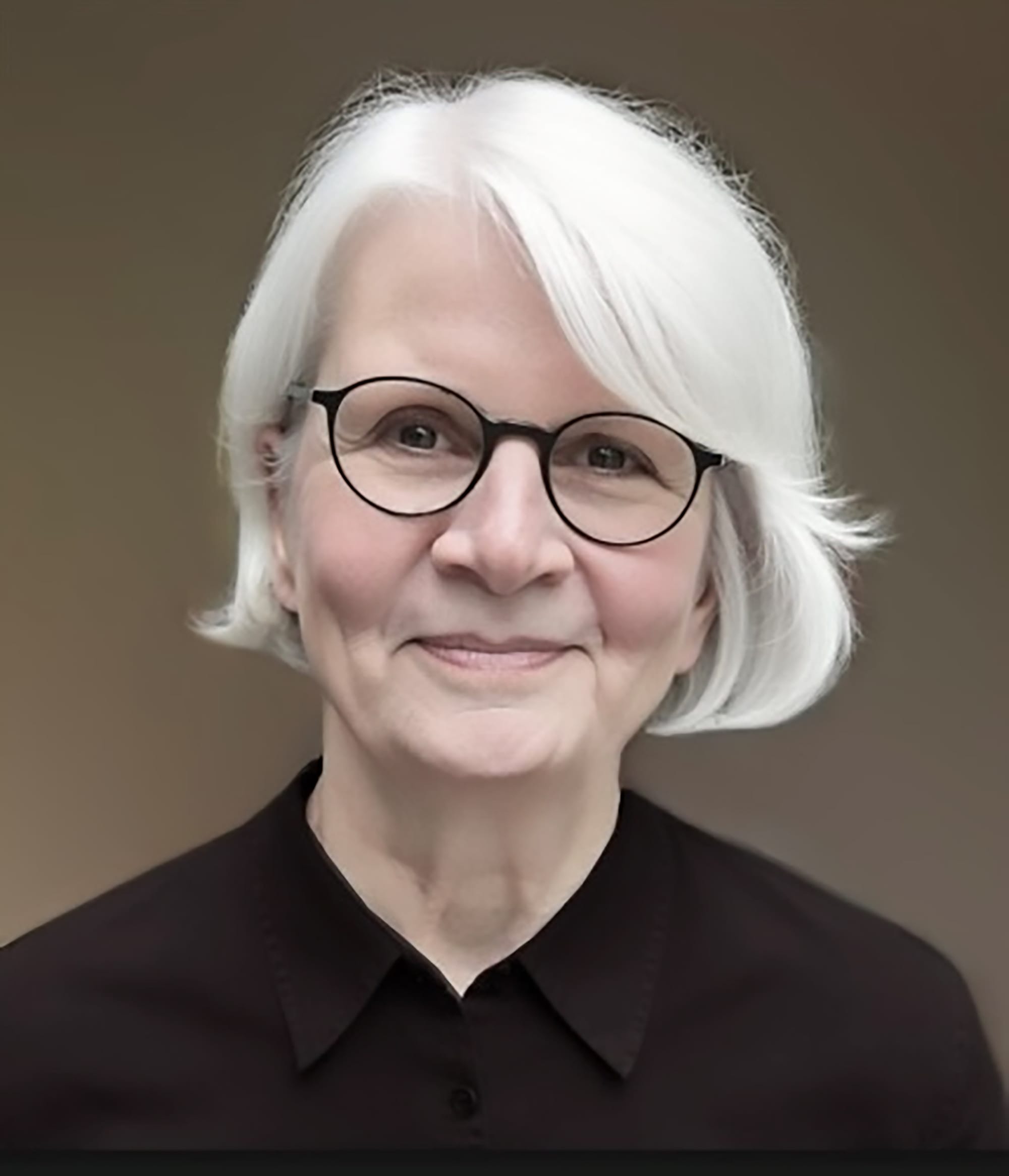
The retrospective reaches back to 1980 and the paper Boertzel made from tropical plants on Guam, where she lived from 1973 to 1989. The museum’s press release calls her the first known tropical fiber papermaker in the western Pacific.
Boertzel trained as a painter and spent her early years on the island painting women doing crafts but did not feel connected to the community. She enrolled in a printmaking class at the University of Guam, needed paper, and asked her husband to bring some back from a trip to Japan.
He returned with washi, Japanese handmade paper, which Boertzel called “the most beautiful paper I’d ever seen in my life.”
“I must learn how to make this paper,” she said.
Boertzel received four or five grants from the Insular Arts Council on Guam, which had matching funds from the National Endowment for the Arts. The grants required her to teach.
“It’s so small. It’s only 30 miles long and 10 miles wide,” she said of the island. “It was not a huge challenge to get a grant like it is in the United States mainland.”
The council’s head, who was Chamorro, wanted Boertzel to document the use of tropical fiber in craft, she said. Her papermaking classes drew Chamorro students “because a lot of the traditional craft on Guam has been lost,” she said.
She took a fiber-processing workshop with Lillian Bell, an Oregon author of Plant Fiber for Papermaking, and studied how Chamorro weavers broke down fiber. She then traveled to Japan to watch papermakers. For her practice, she combined Chamorro fiber processing with Japanese papermaking technique.
In 1985, she received the Territory of Guam’s Governor’s Award for the Arts in Crafts, the museum said.
Boertzel left Guam in 1989 to find better schools for her daughters and to earn an MFA, which the University of Guam required before it would hire her as a professor. She entered the fiber arts department at Cranbrook Academy of Art in Michigan.
“When I got there, I was told my paper was too precious and I should cut it up and put it back together in new ways and figure out how to be an artist rather than just a paper maker,” she said.
She turned to cast paper sculpture. After graduating, she was hired as manager and buyer of the Cranbrook Art Museum store, which was then a bookstore.
“For six years I was handling books every day, and I know that had a strong effect on me,” she said.
When her daughters moved to New York City, Boertzel followed for two years and took classes at the Center for Book Arts. The family now lives near each other in New Hope and around Princeton, N.J.
“We move around the country like a wolf pack,” she said.
Lua said the challenge in a small gallery was finding a through line across Boertzel’s mediums. She settled on the artist book, which combines printmaking, painting, drawing, illustration, papermaking, and what Boertzel calls direct drawing stitchery, drawing with needle and thread.
Some books are bound. Unbound pages sit in low cases or are pinned to the wall in grids.
“In a way, a page is like a singular moment, and putting it together in a book represents the duration of time that has really sustained her attention,” Lua said.
Boertzel said each move forced her to start over. “I’ve moved so much that in each new place I have to establish a sense of place,” she said. “And my stitching and bookmaking is very much connected to where I live.”
One wall piece, Writing a Woman’s Life, began with a neighbor in Michigan. The woman, in her 90s and moving to a retirement community, had collected French linens in France earlier in her life, and Boertzel bought bags of them.
Boertzel cut one large tablecloth into about 80 pieces, stitched the fronts and joined them on the back. The finished work had 42 pages, and 36 will hang in the show.
Its squares and triangles trace her mother and grandmother setting the table every day when she was growing up, usually in silence. “I thought on these different pages, I would try to capture some of their gestures of moving around,” Boertzel said.
She showed the finished piece to the neighbor. “She said that it reminded her of how she plotted out her gardens every summer,” Boertzel said. “I thought that was wonderful.”
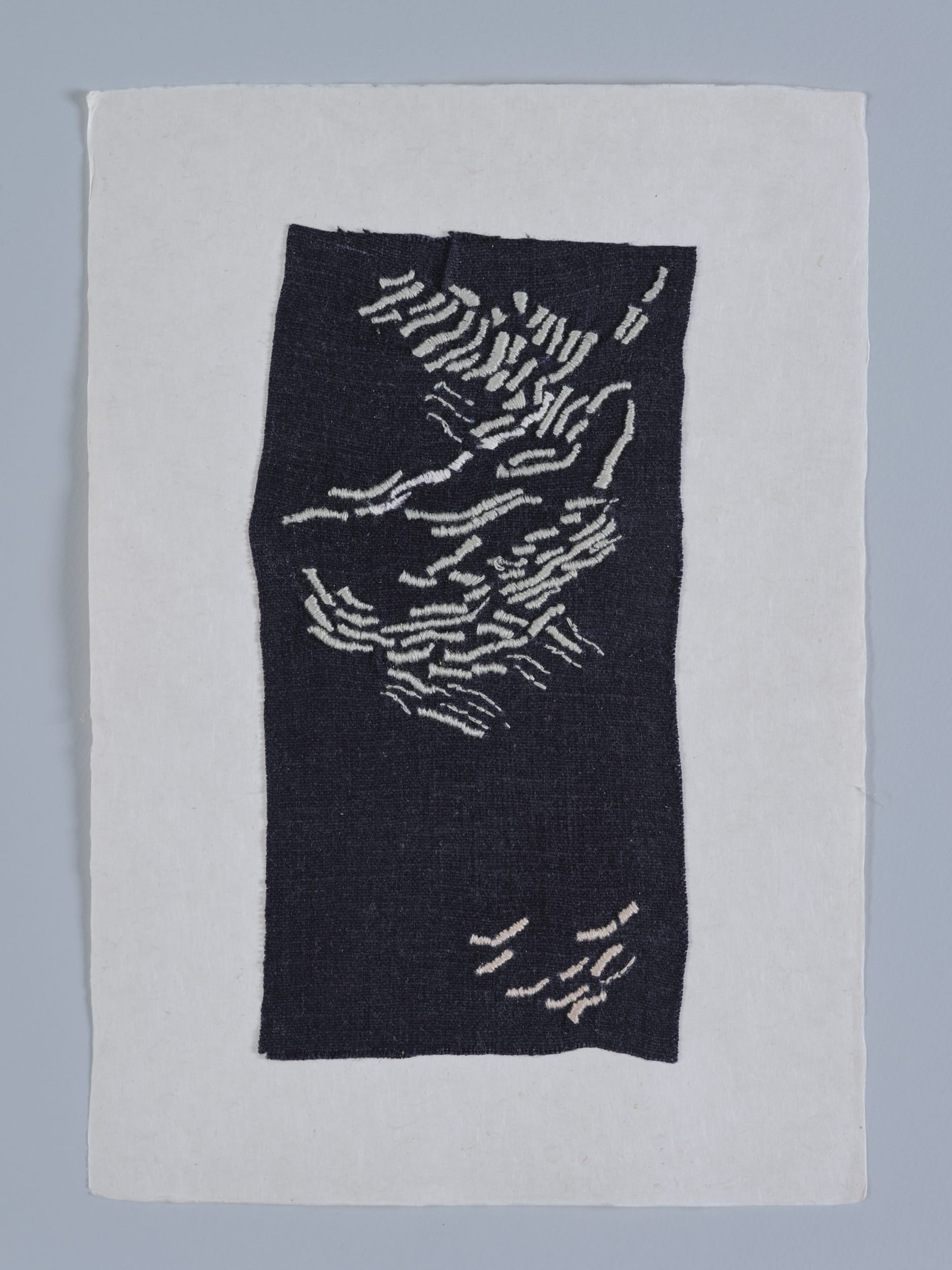
Boertzel stitches mostly on cotton organdy, a thin, starched fabric she called “the closest I’ve ever found to a piece of paper.” When a piece is done, she starches and irons it, and the pull of the thread bends her geometry.
“So that’s a nice part of letting the materials also speak,” she said.
Some pieces take her more than a year. The three books in her new trilogy, “I Listen to the Passage of Time,” took over a year together, she said. The museum said the books are Japanese handbound journals filled with stitched cloth, monoprints, photographs and paper she made on Guam. Visitors can see every page on video.
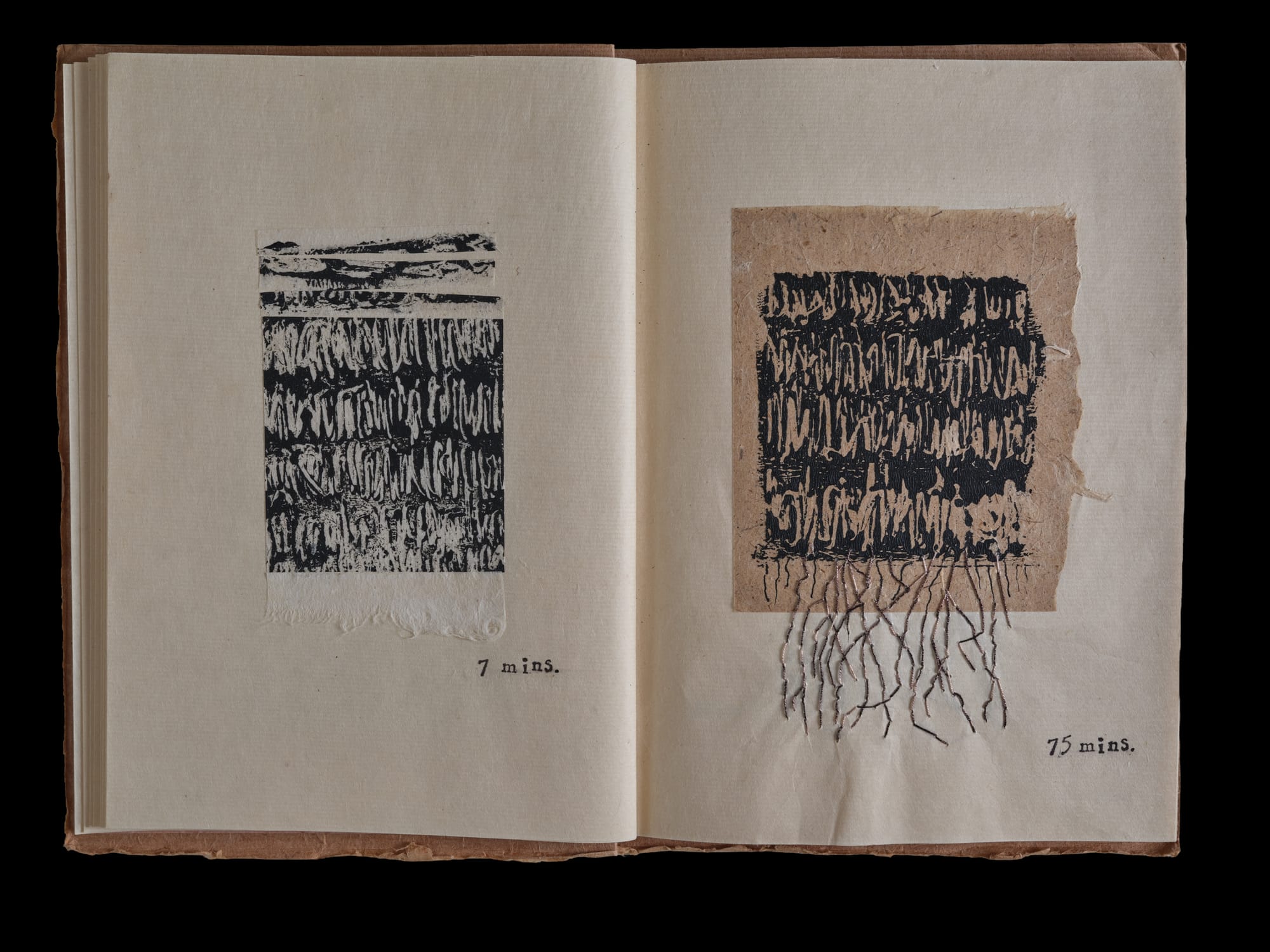
In another handbound book, Hurrying Slowly, she inked time stamps recording how long each page took, the press release said.
Asked how she knows a piece is finished, Boertzel said, “It’s not visions, but I get feelings about how it should be and then I complete what I feel that it should be.”
The museum pitched the exhibition around slow stitch, calling Boertzel an early practitioner. Asked whether she has watched the recent interest in book and textile art, Boertzel said she has followed her own path.
“I feel like I’m on a pretty singular journey,” she said.
She said she has never cared much about the business of art. Gallery artists sometimes have to keep to one medium or look “so the gallery can promote them,” she said.
“And I don’t really care about that,” she said. “I just like to explore.”
Boertzel meditates each morning through Zen Mountain Monastery. For five years, she led a Michener program called “The Art of Stillness,” asking participants to look at a single work for an hour.
“I’m hoping people will slow down and look,” she said.
The show, “Barbara Moon Boertzel: Listening to Time,” runs through April 18, 2027.
Urgent Matter is reader-supported. Please consider subscribing to support independent arts journalism.