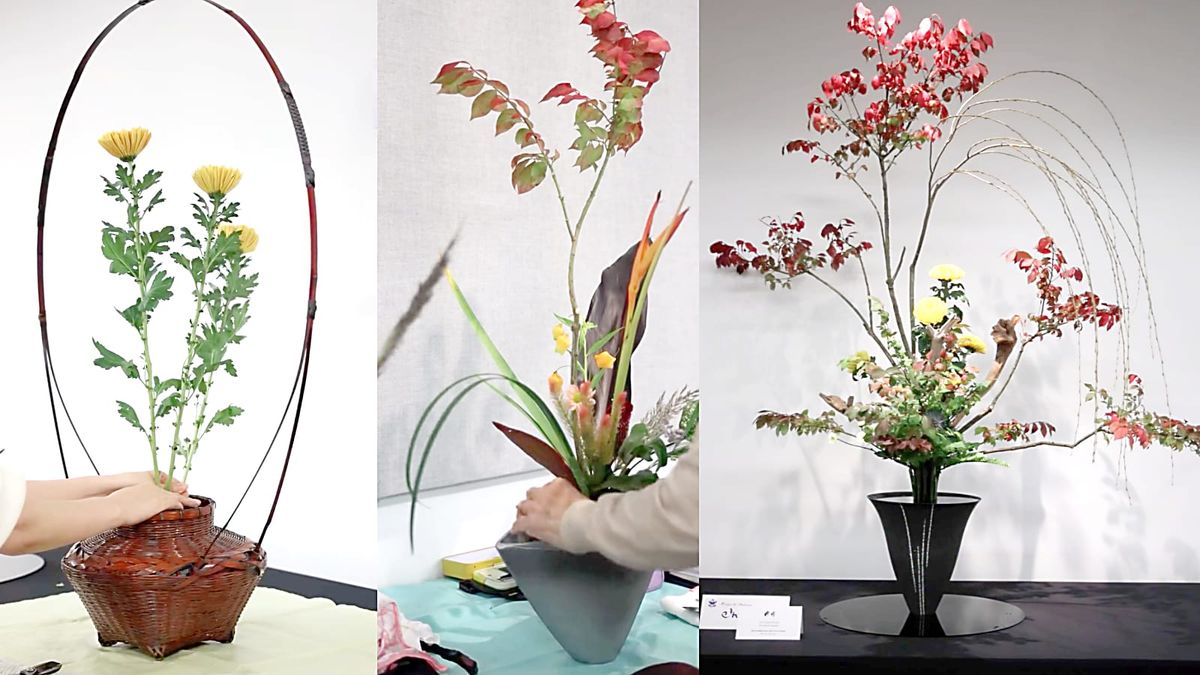
Senko Ikenobo, headmaster designate of the Ikenobo school of Japanese flower arranging, asked an audience at the Asia Society on Saturday to join her in “this quiet moment” before arranging a tatehana, a prayer arrangement, for the school’s New York City chapter.
“So I’m going to make a prayer for the flourishment of the art of Kado, the flower arrangement, as well as the health of the New York City chapter, including everybody here,” Ikenobo said through Yasuko Utsue, the chapter’s president, who emceed and interpreted for Ikenobo throughout the demonstration.
The Ikenobo Ikebana Society New York City Chapter invited Ikenobo to New York for its 40th anniversary and billed her demonstration as “one of the main highlights.” Kishiko Narayanan founded the chapter in August 1986, Ikenobo headquarters said in a 2021 profile.
The chapter and the Noguchi Museum describe Ikenobo, which began in Kyoto more than 550 years ago, as the oldest school of ikebana.
Ikenobo shared the stage with her son, Senshu Ikenobo, and Professor Senso Kobayashi. Both were introduced with her as guests from Japan.
Utsue thanked the Consulate General of Japan in New York and the Noguchi Museum for their support. Before the demonstration, she asked the audience to silence their phones and wait to take photos and videos until afterward.
Ikenobo said the Japanese government recently recognized her father, the current headmaster, as a national treasure and named rikka, the school’s classical style, an important cultural property.
A council of Japan’s Agency for Cultural Affairs recommended Friday that the education minister designate rikka an Important Intangible Cultural Property and certify her father, Sen’ei Ikenobo, 93, as its holder. Ikenobo headquarters announced the same day that he had been certified as a Living National Treasure.
Rikka was one of three traditions the council recommended in a new living culture division, along with ginjo sake brewing and Kyoto kaiseki cuisine. A reference sheet in the agency’s release does not list any earlier designations in that division.
“So this is a very special moment for us,” she said.
She said the school believes rikka was selected for its spiritual sensibility and design, and because it follows strict rules and set forms.
Ikenobo called the tatehana “the most original design” and described it as a Buddhist offering for a temple altar. She said she and her predecessors have arranged it “while making a prayer for our family’s health, the stability of the country.”
“So I’m going to arrange it in a solemn state,” she said.
She worked for nearly six minutes without speaking to the sound of chimes. Then she asked the room to view the finished tatehana from the front. The audience applauded.
The second arrangement was freestyle. Ikenobo said it has “no set forms, no rules” and lets each practitioner’s individuality come through.
“And I’m going to create something that sort of cannot be seen in nature,” she said.
She said ikebana can depict “a microcosm of nature” or “something that does not exist in nature.”
“Think of a theater,” she said. “There are main actors, and supporting actors, and other actors. It’s just like that. You cannot complete it without just the main actors.”
“I find wildlife interesting, and I respect and honor that because it reminds me humans are not the only ones who exist in this world,” she said. “There are plants, animals, and many different types of lives and characteristics.”
Music played while she finished, and she asked whether any fans of the song were in the room.
“So, I drew inspiration from Halloween here,” she said. “It’s coming up soon, right?”
Sign up for Urgent Matter
This article is provided free with the support of paying subscribers. Not ready for a paid subscription? Sign up for a free account today.
No spam. Unsubscribe anytime.
She mentioned “the pumpkins and skeletons all over the town” and said she wanted to show people and “non-human beings all around in this season.”
“Because of the nature of freestyle, I just have fun making it,” she said. “I hope you do, too.”
The third arrangement was a shoka, a style Ikenobo said is simpler than rikka and shows plants as they bloom and wither over a life cycle.
“When I say simple, that doesn’t mean it’s easy,” she said. “Each stem has its own role, and everything has to be there, and everything is calculated.”
She said fewer stems in ikebana can carry deeper meaning, and that a brown stem found in a forest “probably doesn’t have much value to most people.”
“And withered, brown plants, they’re also living, and humans also perish, and we go back to the earth, and we find it is beautiful, that life cycle,” she said.
“So in that sense, Ikebana helps us broaden our perspectives,” she said.
I had planned to stay for the full demonstration, photograph the finished arrangements once photos were allowed, and then head to Queens for the chapter’s exhibition at the Noguchi Museum.
My daughter, Maeve, had a hard Saturday morning at home, so I agreed to bring her along. She had a tantrum for the entire 35 minutes we were inside a somber event with no other children present.
She also smashed peanut butter pretzels into the floor of an auditorium marked no food or drinks.
As we climbed the stairs to leave, my back to the stage, the audience gasped. I did not see what happened.
All I saw was someone cleaning up one of the arrangements. A man in a headset at the back of the auditorium looked a little frantic.
“Excuse me, is your heart rate high? Should we call an ambulance? Are you okay?” Ikenobo joked with the audience. “Just let us know. Are you okay?”
“To be honest, I can’t share the secret. The whole team, including myself, we are a little nervous,” she said. “In Ikebana, we have a flower path. A flower path. That means we have to work hard.”
The exhibition ran Saturday and Sunday in the museum’s Education Studio in Long Island City, free with admission, with about 45 arrangements by Ikenobo, Kobayashi, Noritaka Noda, the school’s Specially Entrusted Overseas Professor in New York City, and chapter members.
The chapter described the show as pairing ikebana with Isamu Noguchi’s sculpture. “Space is shaped as much by what is absent as by what is present,” the chapter wrote.
I didn't make it to the Noguchi Museum. I would have loved to see the flowers up close.
Thankfully, the Noguchi Museum later shared a video showing many of the arrangements.
Urgent Matter is reader-supported. Please consider subscribing to support independent arts journalism.