The federal commission that approved President Donald Trump’s White House ballroom promised to share with his aides the list of reporters planning to attend the project’s first public presentation, emails show.
It also arranged to bring them in through a secured back door and later offered a way around the metal detector and ID check the public had to pass.
“I will share the Commission roster with you all this afternoon and the media RSVP list tomorrow,” Meghan Hottel-Cox, general counsel of the National Capital Planning Commission, wrote January 6.
She was writing to Heather Martin, a special assistant to the president and chief financial officer of the Executive Office of the President, two days before the White House was to present its East Wing plans to the commission in public. The emails do not show if Hottel-Cox sent either list.
Paid subscribers can read the documents released to Urgent Matter.
Urgent MatterAdam Schrader
“Hey there- in addition to the press RSVP can you also let us know how many rsvps you’ve gotten for people that are registering to speak?” Martin wrote the next morning.
Hottel-Cox answered that nobody could sign up to speak at an information presentation and that she would send “the press RSVP a bit later this afternoon (we still have some rolling in).”
Hottel-Cox signed the letter Friday releasing the emails to Urgent Matter, nearly 10 months after the publication requested them January 19. The commission released about 180 email threads and 26 attachments covering January 1, 2025, through April 3, 2026, the day after it approved the ballroom.
She wrote that “several additional responsive documents” were withheld in full as internal deliberations or attorney communications.
Hottel-Cox’s January 6 email gave Martin the address of a secured door on D Street, where staff would let the White House team in and take them up to the commission’s offices. She wrote that arriving by 1:30 p.m. would leave time “to go through our security.”
The team could wait in “a green room where the meeting with be streamed,” she wrote, with staff escorting them to and from the chamber and out the D Street exit. Hottel-Cox gave Martin and an aide a tour the day before.
For the January 8 meeting, the commission told the public that seating was limited and that “once capacity is reached no one else will be allowed to enter the NCPC offices and will need to leave the building.” Visitors faced “full security screenings, including bag checks and metal detector screenings,” and had to show government-issued ID.
Before the April 2 vote, Matthew Flis, a deputy director at the commission, told Martin and architect Shalom Baranes a protest was planned outside the building.
Flis wrote that “similar to January,” the team could enter through a south lobby “instead of going through the metal detector/ID check we have implemented in the NCPC north lobby.”
“NCPC’s south entrance is secured, but someone will be there to verify you are an applicant and let you in,” he wrote.
The January 6 email also gave Martin three ways to hand over the White House’s slides. The first was to email them to Hottel-Cox “with the disclaimer that it is commercial information not for dissemination.”
“After the meeting, the file would be deleted from the shared computer and the presentation would not be subject to release outside of the video from the meeting,” she wrote.
The other options were a flash drive, which staff would return after clearing the file, or printed boards. The Freedom of Information Act lets agencies withhold some confidential commercial information from outside parties. Hottel-Cox is the commission’s chief FOIA officer.
Sign up for Urgent Matter
This article is provided free with the support of paying subscribers. Not ready for a paid subscription? Sign up for a free account today.
No spam. Unsubscribe anytime.
Hottel-Cox wrote Martin on January 2 that, “as discussed, no applicant materials are posted” for the presentation. In the same email, she sent Martin the staff’s written report hours before the commission published it.
“We wanted to pass it along in advance for your reference. Please let me know if you have any questions or concerns,” Hottel-Cox wrote. Martin replied, “this looks good to us.”
The release does not contain the White House’s presentation or any email sending it, and the emails do not show which option Martin chose.
In the meeting transcript, Baranes walks commissioners through “some of the boards that we have here” and later says, “I just have one more board.”
Donovan Slack, a BBC senior editor, asked the commission for copies of the materials the evening of the meeting.
“You would need to contact the White House regarding the visuals presented at NCPC’s meeting,” Stephen Staudigl, the commission’s public affairs specialist, replied the next morning.
The submission form the White House sent in December answered no when asked whether it contained confidential or “For Official Use Only” information.
Martin emailed that form and a slide deck December 22 under the subject line “NCPC Application and Power Point.” Tammy Stidham, a National Park Service official who sits on the commission as the Interior secretary’s designee, was among the recipients. Both documents are in the release.
The two-page form describes the project in five words, “East Wing Modernization and Ballroom,” and lists the review phase as “Concept Review.” The signature box is blank.
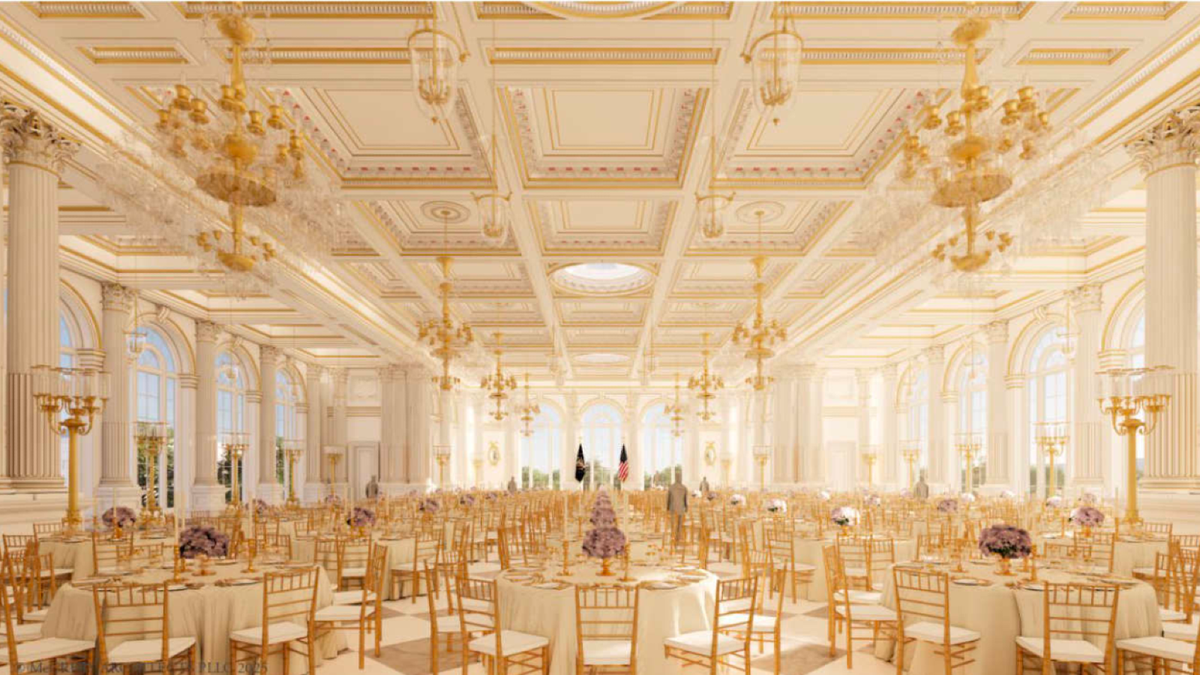
Each of the deck’s six renderings carries a 2025 copyright line for McCrery Architects, the firm the White House had already replaced. Martin had called the deck “a brief power point of the original conceptual designs.”
Eight days later, Staudigl told a Washington Post reporter, “NCPC has not yet received a submission.”
When the White House said it had formally applied, Staudigl wrote that “the disconnect is simply in the terminology” and that the deadline to apply for approval at the March meeting was January 30. He told CBS News on January 2 that the December materials “are not publicly available at this time.”
Martin swore in a January 15 court declaration that the White House “submitted an initial application for the Project to the NCPC” on December 22.
Stidham filed her own declaration for the government December 15 in the National Trust for Historic Preservation’s lawsuit to stop the project. She voted for the ballroom in April.
Martin sent the planning commission and the Commission of Fine Arts a schedule February 24 for the ballroom and two other White House projects.
“We can’t have a month go by whereby we don’t get to work together,” Martin wrote.
For the ballroom, she listed the presentation and public comment for March 5 and the vote for a date she marked “March TBD.”
“This schedule looks correct for NCPC’s timeline. Thanks!” replied Diane Sullivan, then the commission’s director of urban design and plan review.
On February 26, “as discussed with Heather,” Hottel-Cox sent Martin and White House official Caroline Hunter a link to the comment the trust submitted. She added, “in case it is of interest to you all,” a link to the trust’s webinar “on the project and specific things for the public to note in any comments they submit.”
Hottel-Cox also sent the trust’s lawyer, Betsy Merritt, counts of registered witnesses in February and March.
Martin asked March 3 for “our current count of responses and speakers please.” Hottel-Cox replied that 104 people signed up to testify and that the commission received about 34,500 comments.
Staudigl told Axios in an email on March 3 that the commission would not vote March 5, citing “the large amount of public input on the project.” The commission’s written summary of its process, sent to the White House in December, had recommended breaking for at least two days before a vote after “a significant volume of public testimony.”
Thirty of the 104 people originally registered testified March 5, Staudigl told a reporter.
Trump showed reporters a revised design aboard Air Force One on March 29, four days before the vote.
Martin emailed Sullivan and Commission of Fine Arts secretary Thomas Luebke a new rendering the next morning.
“As discussed we removed the stairs, attached is the new rendering,” she wrote. “Please let me know if you think we’ll need re-approval from CFA and if there is additional information you need for NCPC?”
The drawings she attached are dated March 17, 12 days before Trump showed the design to reporters.
A staff addendum dated March 31 says the White House dropped the stairs from the south portico and that a switchback added to the southwest corner stairs “minimally alters the overall site plan.”
Baranes offered March 31 to give “a quick 5 min presentation with boards” on the changes.
“No need to do a presentation,” Flis replied.
Commissioners voted April 2 without hearing public comment on the revised design. The vote was 8-1, with two abstentions and one member absent.
Chairman Will Scharf, also the White House staff secretary, voted yes.
The day after the vote, Robert Miller, who sat on the commission from 1985 to 2014 and was its elected vice chair for seven years, emailed four current members, including Stidham. He copied Mayor Muriel Bowser and Council Chairman Phil Mendelson, the lone vote against.
Miller wrote that he was “somewhat surprised and saddened, for your actions/non-actions yesterday at NCPC to capitulate, like too many other ‘elites,’ to yet another one of Trump’s unlawful and corrupt vanity projects.”
In August, the Supreme Court allowed construction to continue while the trust’s lawsuit proceeds, as previously reported.
The administration asked the court on November 5 to hear the case, and the trust’s response is due December 7.
Urgent Matter is reader-supported. Please consider subscribing to support independent arts journalism.