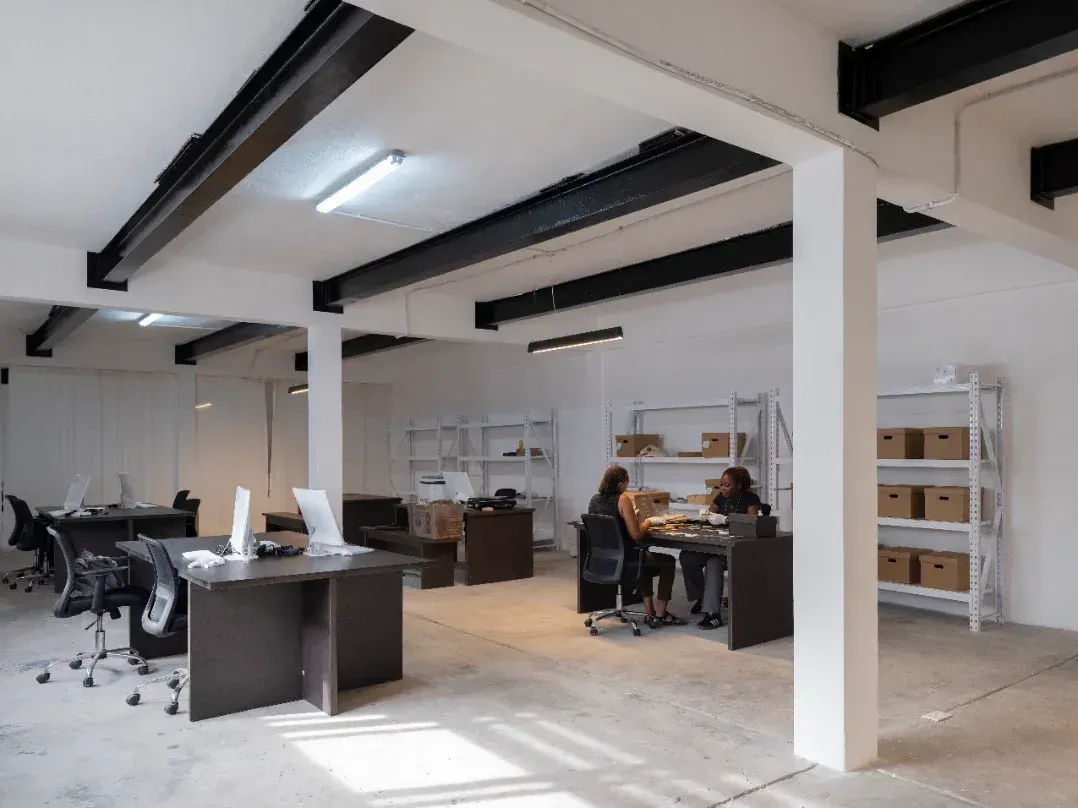
Si Hene, a foundation started by Ghanaian American artist Rita Mawuena Benissan to archive Ghana's chieftaincy and cultural history, opened a membership-based cultural center in a former pharmaceutical factory in Accra.
Its website lists the center as open and calls itself Ghana's first membership-based cultural center. Visitors without membership can walk in for GH₵35 or come free on Fridays.
The Art Newspaper reported in September that Si Hene planned to inaugurate the center during Gallery 1957's Accra Cultural Week, an annual program of exhibitions, studio visits and tours that runs this year from October 29 through Monday.
Si Hene has run mainly on grants since it began, The Art Newspaper reported. Benissan told the newspaper she wanted the center to be self-sustaining and modeled its membership plan on revenue from Western cultural institutions she knew growing up.
The newspaper reported a goal of at least 300 members in the first year.
The foundation’s membership page sorts individuals into three age-based tiers. Young Custodians, ages 5 to 25, pay GH₵50 a month or GH₵600 a year. Custodians, ages 26 to 59, pay GH₵85 a month or GH₵1,000 a year.
Elder Custodians, 60 and older, pay GH₵35 a month or GH₵400 a year. Institutions pay a flat GH₵6,000 a year for five named staff seats, a listing on Si Hene's partners page and the ability to post jobs, grants and residencies on its site.
The center's Archive Lab is a research room with computers, scanners and desks to reserve. It holds photographs, stamps, maps, recordings and other material on Ghana, Africa and the Black diaspora.
Donors gave some of the collection, and Benissan bought other items herself, including some on eBay, The Art Newspaper reported. She described those purchases as "my own restitution."
Si Hene's reading room is a reference library whose subjects include Ghanaian history, Akan and Asante rule, African art, textiles, photography and archiving. Its books do not leave the room.
As of Monday night, the archive database on Si Hene's website said "No catalogue records published yet," and the reading room's online catalog listed four entries marked as samples.
The database page tells researchers to book time at the Archive Lab until records are posted. The lab's booking page says an archivist replies within five working days. The reading room page asks readers to write to the library to check what is on the shelf.
According to Si Hene's website, the center is open Tuesday through Saturday from 10 a.m. to 5 p.m. at 128 Ring Road East. It also lists a coworking and event room called the Forum, a courtyard, a research room for Si Hene's projects, a cafe not yet open, and a studio for artists in Gallery 1957's residency program.
Gallery 1957 represents Benissan as an artist and hosted her in its residency program in 2023, its website shows.
Si Hene was also part of last year’s Cultural Week. Gallery 1957’s 2025 itinerary and recap show the gallery took guests to an unveiling of Si Hene’s new location on November 2, 2025, with Benissan present.
Benissan started Si Hene as an Instagram archive after she looked for pictures of Ghanaian royal umbrellas, stools and chiefs but couldn't find them, according to Si Hene's website.
She said in a 2022 Q&A published by the Ghana Investment Promotion Centre, a government agency, that she founded it on January 3, 2020. The name is Twi for enstoolment, the ceremony that installs a chief, king or queen mother.
In that Q&A, Benissan said Si Hene helped relaunch the National Museum of Ghana in its second year. She said her long-term goal was to establish "Si Hene Museums and Research Institutions in each region of Ghana."
Si Hene's first Custodians of Culture Fellowship, a 17-week course in community archiving for early-career Ghanaian cultural workers, ran with a stipend from March 23 to August 5. Fellows each finished a small archive drawn from a community, which Si Hene has added to its collection, and the program page credits a Gwaertler grant for funding.
Si Hene is also running Living Structures, an 18-month effort to make digital records of Ghana's endangered forts and castles and of the communities that surround them.
The National Archives of the United Kingdom is funding it through PASSAGE, a transatlantic slavery research program backed by the Lloyd's Register Foundation.
It announced on May 28 that it was awarding £450,000 across 15 projects in Barbados, Cameroon, Ghana, Jamaica and Trinidad and Tobago. The announcement did not list how much each project received.
Urgent Matter is reader-supported. Please consider subscribing to support independent arts journalism.