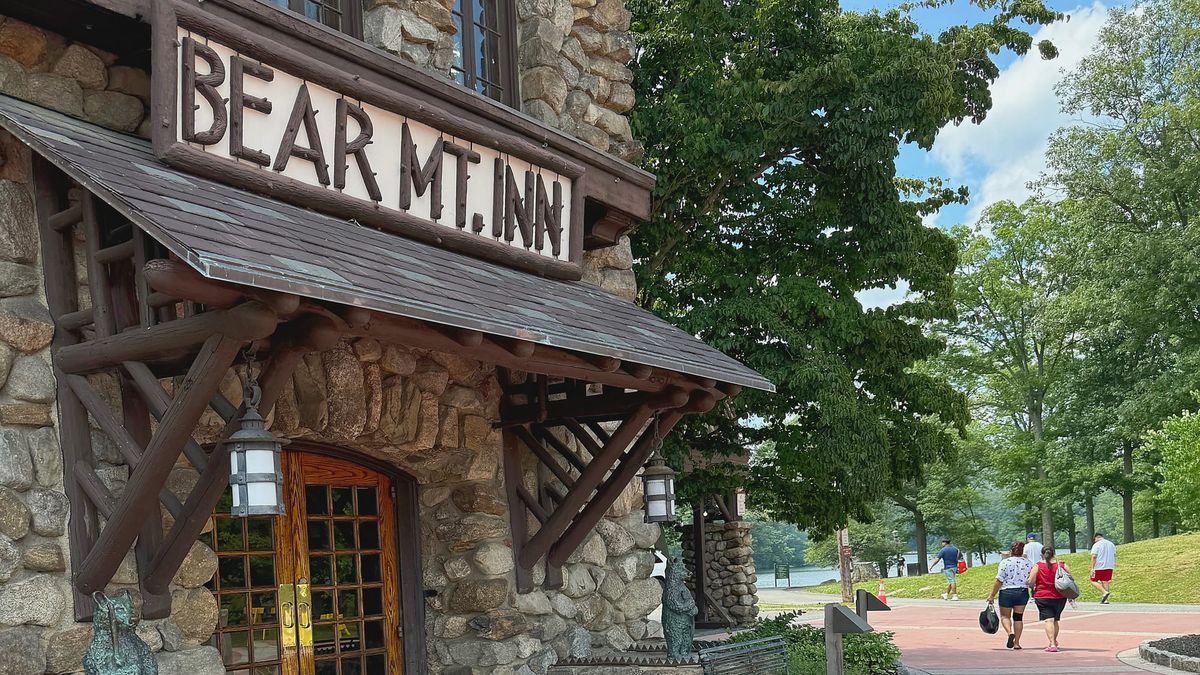
New York State Parks found a human scalp in a cardboard box labeled “Indian Scalp” in pencil, buried at the bottom of a chest of Dan Beard’s belongings on display at Bear Mountain State Park since the 1940s, federal records show.
The state disclosed the scalp in a June 2024 notice under the Native American Graves Protection and Repatriation Act, the 1990 federal law that requires federal agencies and museums that get federal money to inventory Native American remains and burial and sacred objects and return them to tribes and descendants.
A second notice, published in December 2025, described a necklace of what appeared to be Native American hand and foot bones strung with blue glass trade beads. It was “discovered hung on a replica mantle display” in the same exhibit, which the state said is over 80 years old.
It was not immediately clear where Beard, an illustrator and author who helped found the Boy Scouts of America, obtained the remains before he died in 1941 and they went to the park.
Sign up for Urgent Matter
This article is provided free with the support of paying subscribers. Not ready for a paid subscription? Sign up for a free account today.
No spam. Unsubscribe anytime.
“No information is available as to where, when or how it was acquired by Mr. Beard,” the December notice said.
The New York State Office of Parks, Recreation and Historic Preservation determined the scalp came from one Native American person and the necklace from at least two. It could not link the remains to any specific tribe.
The agency invited the Delaware Nation in Oklahoma, the Delaware Tribe of Indians and the Stockbridge-Munsee Community, a Mohican and Munsee nation now based in Wisconsin, to consult. All three agreed the Stockbridge-Munsee Community would take the lead, records show.
A March 27 notice in the Federal Register said the Stockbridge-Munsee Community had asked for the remains of all three people. They could be handed over on or after April 27.
On August 24, State Parks published a fourth notice covering 187 more objects from Bear Mountain, including items on display at the park’s Trailside Museum.
Fifty are objects the state believes were placed with the dead: wampum, pendants, gorgets worn at the throat, stone axe blades called celts, adzes, a ceramic bowl, ceramic pots, pipe fragments, bear teeth and a bear jaw.
The other 137 are sacred objects or items that belong to a tribe as a whole, among them projectile points, net sinkers, nutting stones, shells, a coin, metal and a button.
For the objects on display, “Exact origins of these objects is unknown but suspected of being from in or around the park,” the notice said. Those objects “smell strongly of mothballs,” and any other chemical treatments are unknown.
The History Museum is the largest of four stone museums at Trailside Museums and Zoo, which was established in 1927. State Parks’ website says the museum has exhibits on Beard, the Revolutionary War, colonists and local Native Americans.
A marker along the trail says knives, net sinkers and arrowpoints found at that spot show Native people camped there on hunting and fishing trips. More artifacts found in the area are on display in the History Museum, the marker says.
Since January 2024, federal rules require museums to get “free, prior, and informed consent” from tribes before displaying Native American remains or cultural items. The August notice lists the objects as on display at Trailside.
Objects from two other places, Nicoll Farm and O’Rourke Farm, were “excavated from a known Ancestral burial site and were later donated/stored on Iona Island,” the notice said. Iona Island sits in the Hudson River and is part of Bear Mountain State Park. As far as the state knows, those objects were never treated.
State Parks found a connection between the 187 objects and all three tribes. They could be returned on or after September 23.
The O’Rourke name appears in an earlier federal notice. In December 2022, the New York State Museum in Albany reported holding the remains of at least three people, an adult woman and two children, taken in 1934 and 1940 from the O’Rourke site in Moodna, in Orange County.
The Bear Mountain Trailside Historical Museum dug up those remains after construction disturbed the ground. State Parks transferred them to the State Museum in 2007, that notice said. A 2023 amendment tied the remains in that notice to the same three tribes.
The August notice does not say whether its O’Rourke Farm objects came from the same site.
The state’s repatriation contact for all four notices is based at State Parks’ historic preservation headquarters on Peebles Island in Waterford, where the Mohawk and Hudson rivers meet. The office works out of a converted factory complex on the island.
Gov. Kathy Hochul secured $7 million in this year’s state budget to start turning that headquarters into a public history center called the New York History Preservation and Resource Center, or History PaRC, her office said in May. The announcement did not include a timeline.
An X account called Ocher Mountain, which posted about the Bear Mountain notices October 27, has called on the state to release its archaeological records on Peebles Island before the project goes forward.
A State Parks marker on the island says a 1630 map places Menomine’s Castle, a village named for a Mohican leader, on Peebles Island.
“There is abundant evidence of Indian occupation on Peebles and Van Schaick Islands,” the marker says. Hearths unearthed on the island may show people drying fish to store for winter, it says.
State Parks’ policy says its historic preservation office generally begins consulting tribes on a project when a Native habitation or burial site is found in or near the project area. The policy says the agency also consults tribes on projects it carries out itself.
Urgent Matter is reader-supported. Please consider subscribing to support independent arts journalism.