Janet Biggs chases total solar eclipses in search of her late mother
Biggs’ third solo show at Cristin Tierney Gallery is on view through October 24.

Biggs’ third solo show at Cristin Tierney Gallery is on view through October 24.
Janet Biggs started traveling to total solar eclipses after her mother died.
Her mother had dementia and sundowning syndrome, a symptom that can cause increased confusion or agitation in the late afternoon or evening, Biggs said. Her mother “really reversed day for night.”
“In the middle of the night, she’d get dressed for lunch. We’d open the curtains, and it’s pitch black out,” Biggs told Urgent Matter. “Her brain just stopped responding to circadian rhythms.”
“After she died, I thought, if I put myself in the path of totality, when the whole landscape or biome reverses day for night, then I’d find a connection to my mom,” she said.
Two works from that search are now on view in “Path of Totality,” Biggs’ third solo show at Cristin Tierney Gallery, at 49 Walker Street in Manhattan, through October 24.
The front room holds Eclipse (Antarctica, December 4, 2021), made from 2022 to 2024 after the first total eclipse she traveled to. The main gallery holds Eclipse (Amazon, September 7, 1858), a three-channel video from 2025.
In the front room, with Antarctic glaciers on the screens, I overheard a visitor say they hoped it wasn’t a climate change documentary.
“We get so much information about climate change that people tune it out and say things like, ‘Wow, I really hope this piece isn’t about climate change,’” Biggs said. “I think the arts can focus your attention in a different way.”
“It’s kind of like a sneaky way to make that person think about climate change,” she said.
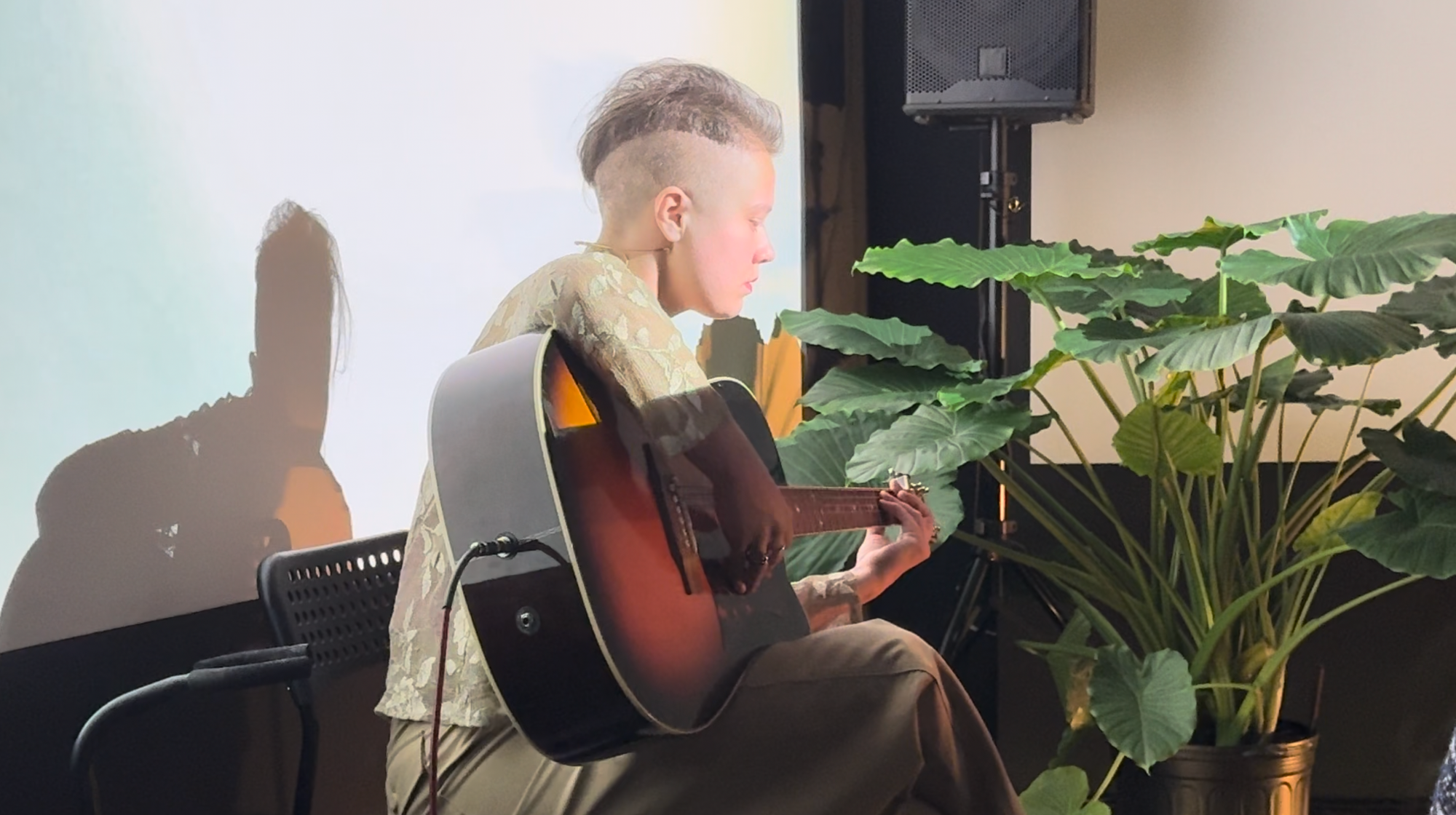
Biggs staged two performances at the gallery on opening night, one for each work.
The first was in the front room. Mary Esther Carter delivered a wordless vocal performance that moved mostly between two pitches a perfect fifth apart. It was beautiful.
When asked whether she is a thrill seeker, Biggs said she has “absolutely a thrill-seeking side to my personality.”
On the way to Antarctica, her ship crossed the Drake Passage, “which is supposed to be the roughest sea in the world.” The first day was calm, and Biggs said she was “super disappointed.”
On the second day, she said, the waves tore the railing off the ship's outside and the insulation off the inside.
“It broke every piece of glassware, and they thought they had tied everything down. So I was super happy,” Biggs said. “I mean, not for the ship, but that it lived up to, you know, my expectations.”
Dense fog then hid the eclipse itself, the gallery’s press release said.
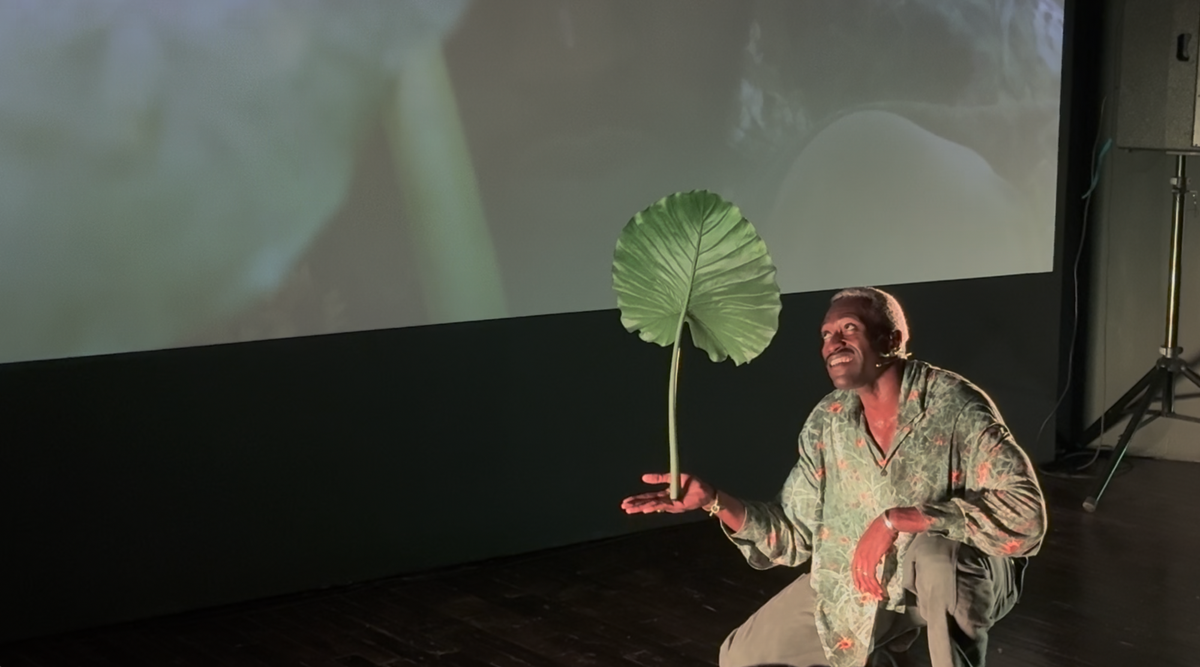
The second performance moved to the back room, where Carter played guitar and sang and Vinson Fraley danced.
I watched from the back row and could not see much of Fraley as he wiggled on the floor. Partway through, his movements began to resemble diving. The video came up behind him moments later.
Fraley wore a microphone that stayed active as he danced, so his labored breathing became part of the sound.
The first song included the words “crushing up against.” Carter wrote it about the emotions that hit her after her own mother died, Biggs said.
“So we have that kind of shared history,” Biggs said.
On screen, the forest started green and vibrant, then went gray and dull. At one point, pages of math appeared on the screen. Biggs said the same document is also on view in the exhibition. It is a Smithsonian-collection record of the 1858 total solar eclipse in Peru.
Biggs said her eclipse research kept turning up accounts written from “a Western male perspective.”
“This is the first time that I read a document that talked about the local population and their response to total solar eclipses,” she said.
During a total eclipse, she said, the light turns green, everything goes mottled and it gets very cold.
“People thought a plague was being visited upon them,” Biggs said. “And I read this in 2020 during the shutdown.”
Biggs said she first filmed the Amazon project at the Amazon's headwaters in Peru. She edited the three-channel piece and thought she was finished.
Then she watched Fraley balance a leaf on his hand “just for a second,” she said, and decided the work was incomplete. They then brought a small crew to a cloud forest in Costa Rica.
“Every day for 12 days, we’d go out into this forest, and Vinson would interact with nature, and I would film, and we had an amazing musician with us,” Biggs said. “And it was like an artist residency dream.”
At night, the group cooked at an Airbnb, drank “a bunch of wine” and talked about her loss of a parent, colonial history and ecological disasters, she said.
“The environment that we were in is precarious at best, and we felt precarious in it,” Biggs said.
Biggs said she had mostly worked with Fraley and Carter live before this project.
“While I get the title of director, they are equal partners in all of it,” she said.
Biggs said she is “reluctant to give a whole lot of information” about why she makes a work because she wants “to share authorship with my audience.”
“Most often, it’s something personal. It’s about my history, or else it doesn’t have any authenticity,” she said. “But for the audience, I want them to make their own reasons about why.”
I asked the gallery how it sells a work like the Amazon piece.
“Not easily,” said Candace Moeller, managing director of Cristin Tierney Gallery. “And it is a museum piece. This is not something that most people could put in their home.”
Moeller called it “a large, maybe even monumental, three-channel projection in a darkened room.”
“I think a lot of times it’s really easy to fork over a large amount for, say, a painting or maybe a sculpture. But video, comparatively, the price points lag far behind other disciplines,” Moeller said. “So it’s a struggle.”
She said a limited number of museums have budgets they are willing to spend on video. “I do believe this will get placed in a museum eventually,” she said.
Asked how she pays for her travel, Biggs said, “My existence is probably half grants, half sales.”
She travels to extreme locations. In the Arctic, the Antarctic or inside an active volcano, she said, “I’m off balance. And then creativity is available to me in a different way.”
Biggs said she has two more eclipse pieces in progress. One was filmed in the Utah desert and the Yucatán. The other is of an eclipse over her parents’ house in Georgetown, Texas, after both of them died.
She also wants to return to the Arctic and go to the Marshall Islands, “because those are the two landscapes that are most affected by the climate crisis,” she said.
The idea started when she saw a fractured ice core sample that “looked just like an x-ray” she had just gotten of her back, Biggs said.
“I’m an older woman,” she said. “I’m navigating my body, which is changing and arguably disappearing from the body that I’ve known.”
Urgent Matter is reader-supported. Please consider subscribing to support independent arts journalism.