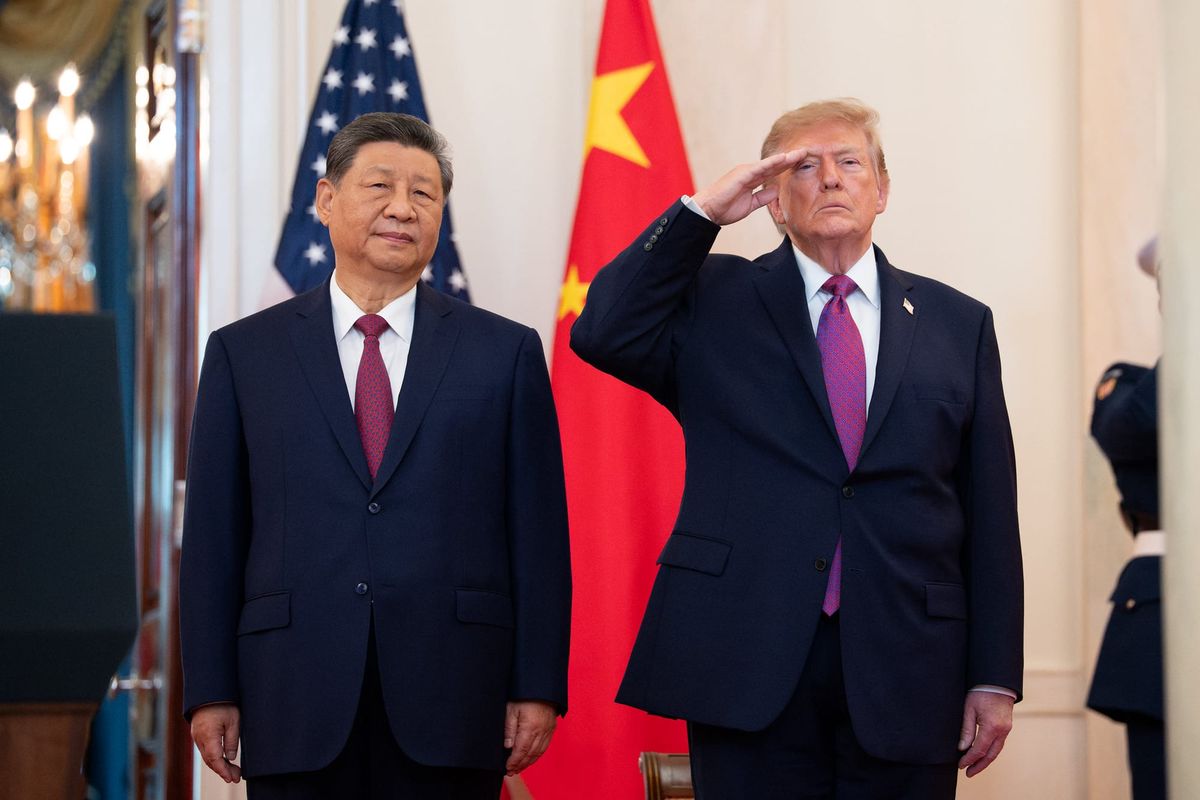
Collector J. Tomilson Hill has put works from his Chinese contemporary art collection on public view for the first time. They hang in a Manhattan exhibition named for the “Thucydides Trap,” a warning Chinese President Xi Jinping raised with President Donald Trump at their summits this year.

The show, “Thucydides Fever Dream,” opened September 16 at 239 10th Avenue, home of the Hill Art Foundation, which Hill leads as president. It runs through December 19. The show features 30 artists and contributors, from Andy Warhol and Agnes Martin to Wu Ziyang and Lu Yang, the foundation said in a press release.

The Thucydides Trap is a political science theory rooted in the Peloponnesian War, as described by ancient Greek historian Thucydides. It holds that a rising power’s challenge to an established one raises the risk of war. The release credits the phrase to Harvard political scientist Graham Allison.

Xi raised the idea with Trump on May 14, in talks at Beijing’s Great Hall of the People. He asked whether the two countries could “overcome the Thucydides Trap and create a new paradigm of major-country relations,” Xinhua reported.

“This exhibition comes at a critical time, where Chinese-American relations grow increasingly more tenuous and complicated, while also providing historical context on the development of Chinese cultural and artistic production through the 70s to the present,” Hill said in the release.

Chinese artists drew heavy collector interest when bankers grouped China into the “BRIC” economies, Artnet’s Ben Davis wrote in a September 24 Artnet Bulletin. Since then, politics has shifted so that “only Ai Weiwei remains as a consistent object of museum interest,” as far as he could tell.

Hill writes in the show’s booklet that he has spent 20 years acquiring Chinese art “because of my belief that artists in China today are uniquely positioned to respond to change.”

The show opened between the two leaders’ state visits. The next day, the Metropolitan Museum of Art displayed four sculptures by Beijing-based artist Liu Wei on its Fifth Avenue facade. They are on view through June 8, 2027, under the title “Speculation,” the Met said.

Liu Wei’s gallery, Lehmann Maupin, called the Met commission the artist’s first major U.S. project. Hill has collected multiple works by Liu Wei, Puck’s Marion Maneker reported.

The Hill show includes three works by Liu Wei, the checklist shows.

On September 24, during Xi’s visit, Melania Trump took China’s first lady, Peng Liyuan, to the Smithsonian’s National Museum of Asian Art, the Associated Press reported.

After the museum visit, the White House released a statement from Melania Trump saying art and culture have “a remarkable ability to transcend borders.”

Peng thanked the United States for sending Chinese cultural relics home in recent years, the AP reported, citing Xinhua. The week before, U.S. authorities had handed over 64 relics and fossils seized by law enforcement, Xinhua reported.

Xi again raised the Thucydides Trap while meeting Trump at the White House on September 24, saying the risk of war it describes “can be overcome,” Reuters reported.

Xin Wang, Pace Gallery’s curatorial director, curated the show. Three works in the show carry “courtesy Pace Gallery” credit lines in the booklet: two paintings by Wang Guangle and one by Li Songsong.

“I thank her for providing invaluable new insights into my collection of Chinese contemporary art, selections of which are here being publicly exhibited for the very first time,” Hill wrote of Xin Wang.

In the booklet, Xin Wang links Xi’s use of the phrase to a wider interest in Greco-Roman classics in China. She writes that history and cultural production “can unfold like fan fiction, full of callbacks, digressions, goofy impulses, and wild liberties in reinterpretation.”

The White House said Xi’s September 23-25 trip marked the first time a Chinese president had visited the White House in more than 10 years.

The two governments extended their trade truce by two months, to January 10, 2027, the South China Morning Post reported. The Post said they also launched tariff cuts on non-sensitive goods, capped at $30 billion for each side, through a “Board of Trade” the leaders announced in May.

The visit produced no movement on tariffs, rare earths, farm purchases, Taiwan or limits on advanced chip exports, MercoPress reported.

Xi urged Trump to handle Taiwan with care, Reuters reported, citing Chinese state media. The two leaders also split over how to manage artificial intelligence.

Days after the visit, U.S. Trade Representative Jamieson Greer used a G20 trade ministers’ meeting to propose a framework urging countries to raise barriers to steel imports, without naming China. Treasury Secretary Scott Bessent called China’s current account surplus unsustainable, the Post reported.

At the White House, Xi also said China would invite 100,000 young Americans over five years to study and take part in exchanges. He added that the relationship’s future “lies with the young,” Press Trust of India reported.

Xi and Trump could meet twice more this year, at APEC in Shenzhen in November and at the G20 in Miami in December, the Post reported.

Warhol’s Lenin (1986) hangs opposite Li Songsong’s Ciao Ciao (2022) in the show’s first gallery, the release says. The booklet says the Li Songsong painting shows Joseph Stalin’s body and funeral wreath.

Wu Ziyang’s video New Silk Frequencies (2026) is about the Chinese media company StarTimes and its reach in rural Africa, the booklet says. The release calls the show Wu’s first institutional showing in New York.

Wang Ye’s silk embroidery Manhattan B (2021) started as an image made by an A.I. system trained on pictures of Window of the World, the booklet says. That Shenzhen theme park builds smaller copies of famous landmarks, Manhattan skyscrapers among them.

Liu Chuang’s 45-minute video Wet Metal and Cotton Dance (2025) was commissioned for the 2025 Bukhara Biennial by the Uzbekistan Art and Culture Development Foundation, the booklet’s credits show.

Qiu Xiaofei’s Heilongjiang Box (2006) holds a renminbi note from a series designed by Hou Yimin. Xin Wang describes Hou as a protégé of Konstantin Maksimov, a Soviet specialist who was teaching in Beijing during the 1950s.

Liu Xiaodong’s 1993 painting Heavy Rain shows Ai Weiwei being life-cast by John Ahearn and Rigoberto Torres in Ahearn’s Times Square studio, the booklet says. Davis also wrote about Ai’s appearance in the painting. The press release does not mention Ai.

The release says the show includes never-before-seen photographs of Charles Simonds building tiny clay dwellings on the streets of Shanghai and Guilin in 1980. Those sculptures lasted only a few hours.

“In retrospect, it is hard to decide if the dwellings vanished so fast because there is little waste or surplus in China and the clay was put to more utilitarian purposes, or whether they were appropriated as private property, or perhaps as souvenirs,” Simonds wrote in Artforum in 1980, a passage the release quotes.

Zhang Xiaogang’s illustrations for a 1989 Chinese edition of Le Petit Prince are also on view. Beijing QL-ART Printing Co. printed the booklet.

The release listed a September 24 talk on A.I. and art with artist Trevor Paglen and an October 5 talk by art historian Thomas Crow, plus artist-led tours through the run. Admission is free.

Urgent Matter is reader-supported. Please consider subscribing to support independent arts journalism. 

Share this article
The link has been copied!