At the Noguchi Museum, flower arranging becomes a meditation
A morning at the Noguchi Museum combined meditation among Isamu Noguchi's sculptures with a lesson in the Japanese art of flower arranging.

A morning at the Noguchi Museum combined meditation among Isamu Noguchi's sculptures with a lesson in the Japanese art of flower arranging.
I wanted to ride my motorcycle to the Noguchi Museum on Saturday. It's been parked on the street, unused, for too long. But it was too cold, so I took the train and bus out to Queens.
I was glad to have the morning to myself. The kids are usually good when we go places, but sometimes they're not, and I wanted to experience this alone.
The class was "Mindfulness in the Galleries: Ikebana," a special edition of the museum's monthly meditation program, led by mindful ikebana teacher Anjie Cho. The museum's listing pitched it as a way to take in Noguchi's art and Japanese flower arranging "as a practice of presence."
“We get a dozen roses, and we jam them in a vase and then forget about them, don't water them, don't change the water,” Cho said during the class. “But this is a practice where we're looking at every single piece.”
 Adam Schrader
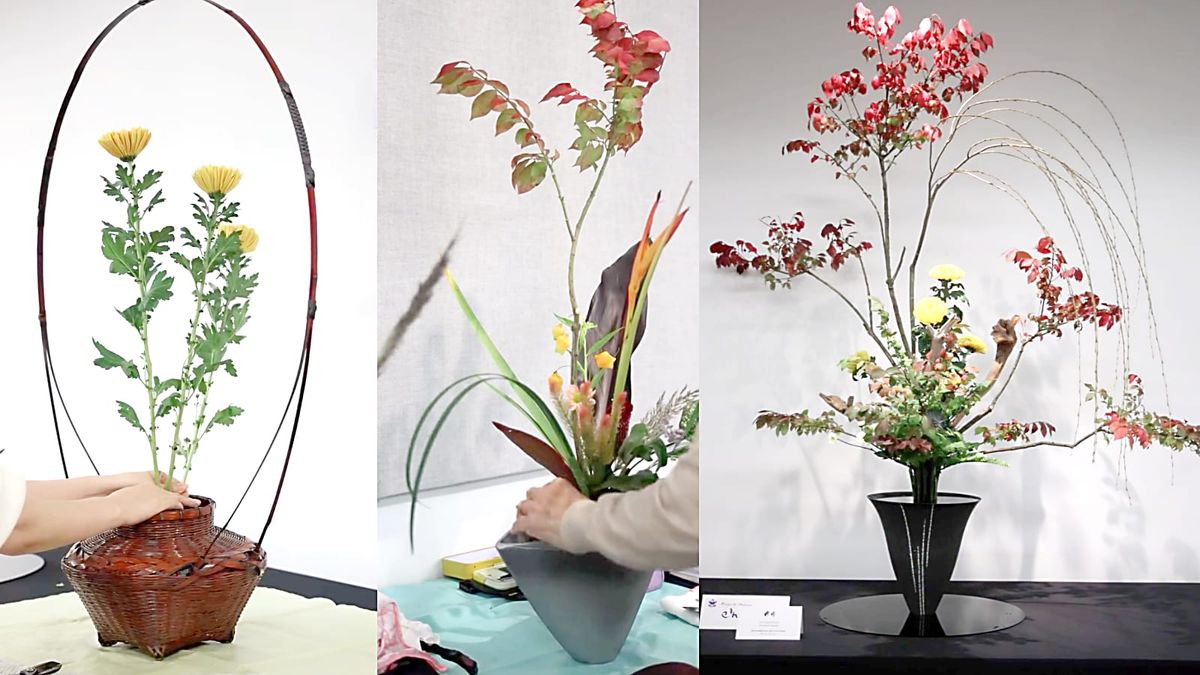
I was first offered a spot in October, with an invitation to "Autumn in Bloom," the museum's weekend show for the 40th anniversary of the Ikenobo Ikebana Society's New York City Chapter. I wrote about Senko Ikenobo's demonstration at the Asia Society that weekend but never made it out to the museum.
The class started at 10 a.m. Security let us in one at a time and gave us name tags. There were fewer than 20 of us. Our ages varied, and most seemed to have come alone. Once everyone arrived, we walked through the museum to the second floor, where we spent 45 minutes meditating.
I sat in the back row so the recorder running on my phone wouldn't bother anyone. That put me facing three of Noguchi's lanterns set behind a scrim, with a stone piece shaped something like a table on a reflective surface in front of it.
Cho led the meditation.
"If you're accustomed to meditating with your eyes closed, I'd invite you to open your eyes in a soft downward gaze," she said.
She wanted us to take in the room around us, "not to separate yourself from it." If we got lost in our thoughts, she said, "that's okay."
I'm not great at meditating, so I just looked at the installation in front of us. It was mist-like, and the lanterns floated in darkness. It reminded me of the Patronus scene on the lake in Harry Potter and the Prisoner of Azkaban.
I could also hear a couple visiting the museum with a baby, and my attention drifted toward them in a good way. Not in a how-dare-they-exist-in-the-same-space-as-me-while-I'm-meditating way.
After the meditation, Mariko, a museum educator, talked about Noguchi's Akari light sculptures. Noguchi wanted something "light and affordable, so everyone or a lot of people can bring it home and be part of their daily practice," she said.
Noguchi started on the Akari in 1951 after a trip to Gifu, Japan, and the museum is marking 75 years of them in 2026.
Then Mariko asked each of us for one word that came to mind when we looked at the sculptures. People said peace, clear, textured, transition, organic, layers, cloudy, illumination, warm, directionality, intentional and whimsical.
I said afterlife.
Two people said warm. One of them pointed to the soft light.
"It's not bright light, it's not necessarily dark, but I think it seems as if you're looking at something that has maybe not fire, but just like a temperature to it," the participant said.
"I'm curious a little bit more about the afterlife," Mariko said.
I told her the scrim made the edges soft, like a boundary to cross to reach the sculptures. The reflective surface in front looked like water, the kind you cross to go to the afterlife.
The ikebana part of the morning happened downstairs, in a classroom.
Cho said what she loves about Asian arts is "a huge emphasis on a transmission, not through words, even though I'm talking." In Japanese, she said, it's "Ishin Denshin, heart to heart transmission."
In a traditional lesson, she said, "the teacher would do your arrangement for you, like many times, and then you would just put it back together."
"But Americans don't like that," Cho said.
She said we were "doing a workshop, not a lesson."
"There's always a couple people that do whatever they want," Cho said. "That's okay too."
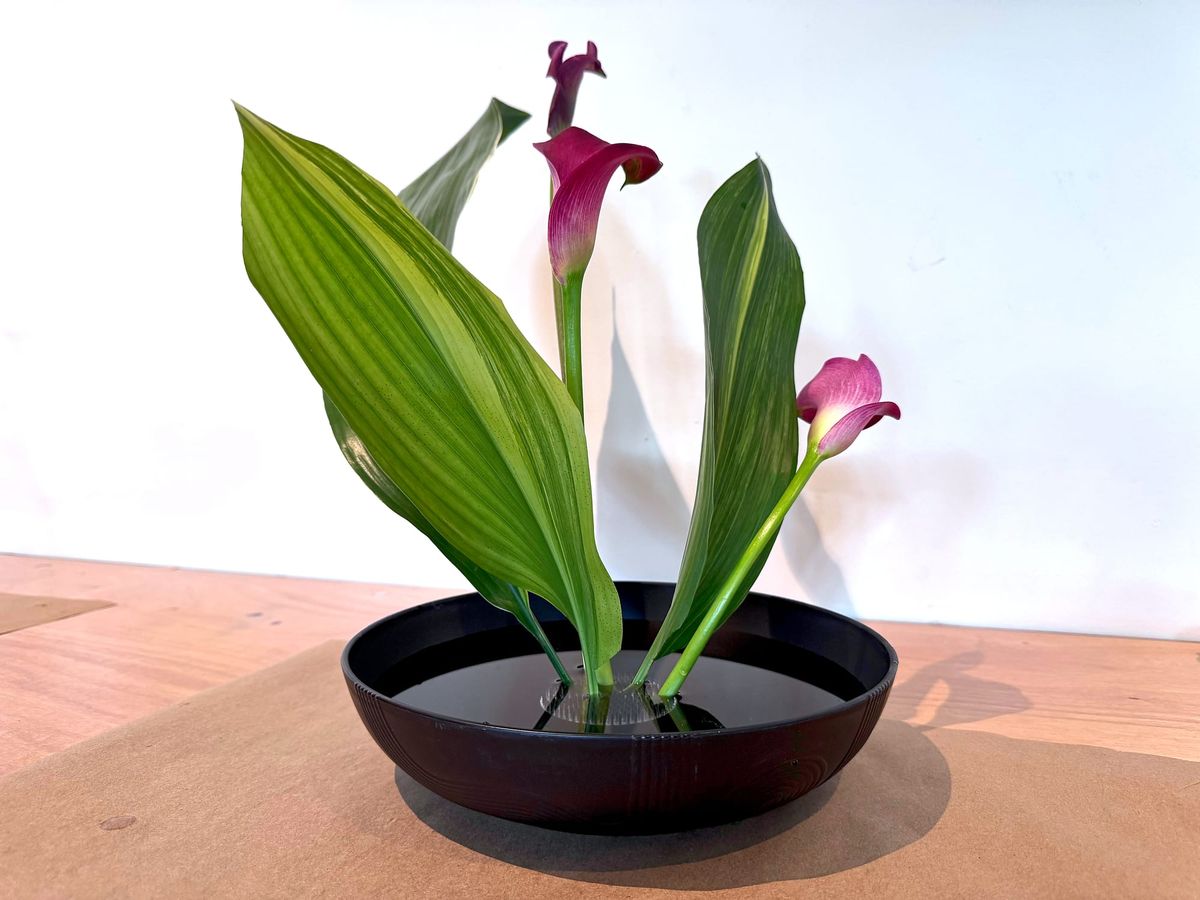
Each of us had a low, flat-bottomed container, a kenzan to hold the stems and four leaves of variegated aspidistra, a plant Cho called "kind of like an evergreen." The equipment belonged to the museum, but the leaves were ours to take home.
"I specifically picked out each one for each of you, and they're so different," she said of the leaves.
We were making a moribana, which Cho called "just a naturalistic style arrangement." It's built on three parts, heaven, earth and human, which she said is a Taoist concept. In Japanese, heaven is shin, human is soe and earth is tai.
Heaven goes in first and is the longest piece. Cho called it "your first ink mark that you put on a piece of paper."
I was first drawn to a leaf with a yellow stripe running down it. Another had a lattice pattern. I felt a little guilty snipping the beautiful stems.
The yellow leaf became my earth.
Cho also showed us how the direction a leaf faces changes what it says. Mimicking a leaf turned the wrong way, she said, "This is saying, please don't come further. This is saying stop."
"We only worry about what's in front of us. But what about what's to the left, to the right, or behind us?" she said.
One question I had was about the kenzan, the little spiky thing in the middle. Someone's wasn't centered, and it helped their arrangement. "Yes, absolutely, you can move it," Cho said.
I also asked if there was a wrong way to do ikebana.
"I wouldn't call it good or bad," Cho said.
For flowers to practice with at home, Cho said, "especially since we're all New Yorkers, you can certainly go to Trader Joe's."
After the class, the woman next to me said she liked my arrangement, and we got to talking. She's the florist behind Flora Voca.
"I'm on the mailing list. I just became a member," she said.
Her own work is bigger than ours, she said.
"It's so interesting that, um, this has existed forever, right?" she said. "But so has cutting from the field and putting it on the table."
"This, to me, is a total meditation. And for what I do, it is a meditation, but it's very different. It's much noisier."
She called her own work "more gardening." Here, she said, "it's much more peaceful."
"And it's much more intentional," Cho said.
"And you're making the decisions almost before," the florist said.
"I mean, I should try to take more classes, really," she said.
Cho said not many people teach ikebana with mindfulness. But she studies ikebana "in tandem with my Buddhist practice."
"My teacher is not spiritual at all, but it comes through," she said. "But I teach it specifically as a mindfulness practice, and the flowers are secondary to a mindfulness practice."
Cho's website lists her ikebana teacher as Nori Noda, her start year as 2015 and her Ikenobo School rank as Level 11 Kako Assistant Professor. She's also a licensed architect and a feng shui teacher.
I felt more relaxed when I walked out. It's nice to make something with your hands. I still want to be an artist, after all, which is part of why I'm focused on making Urgent Matter.
My flowers are still on display at home. They're not arranged the way we did them in class, just in a vase.
Urgent Matter is reader-supported. Please consider subscribing to support independent arts journalism.