Peter Kuper’s monarchs fly across American Museum of Natural History corridor
The show is found in the second-floor corridor in the museum’s Richard Gilder Center.

The show is found in the second-floor corridor in the museum’s Richard Gilder Center.
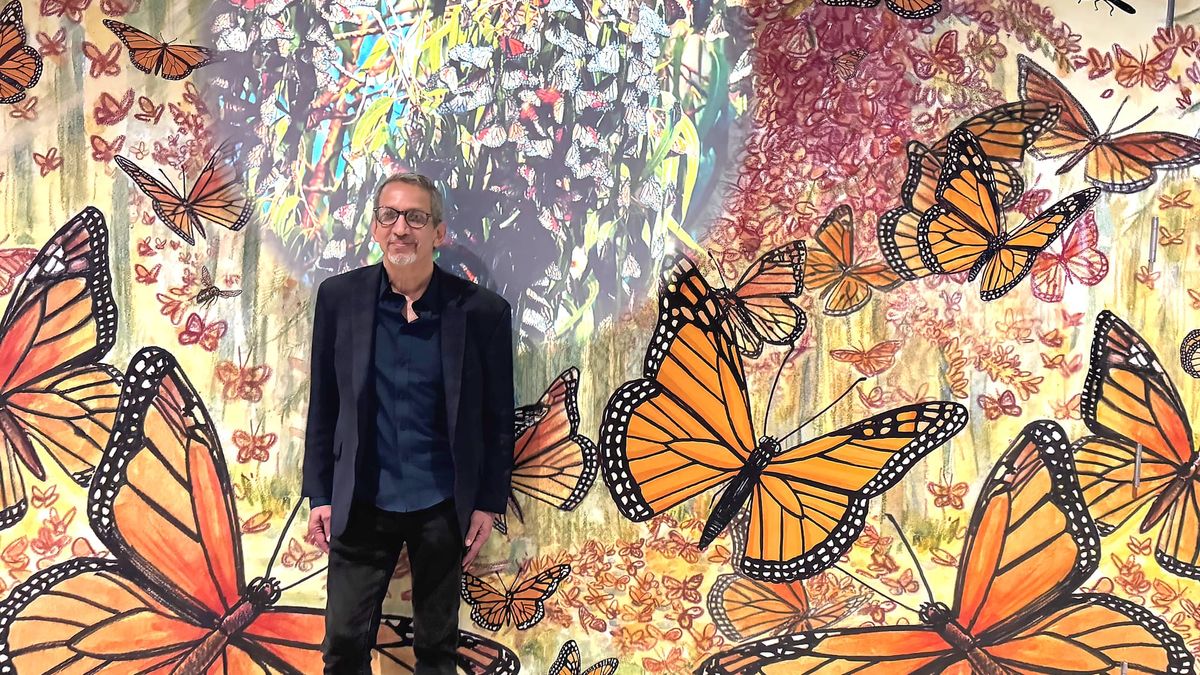
Cartoonist Peter Kuper’s monarch butterflies cover the walls of a corridor at the American Museum of Natural History in “Monarch’s Journey,” an exhibition that opened Friday.
Kuper said he first proposed a history of insects wrapping both sides of the corridor before the plan narrowed to the monarch.
“What’s going to sell this to a broader public is going to be the poster child for insects, which is the monarch butterfly,” Kuper told Urgent Matter at a media preview.
“I’m not done requesting, if they want to use the other side, I got the show for them,” he said. “I will propose that, I assure you.”
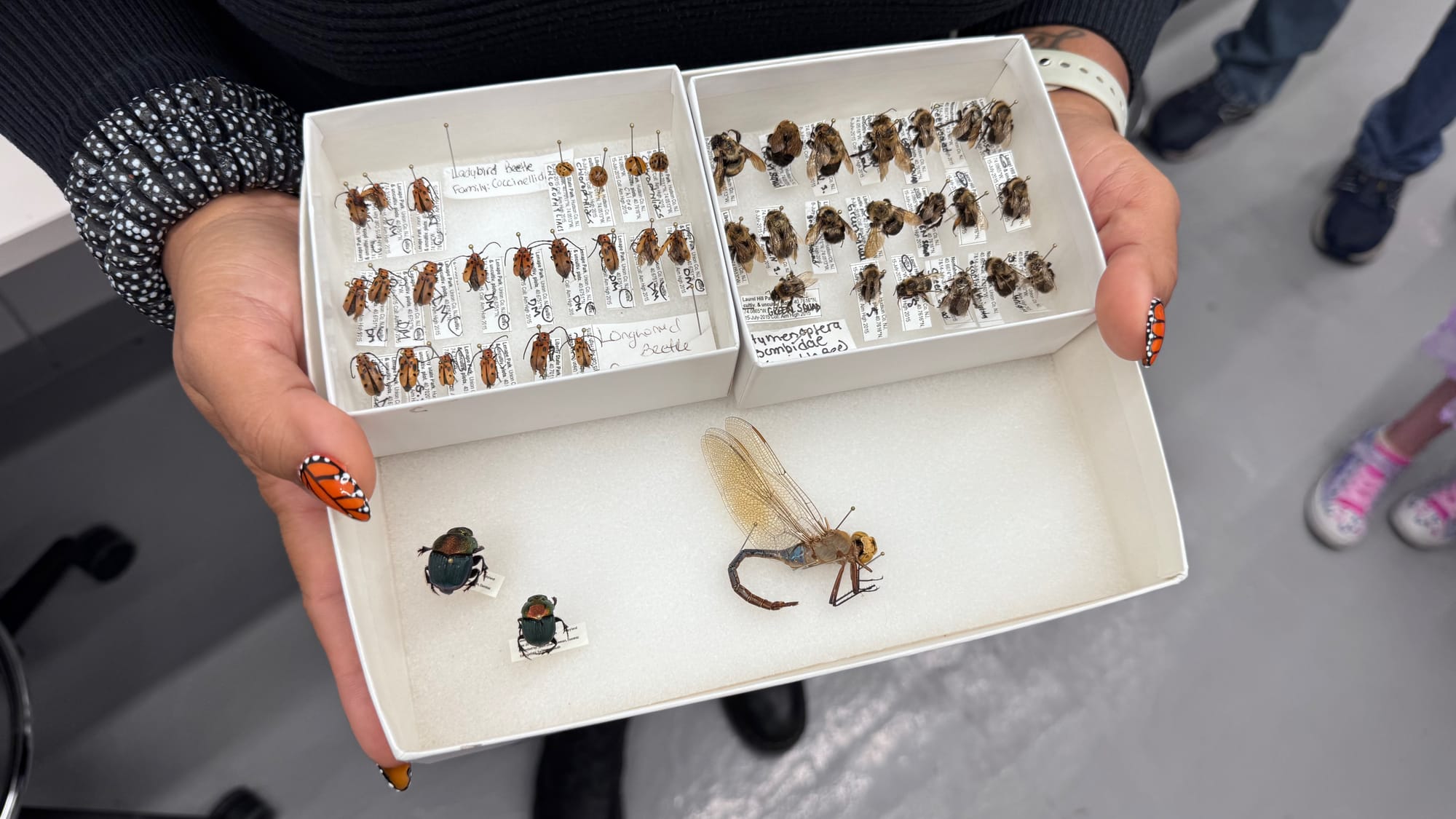
The show is found in the second-floor corridor in the museum’s Richard Gilder Center, beside a research collection of more than 1.3 million butterfly specimens.
Kuper’s illustrations, paired with a video installation, follow monarchs on their nearly 3,000-mile fall migration from the northern U.S. and Canada to the mountain forests of central Mexico.
Along the way, his butterflies fly over the New York City skyline, interstate highways, West Virginia mines, Florida tomato fields, the streets of Monterrey and New Orleans’ Lower Ninth Ward after the Hurricane Katrina floods.
Kuper, a Pulitzer Prize finalist, said he has been fascinated by insects since age 4.
One panel puts an Interstate 35 sign in a Sonoran Desert landscape. Kuper agreed when Urgent Matter pointed out that the highway does not run through that desert.
“I’d swear that I had reference for that but of course I absolutely could have not in that case,” he said. “The main thing that I needed from that sign was ‘north.’”
“I’ve tested this out with a lot of people and you’re the first person to call me out for Sonoran Desert,” he said.
For his book Insectopolis, which took him almost five years, Kuper said he worked from tons of references.
“I use a ton of photos in order to make sure that I’ve got the venation on the dragonflies’ wings sufficient so that Jessica Ware, the expert in dragonflies, is going to look at it and go, 'okay,'” he said.
Ware, the curator of “Monarch’s Journey” and chair of the museum’s Division of Invertebrate Zoology, led journalists on a tour of the museum’s butterfly collection, her nails painted with monarchs.
Kuper said he wanted the book to reach readers who “get bored by Latinates” as well as specialists who “know exactly how many stripes are going to be on a butterfly wing.”
For the book, Kuper said he showed each chapter to an expert. He sent the fly chapter to Erica McAllister in England, who he said came back with “a ton of corrections.”
“She yelled at me for saying mosquitoes kill people because. It’s the microbe in their body they carry,” Kuper said. “It’s like blaming the syringe for the heroin.”
He said the fix took two weeks and added pages on Italy’s Pontine Marshes, mosquitoes’ effect on the Revolutionary and Civil Wars, and malaria arriving with Christopher Columbus.
“I have been called a mosquito apologist, which I am not,” he said.
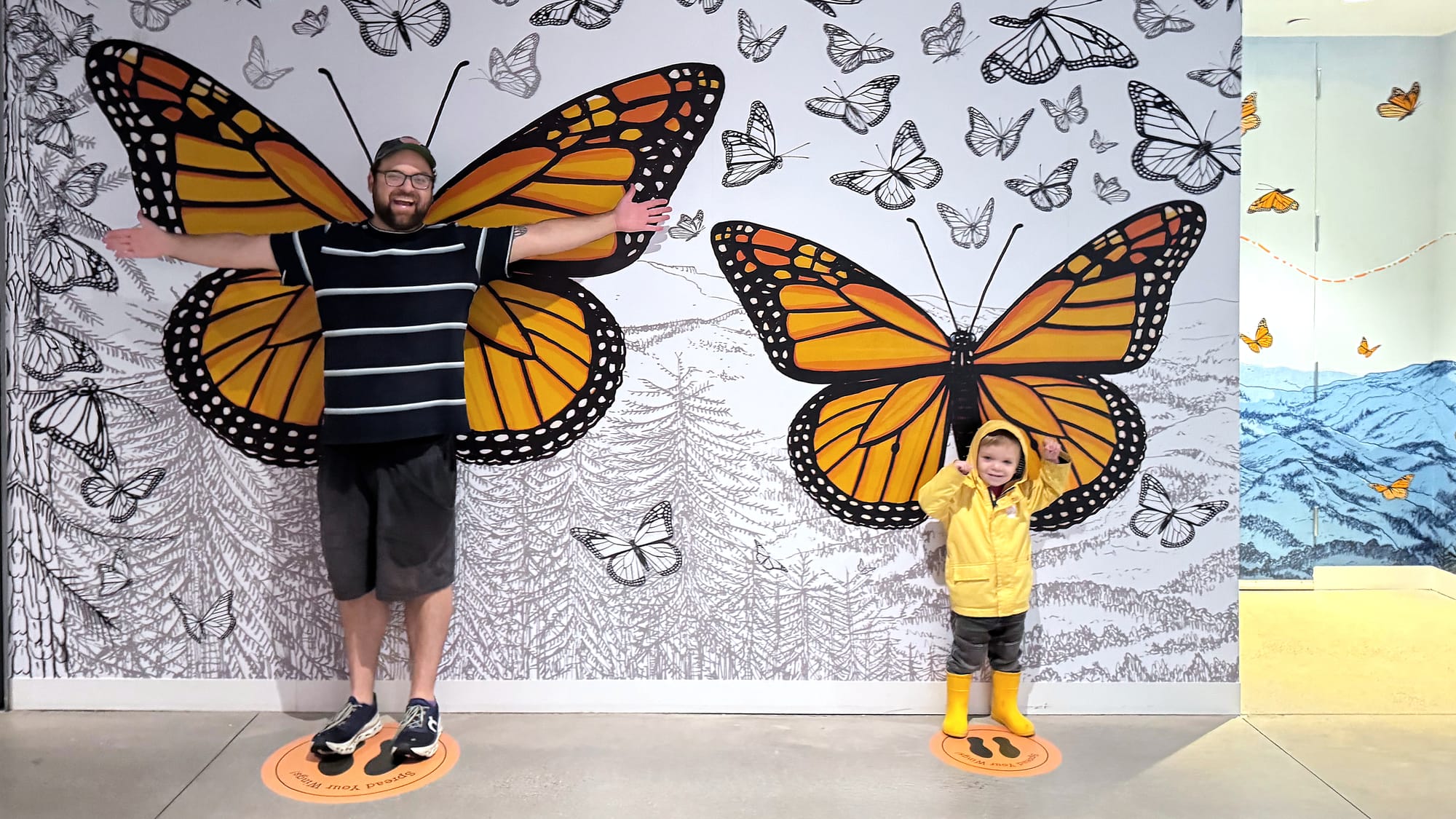
To plan the corridor, Kuper photographed the empty space and placed his images into the photos. The original drawing had one butterfly at the top, but he wanted monarchs coming across the floor.
“I’m thinking in terms of, like, what can I do that will make this immersive?” he said.
He said he draws his originals at a much smaller size.
“When I first scaled it up, I had to redraw tons of stuff,” Kuper said. “I mean, that’s a brand new drawing over there because when I saw one drawing blown up, it was like, ‘Oh God, that’s terrible.’”
For one wall, he said he drew “tons and tons of monarchs,” then placed them and reused some turned in different directions. “So that whole wall pretty much is brand new,” he said.
Another image first appeared in his book Ruins, where Kuper said it ran darker. He said he reworked the color and added sharper monarchs for the museum.
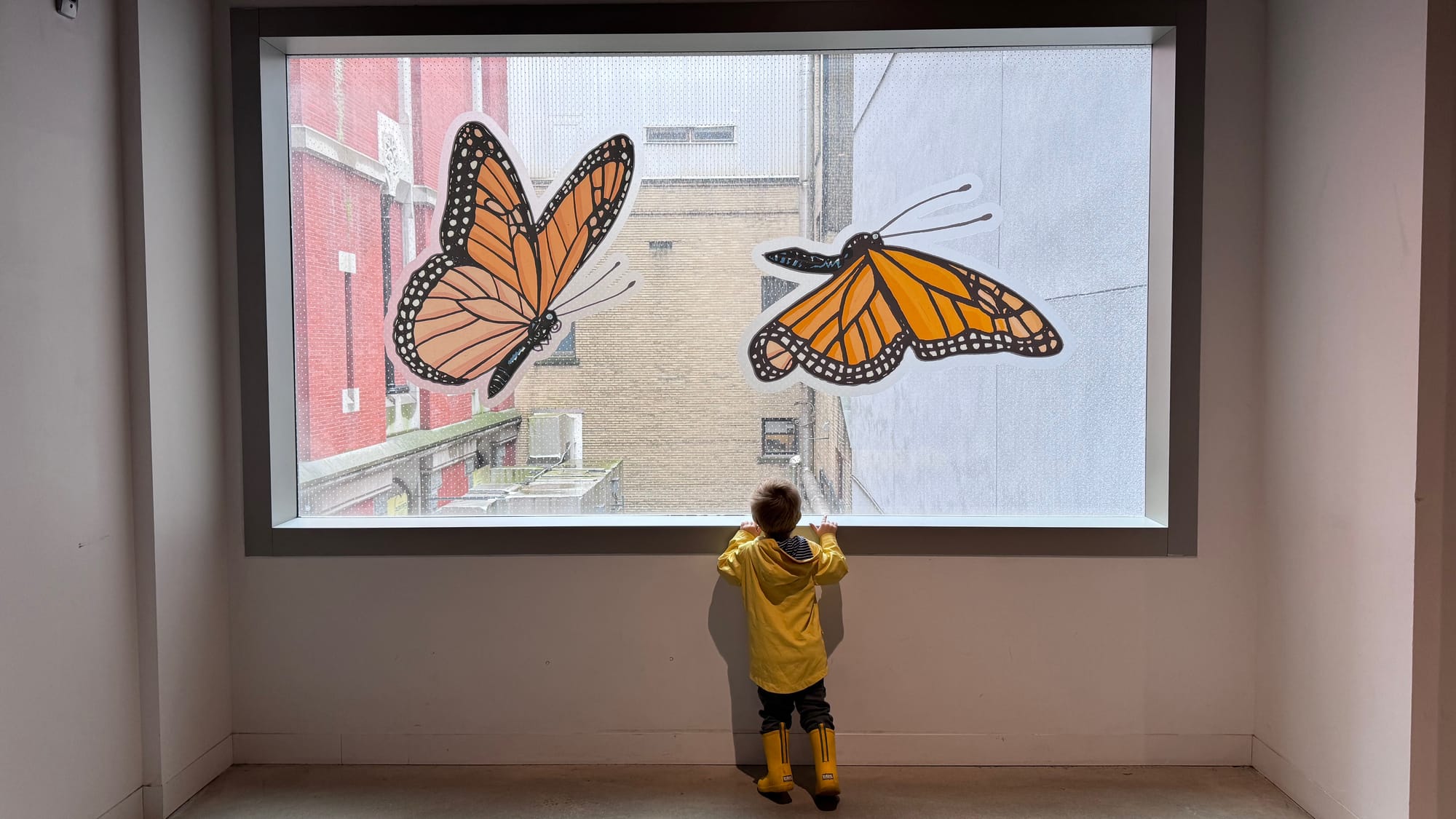
“When you blow it up, you have to blow it up at a tremendous DPI to make sure that the line work doesn’t get foggy,” he said.
“When I see it, it’s both impressionistic and sharp in some places; some things are softer and some are not,” Kuper said. “I feel like it came out the way I wanted, but I guesstimated a lot.”
Kuper draws in pen and ink on paper and colors the drawings on a computer, where he said he can “try, experiment, and undo it.” He has also worked in stencil and spray paint, in watercolor and in scratchboard, which he used for an adaptation of Franz Kafka’s The Metamorphosis.
He said the wall prints cannot show the physical drawing, which he wants young artists to see as a reminder that “everything’s not digital, there’s an analog part.” He plans to post the originals online.
“I have original art, and that’s a piece of my income, is selling original art,” Kuper said. “As fewer and fewer people work analog, and it’s all digital, my work becomes more valuable.”
He said he “jokingly” encourages students to stay digital, “because my work is just going to get raised in price, because nobody will be doing it anymore.”
Kuper said he has argued for comics since he made a fanzine at 11. He called comics “one of the most difficult art forms,” and said that for decades “there was virtually no money in it.”
He still self-publishes through World War 3 Illustrated, a collective where he said: “nobody gets paid.” A new issue just came out.
“Having comics in an institution like this is one more step in this mission I’ve had to basically say to people, comics deserve to sit in an institution like this,” Kuper said. “They can be the highest level of science and fine art, and then also just comics, and that’s fun, and you can stand in front of monarch wings.”
He said the exhibition is “opening the door for the millions of people who are going to come through here.”
“This is as big a museum as I need to get for something like this, and I’m thrilled to be in this environment,” he said.
“I think we are on the cusp of pretty much all institutions waking up to the fact that comics is an ideal form for them too,” Kuper said.
The museum store is selling Kuper’s graphic novels and two numbered, signed limited-edition prints, one of them made from a drawing he created for the museum.
Urgent Matter is reader-supported. Please consider subscribing to support independent arts journalism.