Whitney unveils first major New York Lichtenstein retrospective since 1993
Paid subscribers can read Urgent Matter's thoughts on the show in the paywalled section below the main article.

Paid subscribers can read Urgent Matter's thoughts on the show in the paywalled section below the main article.
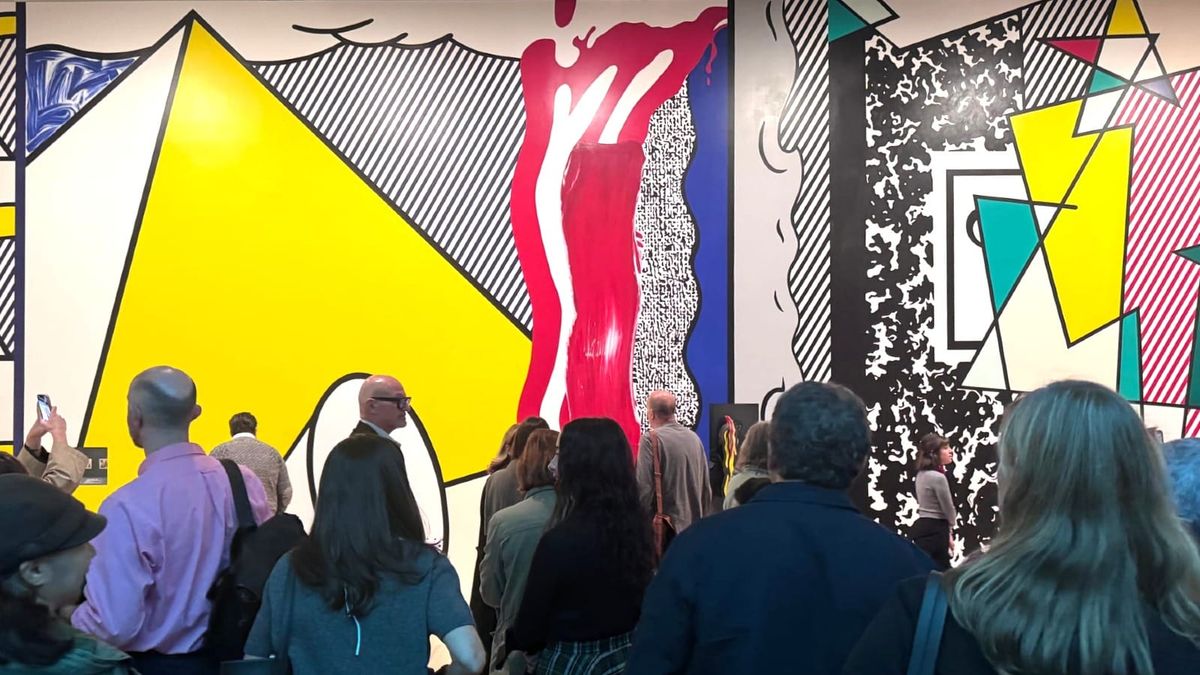
The Whitney Museum of American Art showed its Roy Lichtenstein retrospective to dozens of journalists Wednesday, calling it the first major survey of the Pop artist at a New York museum in 33 years.
The show, titled “Roy Lichtenstein: Like New,” opens to the public October 11 on the museum’s fifth floor, bringing together more than 130 works made from the early 1940s through the 1990s.
“The last major Roy Lichtenstein retrospective at a museum in New York City was at the Guggenheim in 1993,” Whitney director Scott Rothkopf said at the preview. “So when I say once-in-a-generation, I mean it quite literally.”
Whitney curator Meg Onli co-curated the show with artist Alex Da Corte, whose own work is also included. The curators organized it around copying, duplication and how images move from one place to another.
“We click, we drag, we copy. We don’t know necessarily what authenticity is. We share,” Rothkopf said, describing how the curators connected Lichtenstein’s work to the way images now circulate on phones.
“We know that Lichtenstein is a copier, and so we wanted to have some type of copy in our show,” Onli said.
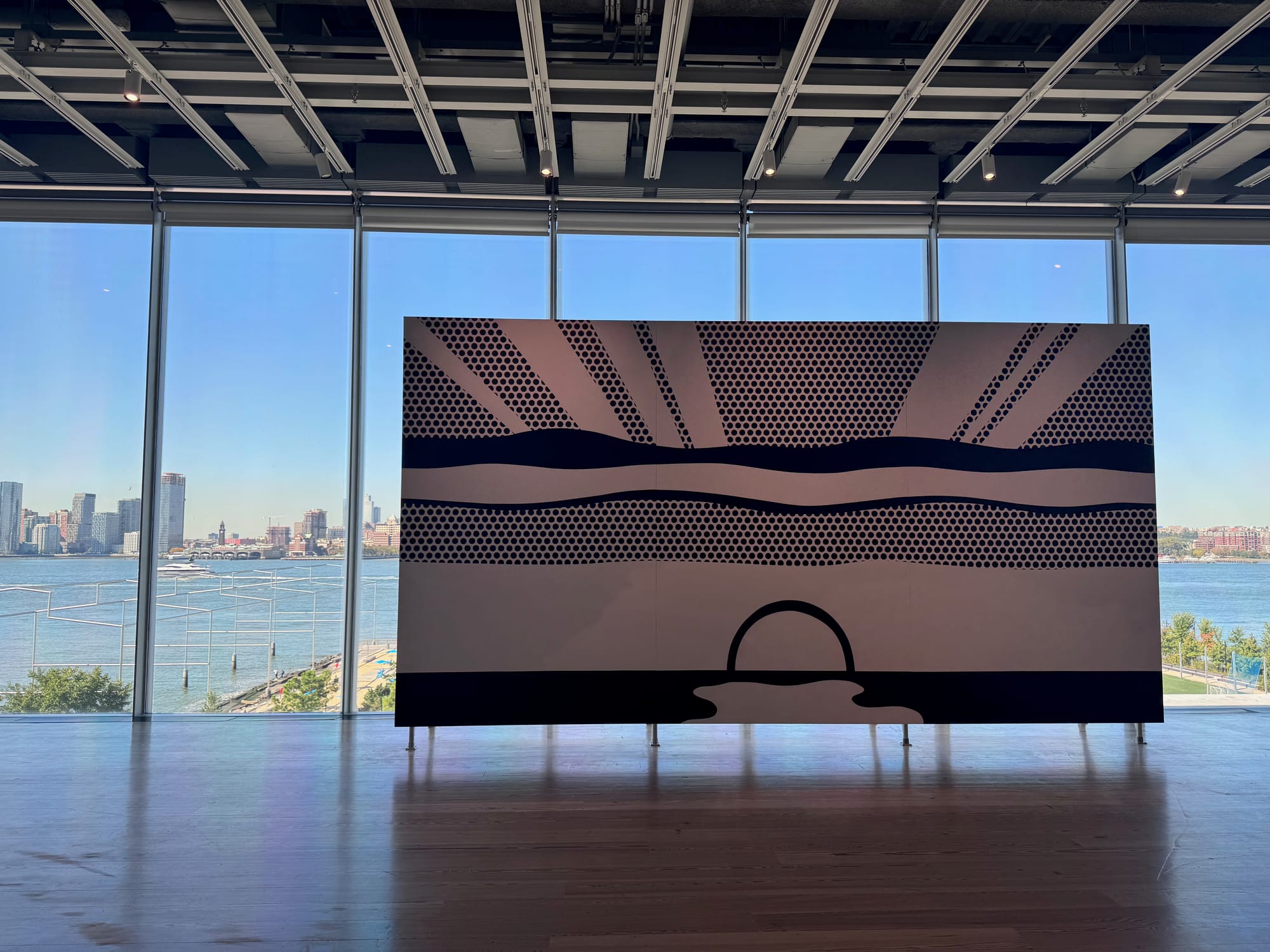
That copy reconstructs Lichtenstein’s first Pop exhibition, held at Leo Castelli Gallery in 1962. All eight works from that show hang together for the first time since then, Onli said, at heights the team worked out to match the original installation.
Works like Laughing Cat and The Kiss had not been shown in public in New York in decades.
“His work is famous, and it is in some ways now overlooked because of its ubiquity,” Da Corte said of the 1962 paintings. Seeing them together again, he said, “we get to read them and see them as clearly as Roy wanted them to be seen.”
Another room places finished paintings beside their sources, like Drowning Girl hanging with the “Secret Hearts” comic by Tony Abruzzo, along with original drawings by comic artist William Overgard. The room also includes material from art historian Erle Loran, whose work Lichtenstein used for his portrait of Madame Cézanne.
“He was working with many different sources, these aren’t one-to-one copies,” Onli said.
The show also includes artists who copied Lichtenstein while he was alive, among them Sturtevant, Richard Pettibone, William Anastasi and Dove Bradshaw. Onli said Lichtenstein took part.
“He provided stencils to Sturtevant to make more accurate paintings,” Onli said. “He signed the back of one of Pettibone’s paintings as if it was an authentic one. He went and actually produced and created and worked on a copy with Bill Anastasi and Dove Bradshaw.”
“This was an artist who, when we return and think about him today, he is really thinking about ideas of the death of authorship and questions of that, but also at the same time, he’s interested in the proliferation and circulation of images,” Onli said.
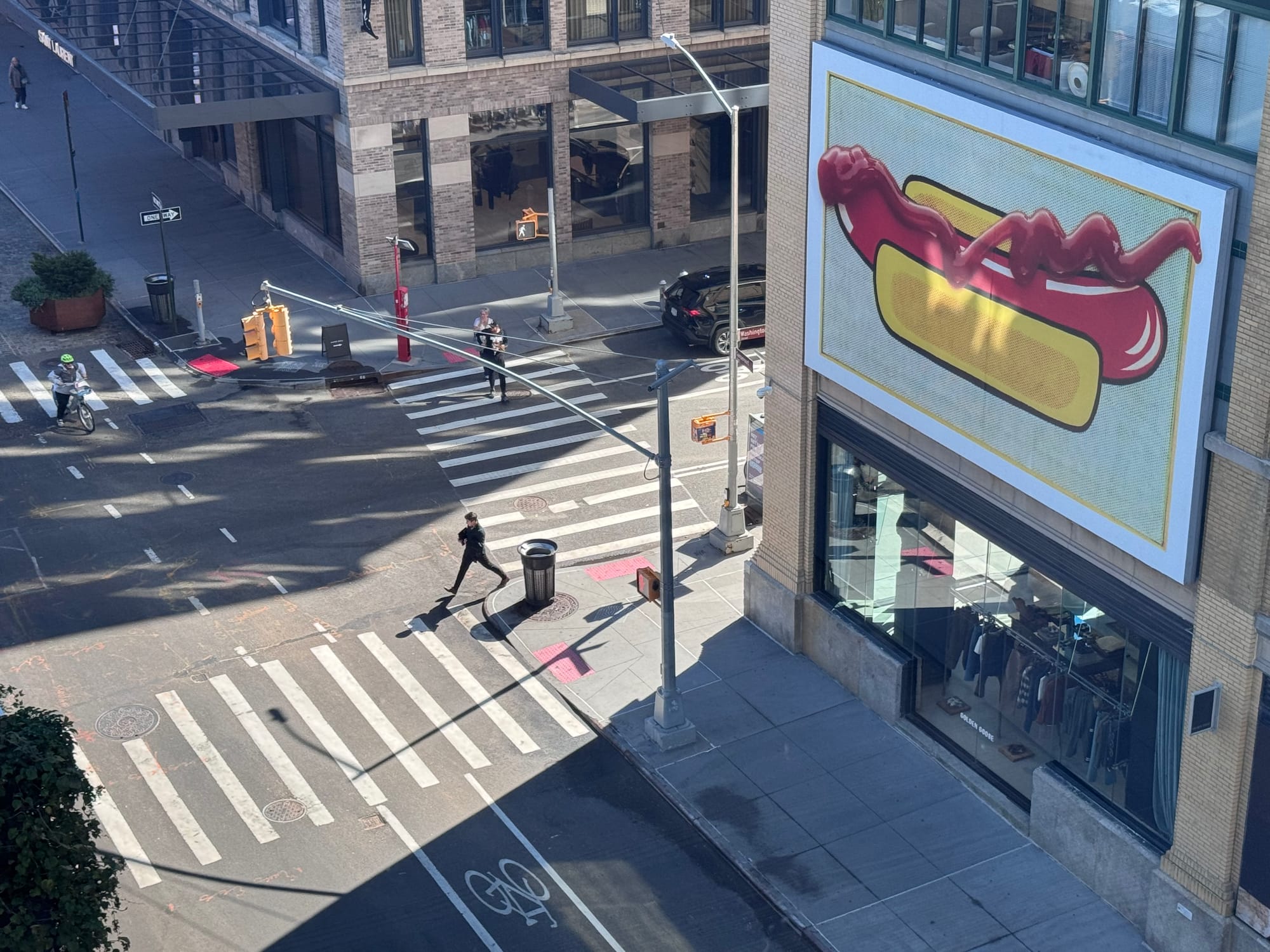
The curators also emphasized how much of the work was hand-made. The show opens with a re-creation of Greene Street Mural, which Lichtenstein painted in 1983 for Leo Castelli Gallery. It is one of four hand-painted murals in the exhibition, made by Whitney staff, Da Corte’s studio and the sign-painting company Colossal, Onli said.
“Give the people what they think they know about Roy right away, which is, it’s big, it’s bodied, it’s graphic, it’s instant, and then slow it down,” Da Corte said.
“When you think about Lichtenstein, you think about an effortless style, something that looks like it’s been machine made, and yet it’s emphatically handmade,” Onli said.
The retrospective is the last of three parts of a legacy project the Whitney began in 2018 with Dorothy Lichtenstein, the artist’s widow, Rothkopf said.
The museum received a gift of 400 works from the Roy Lichtenstein Foundation, now held as the Roy Lichtenstein Study Collection. It also received the couple’s former home and studio on Washington Street, which Rothkopf said now houses the museum’s Independent Study Program and an artist residency.
The show was planned for Lichtenstein’s 2023 centennial.
“The pandemic and other things intervened, and so we had to wait a few years,” Rothkopf said.
Rothkopf thanked a long list of funders, including corporate sponsors Delta, Gap, Gagosian and Northern Trust. Gagosian represents the Lichtenstein estate. The gallery staged its own Greene Street Mural exhibition in Chelsea in 2015 and held a show of his brushstroke paintings this spring.
“As you can imagine, when you go upstairs, there was not a lot of value engineering put into this show,” Rothkopf said.
Gap’s support comes with a product line. The Whitney announced Wednesday an 18-piece “Gap – Lichtenstein – Whitney” collection made with the Estate of Roy Lichtenstein, on sale starting that day at select Gap stores, Gap.com, the Whitney’s online shop and its museum store.
Prices run from $28 for a pair of socks based on Sock (1962) to $138 for a satin varsity jacket based on Standing Explosion (Black) (1965). A $118 sweater is based on Laughing Cat, one of the 1962 Castelli paintings in the show. Three styles are sold only at the Whitney.
“Thanks to Gap’s broad reach and global audience, the legacy of Lichtenstein will be exposed to millions of people in new and exciting ways,” Jack Sachs, the Whitney’s director of retail and licensing, said in the release. “At the core, we wanted to pose the question: what does Roy’s work mean to consumer culture today?”
A smaller companion show, “Roy Lichtenstein: 1997,” is already on view on the third floor through June 1, 2027. It collects studies, prints and models from the last year of the artist’s life, many unfinished, the museum said in a separate press release.
“Because many of the works on view remain unrealized or unfinished, they provide a rare glimpse into the artist’s hand at work,” said David Crane, the Whitney curatorial research associate who organized the show with curatorial assistant Nakai Falcón.
The same day, Crystal Bridges Museum of American Art in Bentonville, Arkansas, said it had acquired Lichtenstein’s “Brushstroke” from the Hirshhorn. It plans to install the sculpture on the lawn of the Heartland Whole Health Institute on its campus.
The sculpture is a giant stroke of white paint, 32 feet high and 20 feet wide, and weighs almost five tons, Crystal Bridges said in an emailed news release. It is dated 1996, and it was enlarged and fabricated in 2002 and 2003, after the artist’s death.
The release said the acquisition was “consistent with the collections policy established by founding donor Joseph H. Hirshhorn in 1966.” It did not say what Crystal Bridges paid.
Paid subscribers at the Insider level or higher can read Urgent Matter's brief thoughts on the show below.
Subscribe now and have access to all our stories, enjoy exclusive content and stay up to date with constant updates.