Indigo Arts Alliance artists pair their work with the Haggerty’s African collection
The four artists selected the museum objects that their own pieces will hang beside.

The four artists selected the museum objects that their own pieces will hang beside.
Four Black artists affiliated with Indigo Arts Alliance selected objects from the Haggerty Museum of Art’s African collection to be shown alongside their own work in “Thresholds,” an interdisciplinary exhibition opening August 28 at the Marquette University museum in Milwaukee.
The show runs through December 19 and features work by Aisha Tandiwe Bell, Stephen Hamilton, Portia Cobb and Daniel Minter, placing contemporary pieces in dialogue with the museum’s African holdings, according to an announcement.
Minter co-founded Indigo Arts Alliance, the Portland, Maine, arts incubator. Bell and Hamilton are alumni of its artist residency, and the announcement identifies Cobb as an Indigo community supporter.
Hamilton, who has five pieces in the exhibition, said the artists chose which collection objects would accompany their work, rather than the museum’s curators.
“It wasn’t as if the pieces were paired by the curation team,” Hamilton told Urgent Matter. “We were selecting the pieces that we wanted to include.”
He described the process as open access to the collection. “They gave us access to a selection of pieces that could be exhibited, and we chose from those,” he said, adding that the choices grew from “a group conversation about the work we were interested in and the conversation we wanted to have with the work.”
Hamilton said the artists approached the pairings differently. “Some artists are more creative in the way that they’re directly incorporating it in the pieces,” he said, “but then you also have artists that are showing the works alongside the pieces.”
Jordia Benjamin, executive director of Indigo Arts Alliance, said the organization acted as a partner on the show rather than its curator.
“We are not necessarily the curators of this exhibition,” Benjamin said. “Most of our exhibitions come from our alumni cohort. The museum is working independently with these artists and really pulling what materials they want.”
Benjamin said Indigo takes on different roles on different projects, sometimes holding the full curatorial lens and sometimes deferring to a partner.
“In this particular instance, the passenger’s role was wonderful,” she said. “And in other instances, we have been able to completely drive that vehicle forward and do everything from A to Z as far as the selections, the titles, the curatorial writing, the wall text, the programming.”
Benjamin said Minter sought the collaboration because Indigo could not run the show on its own at the time. “He entered it into an understanding that at that time, the organization wasn’t going to be able to fully drive,” she said, “and so was seeking a partnership that was able to do that work.”
Benjamin said the exhibition came together through relationship-building, crediting Minter’s connections and Henry Drewal, a member of Indigo’s advisory committee and a scholar of African studies who has been with the organization “from the very beginning.” An opening in the museum’s calendar let the collaboration proceed, she said.
The exhibition is one of three the Haggerty is opening at once under a museum-wide presentation titled “The Otherworld is Home,” according to the museum. The others are “African Art: Ancient Roots, Enduring Values,” a show of more than 40 works from the Haggerty’s collection curated by Drewal, and “Iké Udé: Sartorial Anarchy.”
Hamilton described the Drewal-curated collection show as linked to “Thresholds.” Drewal is an inaugural member of Indigo Arts Alliance’s Advisory Circle and the show’s contemporary works were selected by the artists in consultation with him.
Hamilton, who is based in Boston, works as a weaver, dyer and woodcarver, building large-scale mixed-media paintings that combine textile collage, hand-dyed fabric, hand-woven elements and figurative painting.
He said his pieces draw on “the underlying cosmologies and philosophies that are inherent in certain West and West Central African cultures,” referencing traditions including Yoruba religion and Congo religion and culture.
Asked about the announcement’s description of his work as reclaiming craft knowledge, Hamilton traced the term to his training in Nigeria, where he spent nine months between 2015 and 2016 learning traditional weaving, indigo dyeing and wood carving from local artisans. Learning those forms as an African American, he said, amounts to “a reclamation.”
Hamilton said he also thinks about how such skills were used under slavery. The crafts, he said, “were also exploited in the Americas during the transatlantic century — not always for the enrichment or betterment of enslaved people, but for those exploiting their labor.”
He said he has since incorporated the forms into his work and teaching practice, passing them on to others.
Hamilton said he is also a researcher whose work centers on West Central African textile traditions, and that he valued speaking with Drewal, a scholar of Yoruba art and religion, during the project.
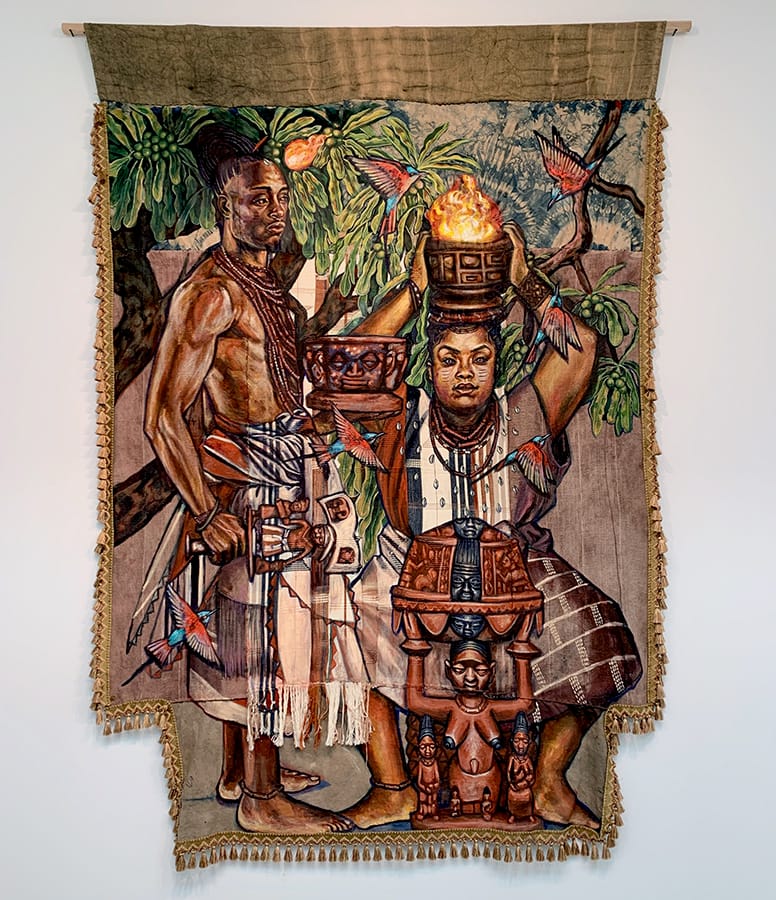
One of Hamilton’s works in the show is from a series of portraits called “Between the River and the Forest,” made between 2020 and 2022, depicting people from the Boston area.
Hamilton said the piece references Shango, the Yoruba deity of fire, thunder and lightning, and will hang next to a Yoruba house post from the Haggerty’s collection — an image of a priestess carrying ritual bags associated with Shango, originally made to help hold up the veranda of a household.
Hamilton said he made two new pieces for the exhibition, titled Night Bird and Birth of the Buzzard as the Black Sun Rises. He described the latter as a monumental work depicting vultures flying around a large black figure, with three smaller figures dancing around it that represent religious traditions from across West and West Central Africa.
That piece draws on Afro-American traditions of Hoodoo and conjure, which he views “not necessarily as an amalgamation of African religious traditions, but new religious traditions born from African religious traditions.”
The title references Dr. Buzzard, a root-doctor figure in the Afro-American tradition, and the vulture, which he called “a powerful bird across West and West Central Africa” associated with the passage between visible and invisible worlds.
"The dynamism that’s inherent in African traditions as something which is both ancient and new," Hamilton said. "Not something simply persisting unchanged over generations, but something that is constantly creating new thought, constantly creating new ideas, constantly adapting to different circumstances.”
Benjamin said community is the through-line connecting the four artists, pointing to Hamilton’s practice of bringing other artisans into the foraging, dyeing and weaving of his work, and to Bell’s ceramic faces made “in the likeness of community members.”
She said the theme “rounds back to Indigo, because our motto is supporting artists by transforming community.”
Benjamin said the work speaks to how many African Americans trace their roots to Africa. She recalled a line from Hamilton: “The enslaved came empty-handed, but not empty-headed.” She said Hamilton’s weaving works in the traditions of West Africa while incorporating “the materials of America.”
Benjamin described Bell as a multidisciplinary artist working in ceramics, performance, drawing and installation, and said Cobb, whose work she called documentarial in style, will show “some kind of film documentary.”
Cobb is also doing installation and video work, Hamilton said, and much of the exhibition will be sculpture. His own contribution will include fragments of costumes and feather headdresses alongside sculptural material.
Benjamin said Minter will bring woodworking tied to his Malaga Island series, linking Maine history to what she called a “national discussion of displaced communities, especially Black communities throughout the U.S.”
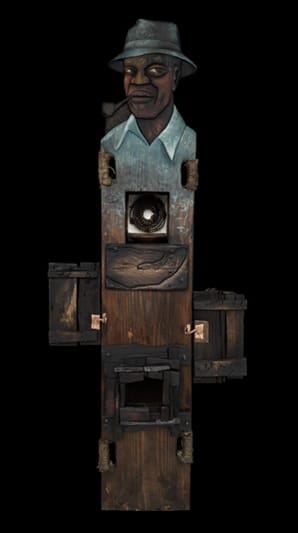
Minter’s Malaga Island work refers to the state of Maine’s forced removal in 1912 of a mixed-race fishing community — Black, white and Native American residents — from an island off the state’s southern coast, an episode he has spent more than a decade documenting.
She said Minter uses a recurring blue to signal water and air, incorporates agricultural materials such as okra, black-eyed peas and rice as offerings, and is initiated into Candomblé, the Afro-Brazilian spiritual tradition.
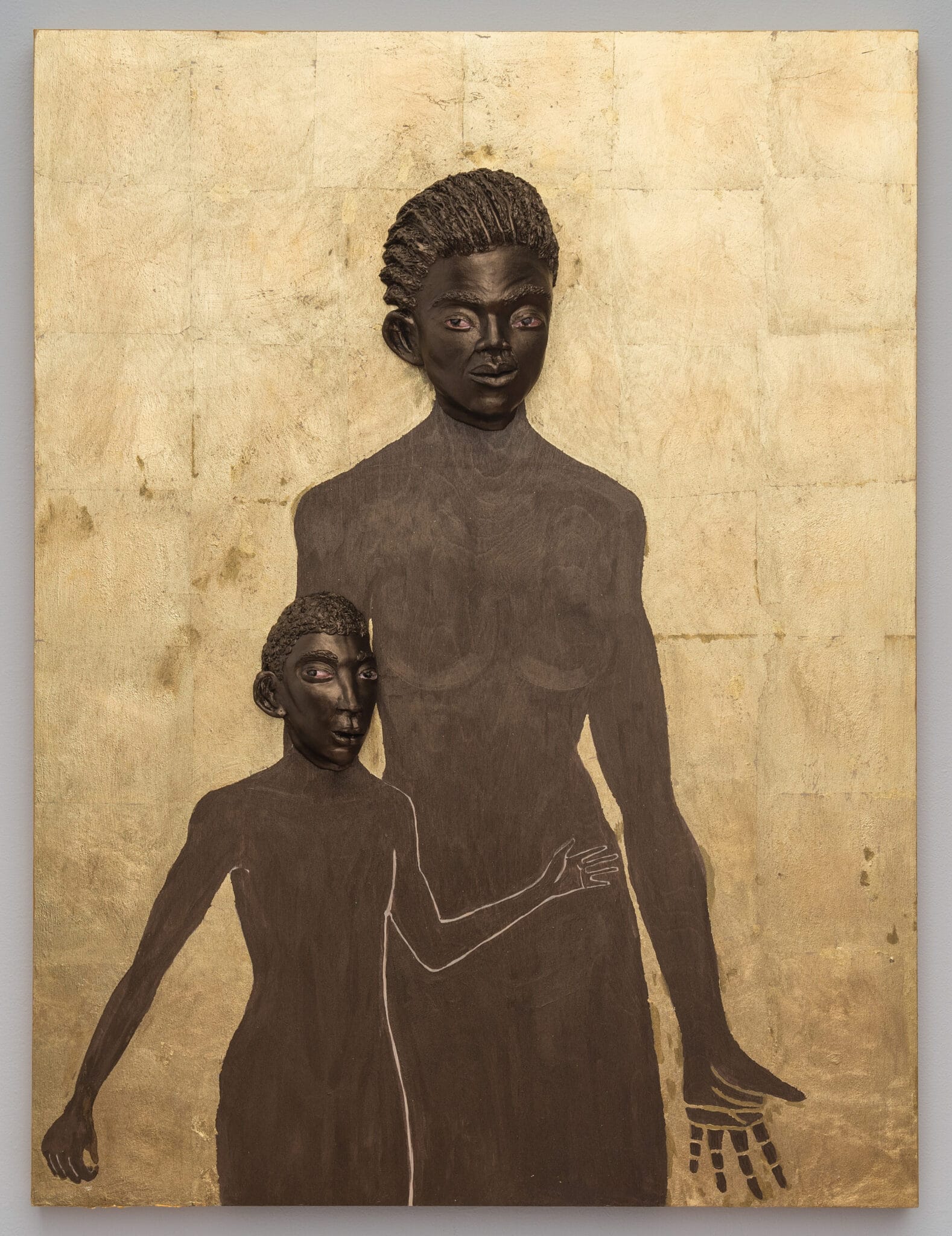
The featured image in the announcement is Bell’s Gold and Shadow, a 2020 work in acrylic, metal leaf, stoneware, cobalt oxide and glaze on wood, measuring 30 by 40 by 7 inches.
Benjamin said the exhibition does not reveal its Portland roots to viewers.
“The only person from Portland is Daniel,” she said, noting Hamilton is based in Boston and Bell in New York. She said each artist’s residency experience appears in the work in ways “not obvious to the eye, but only obvious to the artist,” calling it “kind of an artist’s secret.”
Benjamin said the museum funded the show. She framed the collaboration as an extension of Indigo’s residency model.
“We’re here to amplify artists, during and beyond their time with us,” she said.
Urgent Matter is reader-supported. Please consider subscribing to support independent arts journalism.