Artist to project Hudson Canyon onto Brooklyn Bridge to push for sanctuary status
Her two-night projection pairs art from a 1925 deep-sea expedition with new NOAA footage to rally public support for the canyon.

Her two-night projection pairs art from a 1925 deep-sea expedition with new NOAA footage to rally public support for the canyon.
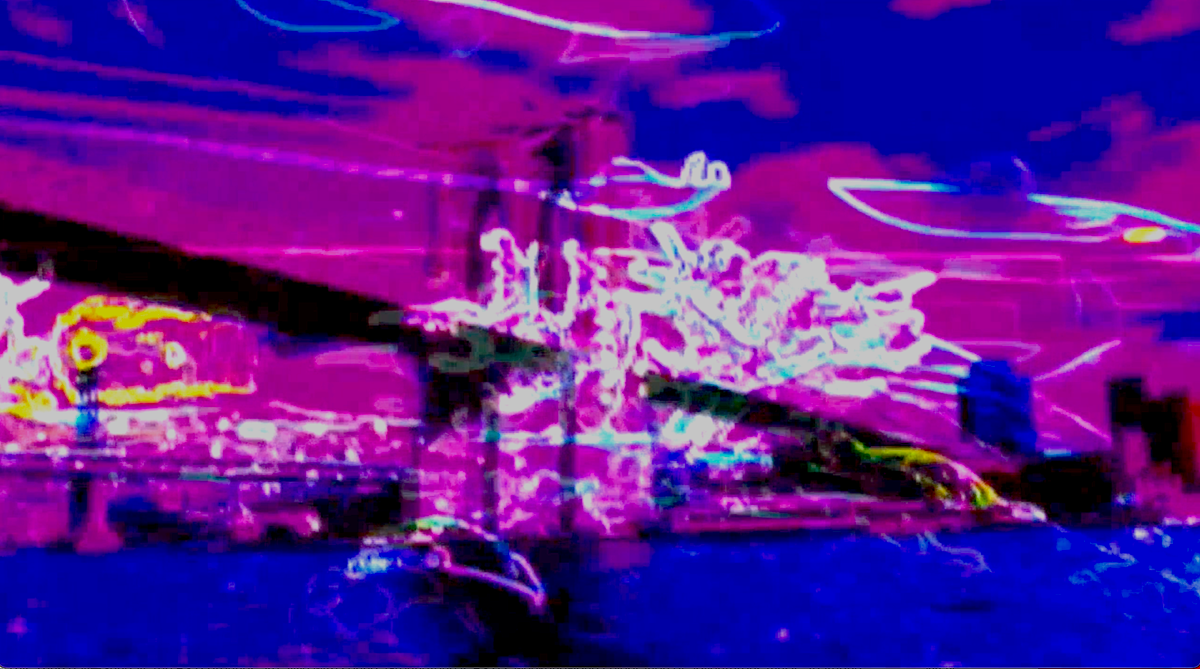
Anita Glesta will project an 18-minute artwork about the Hudson Canyon onto the Brooklyn Bridge on two nights this month as part of a push to win federal protection for the undersea canyon off the New York coast.
The projection, AQUA COSMOS: The Hudson Canyon, runs September 25 and 26 from 7 to 10 p.m. each night, viewable from Emily Warren Roebling Plaza in Brooklyn Bridge Park. It is free and open to the public.
Glesta made the work with the Wildlife Conservation Society and ArtW, a nonprofit promoting women in the arts, presented through the New York City Department of Transportation’s art program.
The canyon lies about 100 miles off New York City and is the largest submarine canyon on the Atlantic Coast, home to whales, sea turtles, sharks, tuna and cold-water corals.
On the day of the interview, Glesta was scheduled to go whale watching. She said the canyon is little known to people who live closest to it.
“Most people don’t know that 100 miles off New York City is one of the deepest ocean canyons,” she said. “Diverse species of whales and sharks and even corals.”
The canyon does not currently have national marine sanctuary status. WCS nominated it for consideration as a national marine sanctuary in 2016, and the National Oceanic and Atmospheric Administration leads the designation process, which would create the first marine sanctuary off New York and New Jersey.
“It does not yet have sanctuary status,” Glesta said. She said the goal she shares with WCS is preservation. “What the Wildlife Conservation Society would like to do is bring attention to this to preserve what is so special about this area,” she said.
Glesta said she pitched the projection as a way to reach people who might never read a report about the canyon. “You can’t write this, but we can find another language,” she said.
She said she wanted viewers “to understand the political ramifications of being a city right on a very threatened seashore.” She described her method as drawing people in before the argument arrives. “I make beautiful work to seduce in order to be subversive,” she said.
In a statement issued with the announcement, Glesta tied the work to her own history. “I’ve spent much of my life exploring what lies beneath the surface — of memory, of the body, of the landscapes we live in,” she said. “When I learned that an extraordinary marine ecosystem exists just beyond New York City, it felt like another one of those revelations.”
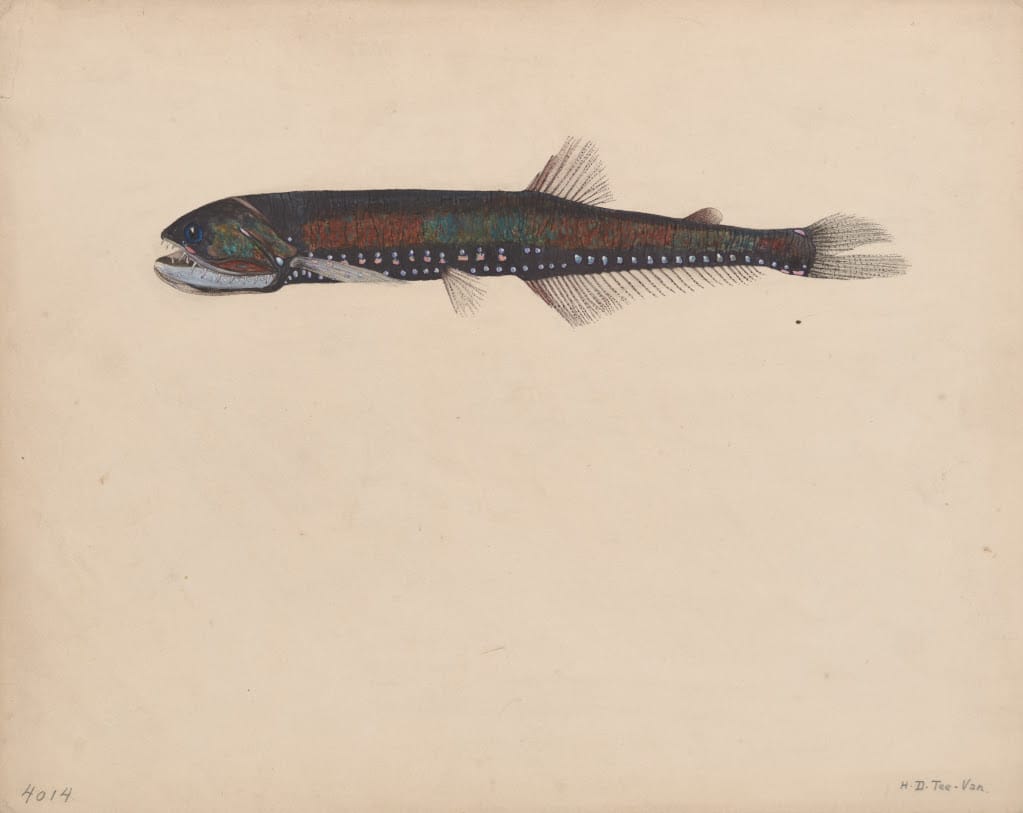
The work is built on the society’s 1925 Arcturus Expedition, an early survey of the canyon led by naturalist William Beebe. The expedition included six professional women, including the science artists Isabel Cooper and Helen Damrosch Tee Van. Because early photography could not capture the deep sea, the artists created illustrations.
Glesta paired the drawings and historical footage with NOAA footage shot in September 2025 by remotely operated vehicles. The result blends the archival art with expedition journals, animation, painting and sound.
The women on board came up repeatedly in the interview. “Another layer that’s interesting to me was that there were women on this vessel,” Glesta said. “Nobody thinks about it.”
She said the women’s drawings were crucial to documenting the fish the expedition encountered, yet the artists were not regarded as important.
Glesta said Beebe’s own journals still speak to current science. She said the naturalist attributed the fish’s shifting colors to “the moods of the fish,” an observation she called “amazingly prescient.”
“Besides the nature of things, there was emotion,” she said of the expedition’s record. “And I find that.”
Glesta played the full film at her Red Hook studio during our interview, and I watched it with my 2-year-old son, Jack. He pointed at the screen as the animals surfaced — “Water,” “Sharks,” and “Blub, blub” for a fish— and named the colors as they moved.
It got me a little emotional. When the century-old archival footage and the new deep-sea footage ran side by side, I felt a bit of goosebumps.
“Educational, but also pretty,” I told Glesta. I couldn’t decide what it belonged in more — an art museum or a science museum.
Glesta’s wider practice, from the research behind her work to how she approaches political art, is the subject of a companion profile in Urgent Matter’s upcoming October print edition.
Urgent Matter is reader-supported. Please consider subscribing to support independent arts journalism.