The Price of Prehistory: Billionaire collectors put science, museums and public access at risk
A paleontologist says the anonymous buyer of Jodi, the Nanotyrannus Sotheby’s sold October 27, should loan it to a museum.

A paleontologist says the anonymous buyer of Jodi, the Nanotyrannus Sotheby’s sold October 27, should loan it to a museum.
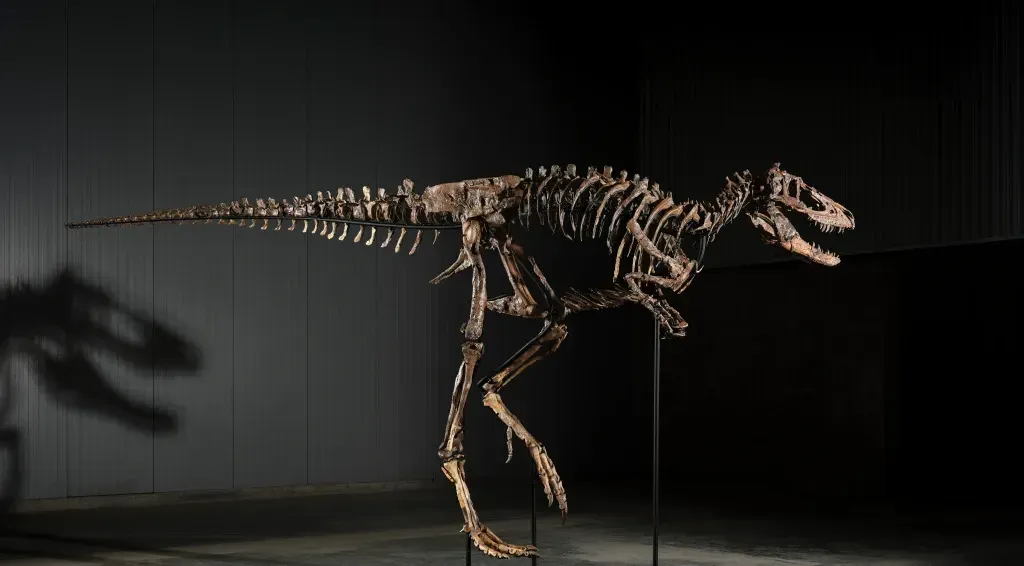
Just when you thought the inequality gap couldn’t get any wider, the billionaires are coming for your childhood — the dinosaurs. Sotheby’s just sold Jodi, one of only three known Nanotyrannus specimens in the world, to an anonymous buyer for $47.3 million.
Although smaller than its relative Tyrannosaurus rex, Nanotyrannus was a formidable carnivore, measuring 18 feet long and weighing 1,500 pounds. A 2025 study has shown Nanotyrannus to be a valid genus, but Jodi remains unstudied and is one of the most complete Nanotyrannus specimens.
If researched, Jodi would provide additional scientific information about this American tyrannosaur that deserves to be shared with the public.
Well, we could have obtained this precious scientific information if Jodi had not been sold to the highest bidder on October 27.
Instead of being excited to see where this American tyrannosaur will be enjoyed by the public and studied by scientists, we must now hold our breath to see whether the anonymous buyer will graciously donate this specimen to a museum or keep it in the foyer of their mansion.
For now, it seems Jodi will share a fate similar to Gus the T. rex, another American tyrannosaur sold by Sotheby’s to an anonymous buyer for $50.1 million that remains in the buyer’s private collection.
This hits particularly hard after Drexel University closed the Philadelphia Academy of Natural Sciences, America’s oldest natural history museum, to the public on September 30. The public lost one of America’s premier museums to learn from and be inspired by, and scientists will likely lose the collections their research and the future of science depend on.
For the $47.3 million this anonymous buyer paid Sotheby’s to decorate their mansion with a dinosaur, they could have kept the Academy of Natural Sciences open to the public for at least twenty more years. Most natural history museums in America were built on donations from Gilded Age philanthropists.
Where are today’s billionaire philanthropists? Why are they buying dinosaurs as decorations when they could be saving entire museums?
It doesn’t have to be this way. In 2024, billionaire Kenneth Griffin bought Apex — the largest stegosaurus ever found — for $44.6 million from Sotheby’s. Unlike other billionaire buyers, Griffin did the right thing by loaning the dinosaur to the American Museum of Natural History for a four-year term and even funded a postdoctoral program to conduct important research on this specimen.
Is it ideal that Apex is currently only on a temporary loan? No, but at least this gives the public a chance to see it and scientists a chance to complete important research. Who knows, maybe he’ll extend the loan. Hopefully the billionaire who purchased Jodi follows Griffin’s lead and donates or loans the fossil to a museum.
In the weeks leading up to Jodi's auction, Sotheby’s Vice Chairman Cassandra Hatton and associated commercial collectors posted several videos that tried to pull on the public's heartstrings while preparing to sell this Nanotyrannus purely for profit.
They made many egregiously false claims, treating their selling of dinosaurs to billionaires as though they were saving shelter puppies. They claim they are “saving the dinosaurs from re-extinction by saving them from erosion,” implying they had no choice but to sell these tyrannosaur bones to the highest bidder before they evaporate.
As a paleontologist, I can tell you that large dinosaur bones take years, sometimes hundreds of years, to erode away. Sotheby’s also claims commercial collectors only care about “getting the dinosaurs to a good home,” yet that “home” is a random billionaire’s instead of a museum equipped to house fossils, conduct research, and share them with the public.
If they really care about the scientific and cultural significance of these fossils, as they claim in their videos, Sotheby’s could easily require buyers to partner with museums to provide fossil loans and research funding. But their social media content makes it clear that they don’t, and that they’d rather use cheap emotional ploys to distract the public while they actively destroy science–and thus our future.
The reality is many billionaires have chosen to continue destroying our planet and futures in every way possible, and their bootlickers like Sotheby’s help them do so for a small commission. To them, these treasures of Earth, the institutions that house them, the communities that need them, and the planet they support are all expendable.
There is something deeply troubling and dystopian about watching a priceless fossil sell for $47.3 million while a natural history museum closes its doors in a country that should be leading the world in scientific discovery.
And what is happening with Sotheby’s in New York and the museum in Philadelphia should concern far more people than just those who grew up looking at dinosaurs. It should concern anyone who believes science, education, and access to our natural history are worth protecting.
What makes this moment even more difficult to reconcile is what is happening elsewhere in the world. In July 2026, Shenzhen, China, opened a new natural history museum spanning more than 105,000 square meters, featuring eight permanent exhibition halls dedicated to everything from dinosaurs and evolution to ecology and the universe.
While other countries invest in new spaces for scientific discovery and public education, we watch science slowly die in ours because of record-breaking federal funding cuts, university censorship, the closing of natural history museums, and the greed of private collectors who see dinosaurs as personal playthings.
This is not about suggesting one country cares more about science than another. It is about recognizing the priorities we set. Natural history museums and the dinosaur fossils that belong inside them are not luxuries. They are essential educational, scientific and cultural infrastructure.
If we want future generations to understand the natural world, appreciate biodiversity, pursue careers in science, and create a sustainable world for everyone, we have to give them places where those interests can take root.
As someone who has dedicated my life to paleontology, evolutionary and conservation biology, science communication, and making the prehistoric world accessible beyond traditional academic spaces, the loss of Jodi and the closure of these museums go hand in hand.
Dinosaurs and museums are not just relics of the past meant to be enjoyed only by elites — they are where curiosity begins. When a child sees a dinosaur skeleton or other priceless Earth treasure for the first time, they realize that science and this world are something they are part of.
The museums that house these treasures are where families, students, researchers, and communities can connect with each other and our planet in a way that no textbook, documentary, or social media post can replicate.
As an independent researcher and science communicator, I have built my own platform to make paleontology more accessible and encourage people to engage with science in ways that feel approachable, exciting, and inclusive.
I am fortunate to have a direct relationship with my audience and the freedom to speak openly about the issues affecting the scientific community. I believe that comes with a responsibility to use my voice when institutions and resources that matter to our collective understanding of the natural world are at risk.
Ultimately, this is bigger than dinosaurs or natural history museums. It is about the kind of relationship we want future generations to have with science and our planet.
We cannot expect children to grow up curious about the natural world if we keep taking away the places and specimens that let them experience it. We cannot claim to value scientific discovery while letting the institutions that make it accessible disappear and selling dinosaurs to billionaires who treat them like decorations.
Dinosaur fossils and museums preserve the past, but their greatest value may be what they make possible for the future. We should be building more opportunities for people to experience wonder and connection, not fewer. And we should be asking ourselves what kind of scientific and cultural legacy we are leaving behind if the next generation has fewer places to discover it.
Now more than ever, it’s clear we must decide: do we want to let a handful of wealthy people decide our destiny according to their frivolous whims, or will we come together and forge a new, sustainable one that’s better for all of us?
I say we choose the latter. They’re taking everything from us, even the dinosaurs—so what have we got to lose?
Urgent Matter is reader-supported. Please consider subscribing to support independent arts journalism.