Dino Mommy, a self-funded paleontologist, fights to reopen Philadelphia museum
Reysuka, who pays for her science with OnlyFans income, has used the museum's specimens for her own research.

Reysuka, who pays for her science with OnlyFans income, has used the museum's specimens for her own research.
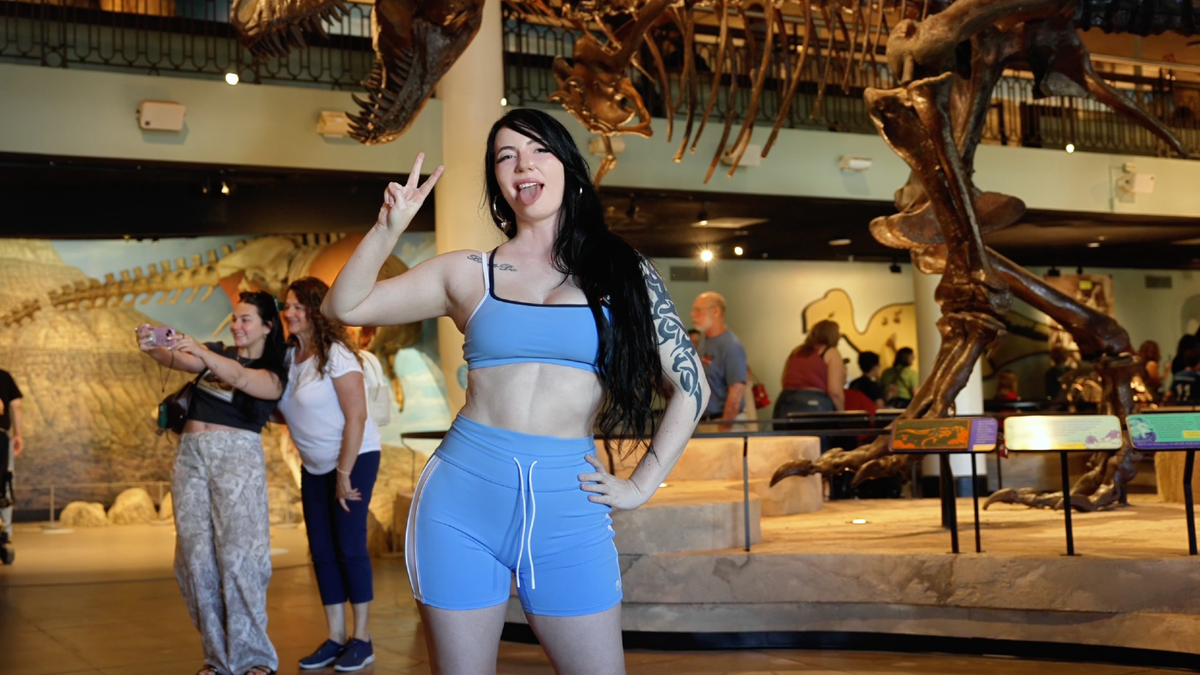
When the paleontologist known online as Dino Mommy toured the Academy of Natural Sciences of Drexel University in September, its dinosaur hall was packed with families who had come to see it before it closed.
“I saw so many little girls running around the museum with princess dresses on and looking up at the dinosaurs and having fun,” she told Urgent Matter. “It made me remember that that’s really why I became a paleontologist is that inspiration from being a kid and coming to museums like this.”
Dino Mommy, also known as Reysuka, flew to Philadelphia with a cameraman to film the exhibits, livestream a tour of the dinosaur hall, and press Drexel to keep the museum open.
Urgent Matter confirmed Dino Mommy’s legal name and verified her academic credentials, including her doctorate and her record of peer-reviewed research, but is not publishing her name or other identifying details to preserve her anonymity.
The Academy was founded in 1812 and opened to the public in 1828. Drexel announced the closure on September 1. The museum closed to the public on September 27.
Drexel and Academy leadership have said they will preserve the institution’s research operation and its collections, which hold more than 19 million specimens. The William Penn Foundation has publicly offered bridge funding to keep the museum open for at least a year.
Drexel said on September 30 that it had not received a formal proposal with a defined level of financial support and that it welcomed further discussions. The Inquirer reported on October 2 that Drexel and the Academy were discussing their future relationship, with disaffiliation one possible outcome.
“I made the trip because I was shocked to see it was closing. I wanted to use my platform to raise awareness, hopefully stop the closure, and document what I could on video in case it closed forever,” she said.
She spent one day at the museum. The halls were crowded with children, and volunteers handed out petitions to save it, she said.
Because her cameraman carried a large camera, several people approached her and asked her to “please use this to save the museum,” she said.
“The general attitude was shock and sadness that this was being taken away from them, knowing it was a huge blow to their futures,” she said.
The trip produced short-form videos, the livestream and a long-form YouTube video posted September 29.
This article is provided free with the support of paying subscribers. Not ready for a paid subscription? Sign up for a free account today.
No spam. Unsubscribe anytime.
She calls the museum’s habitat dioramas “irreplaceable national treasures” in the video, because they were built in the early 1900s, “when we didn’t have photographs or nature documentaries in order to show people what animals lived around the world.”
The video opens with an update recorded after her visit. She said Drexel “wants the museum to shut down because all they care about is profit and the money they’re going to be paid for the museum to be mowed down and turned into condos.” Urgent Matter has not verified that claim.
David Cohen, a former U.S. ambassador to Canada whom Gov. Josh Shapiro asked to help with the Academy, told 6abc that the museum “could return later” in a smaller form but that it would vacate its Parkway site, Billy Penn reported.
Dino Mommy has studied the Academy’s collections herself. During a federally funded postdoctoral fellowship at another large museum, she found that it lacked what scientists call developmental series, she said.
“Basically, that’s a series of specimens from fetus to adult,” she said. “I needed to look at that because it’s the only way we know how animals develop and how their bones fuse, which has implications for dinosaur and evolutionary biology research, my focus.”
Part of that work tied genes in birds to the order in which their bones form. She said the research bears on human medicine “because any gene we can connect in an animal can be looked at in a human.”
“I was surprised to see that the Academy of Natural Sciences Museum is one of the only museums in the world that has a lot of these developmental series, and they’re not really replaceable, because a lot of birds are endangered now,” she said.
She said she does not know what Drexel plans to do with the collections.
“Worst case scenario, they dump a lot of it. I think it’s more likely that they’re going to sell it off,” she said.
A sale would technically save the specimens, she said, but “scientists and the public don’t have access to it,” and “we can’t get anything out of them anymore at that point.”
If the Academy keeps everything, research would still stop while staff packs specimens into climate-controlled boxes, moves them, unpacks them and reorganizes them, she said.
“When museums have closed before and claimed that researchers were going to be able to work on the collections, like in the case of Brown University’s Natural History Museum, I mean, those specimens were just thrown out in the river,” she said.
Brown’s Jenks Museum of Natural History closed in the early 1900s. In 1945, the university hauled 92 truckloads of its collection to a campus dump on the banks of the Seekonk River, and about 600 objects survived, Brown has reported.
She said the closure “sets a dangerous precedent for other natural history museums to close” and that losing them would cut off scientific training.
“Students need to work on actual specimens to get trained,” she said. “And universities usually don’t have specimens unless they’re connected to a museum.”
Dinosaur skeletons have sold for millions at auction in recent years, and Urgent Matter asked whether anything in the Academy’s holdings could pay to keep the doors open.
“I’m sure they have something that’s worth, like, a million dollars, which would probably keep the museum open at least another year,” she said.
But she said the university did not try to raise money before announcing the closure.
“They had every opportunity to get funding. They could have informed the public, donors, city council, or other officials, but they didn’t,” she said. “They just announced a month ahead, like, ‘oh, we’re closing.’”
“They even got an offer from the William Penn Foundation for bridge funding to keep the museum open another year while they figure out what to do with it, and Drexel still hasn’t accepted that,” she said. “To me, it just seems like that wasn’t their interest.”
She said she has watched other museums shrink their science staff from the inside.
“They’ve let scientists retire without rehiring, specimens are neglected, funding is shrinking, and scientists are replaced with bureaucratic jobs held by people from wealthy families,” she said.
Museum staff are told those hires will bring in donors, more money and more science jobs, she said.
“But that never really happens, and we keep losing science positions,” she said. “Museums are slowly becoming showcases.”
“People should keep putting pressure on Drexel University because public pressure is working,” she said.
Dino Mommy’s parents both worked at the American Museum of Natural History in New York, where her father was a curator.
When she was little, he brought her to work most days, she said. She spent her time in the museum’s “back catacombs,” where she was “the only kid there,” “playing with the dead animals and stuff.”
She said her parents were the first in their families to attend college.
“It was weird because I grew up with one foot in poverty at home and one foot in the museum where they worked, seeing this elite realm that was foreign to me outside of that,” she said.
In college, she majored in visual art and anthropology “because I was interested in human medicine and anatomy and art and a bunch of things.”
In her final year, she went to an anthropology field school and worked on thousands of animal bones from archaeological sites.
“I realized with my visual arts skills I’m really good at identifying bones and new species,” she said.
She later earned a master’s degree in ecology, evolution and conservation biology and a doctorate in paleontology, her website says. Her graduate work focused on how Mesozoic dinosaurs such as Velociraptor and Tyrannosaurus rex evolved into living birds.
“After that, it was kind of like that was the rest of my life’s work because it’s going to take my whole life to answer that question,” she said. “I don’t even know if I’ll be able to, but that’s why I go around the world to museums and in the field to look for these missing link fossils.”
Her website says she has searched for dinosaurs in remote parts of Antarctic South America, China, Denmark and the western United States.
Her Google Scholar profile shows more than 400 citations of her work, most since 2021. She is the lead author of five papers identified by Urgent Matter. Her most recent work was published in 2025. Her co-authors include curators at the American Museum of Natural History, the Smithsonian and the Carnegie Museum of Natural History, as well as researchers from Harvard to Cambridge.
Dino Mommy pays for her own research.
“I’m the only person I know who does it,” she said. “I got lucky because of my work with social media. I fund everything myself, from my lifestyle to lab and research expenses and field trips to find dinosaurs.”
“That’s been empowering because I don’t have to be censored in what I advocate,” she said. “I don’t have to worry about losing my job at a university like Drexel. I can advocate for the museum because I’m not beholden to an institution or donor.”
She started posting in 2021 as she finished her doctorate, she said.
“Then I started talking about dinosaurs while wearing a costume, and that’s where my numbers really took off,” she said.
One post went viral. She kept posting to see if it was a fluke and quickly reached about 100,000 followers across platforms, she said.
Her website bills her as a “Paleontologist, Influencer and Artist” who mixes paleontology with cosplay, comedy and skits.
Her links page lists a VIP page, a free page and OFTV, the video platform run by OnlyFans, under the heading “Exclusive Content: support dinosaur research!”
“It was a scary decision because I worried I wouldn’t be taken seriously,” she said of joining OnlyFans.
She made the choice as research funding and jobs dried up and “museums were running on skeleton crews,” she said. She knew the platform would pay “more money than I ever could as a scientist.”
It also let her “be myself fully and not be ashamed of sexuality,” she said.
“You would think it wouldn’t be a big deal to evolutionary biologists and paleontologists because they study sex and evolution, but it’s like any other workplace. There’s a lot of misogyny,” she said. “Sex is shamed sometimes even more there than other places because of this elitist environment.”
Social media is “a crazy grind,” she said, but it has given her more time for research. She does not teach or handle the bureaucratic work that comes with university or museum jobs.
“I’ve been able to publish more than many colleagues my age,” she said. “It’s funny because many of my citation indices are the same or greater than theirs, just because I don’t have to do all these extra things.”
For access to collections, she usually emails people she knows because the field is “a super small circle,” and they let her study specimens for a few days.
In that small circle, some people have figured out who she is, she said. Some paleontologists she told directly have been open to working with her.
“They see, okay, you’re getting more numbers than the museum’s social media, like, you’re gonna pay for some of our digs or something,” she said.
“I’m excited to give back,” she said.
Others who connected her persona to her name “weren’t happy about it,” she said. Most were museum staff who believed “we can’t have people be sexy and be a paleontologist.”
“There are definitely people who want to bring me down, which I think is sad because I’m really on their side, if anything,” she said.
She said she doesn’t know anyone else who has finished a doctorate and also runs an OnlyFans page, though she knows women who left graduate school for it.
“That’s what’s unique about me, is I actually can still do the science and be in that world and do the OF kind of side,” she said.
She kept a museum job alongside her online work until she realized she could make a living from her platform, she said. Holding “a 9-to-5 museum job” while posting became too much.
“I plan to come out with my real name soon because I want to talk about my actual research,” she said. “I think it’s important to show I really am a scientist. A lot of people think I’m lying about that.”
Urgent Matter is reader-supported. Please consider subscribing to support independent arts journalism.