Emmalea Russo skewers the art world in surreal sequel 'The Moon Papers'
The Bellmer-Furio family saga continues as a cult-like collective attempts to launch an artificial moon, skewering the narcissism, market logic and absurdities of the art world.

The Bellmer-Furio family saga continues as a cult-like collective attempts to launch an artificial moon, skewering the narcissism, market logic and absurdities of the art world.
A couple of years ago, poet Emmalea Russo had her fourth poetry collection canceled by its publisher because of her affiliations with entities like Compact, a magazine linked to the post-liberal milieu blending traditional conservative social values with class-focused populism.
That experience appeared to directly inform Russo’s 2024 experimental novel Vivienne, a dark and often deliberately abrasive satire of cancel culture, artspeak and social performance in the contemporary art world.
Reviewing the novel for Artnet at the time, I described it as a book whose “quips at the expense of today’s art market are laugh-out-loud funny for clued-in insiders.” I also noted that its fragmented structure and dense poetic sensibilities often made it inaccessible to broader audiences.
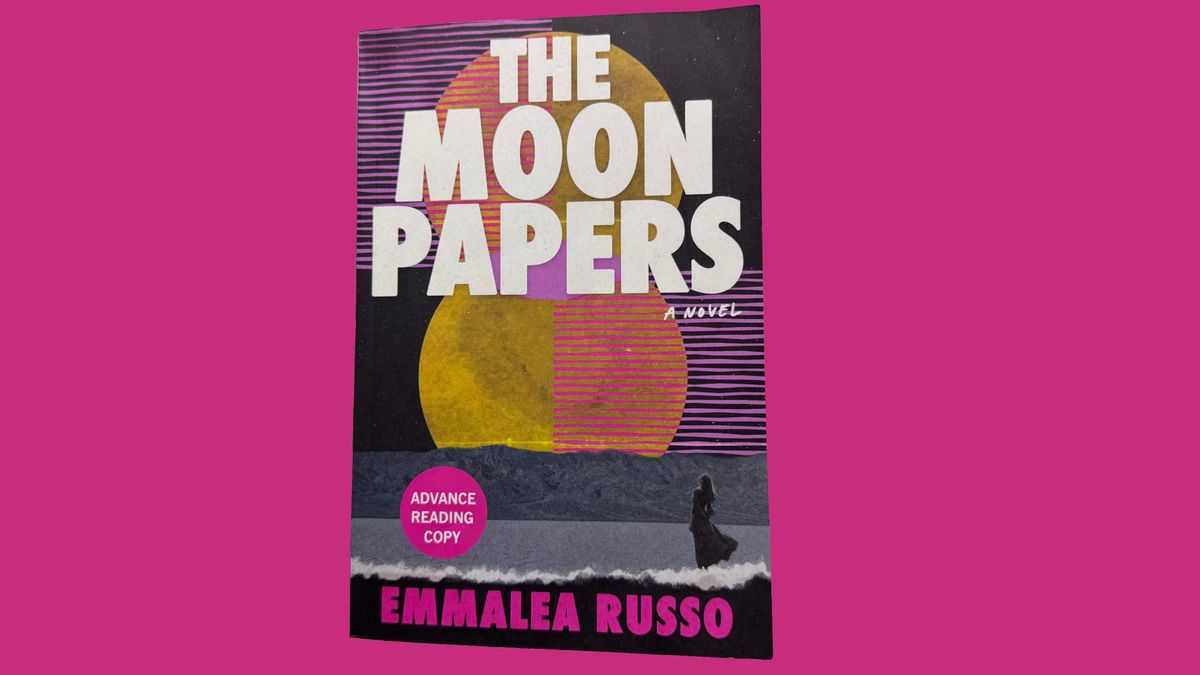
Now Russo returns to that fictional universe with The Moon Papers, a sequel that retains Vivienne's surrealism and acid humor while being a much smoother, more confident novel.
Russo seems more comfortable working in long-form fiction, dialing back some of the opaquer experimental elements of her previous book without abandoning the unnerving atmosphere that made it memorable. Still, I could have done without the chapters from disembodied “Voices” that seem to jump out of chronological time and require close attention to determine who is speaking.
In Vivienne, Russo follows the Bellmer-Furio family over the course of a week as the aging Vivienne — the fictional former lover of the real-life surrealist artist Hans Bellmer — faces mounting criticism ahead of a major museum retrospective after allegations emerge that she played a role in the suicide of another Bellmer-associated muse decades earlier.
As scrutiny grows, the planned museum exhibition is canceled. Into the chaos steps Lars Arden, an aging and unsettling gallerist who attempts to capitalize on the scandal by mounting a solo exhibition of Vivienne’s work himself.
Living alongside her younger boyfriend, daughter Velour Bellmer and granddaughter Vesta Furio, Vivienne becomes embroiled in the fallout surrounding the canceled retrospective as Lars attempts to use the controversy to promote her work.
SPOILERS: Both novels partly operate as mystery narratives, so readers sensitive to spoilers should proceed with caution.
The novel culminates when a brick crashes through Lars’ gallery window and leaves Vivienne braindead in what may have been a staged publicity stunt. Neither Vivienne nor The Moon Papers definitively resolves this question. Years later, Vivienne is transferred to the cult-like Center for Constant Creation, while Vesta eventually marries Lars.
The sequel picks up roughly a decade later. Vivienne is dead. Velour, an aging artist living in rural Pennsylvania, spends much of the novel dealing with accumulated furniture and objects in the family home while also managing a bat infestation in her attic.
Velour’s daughter Vesta—now, too, an artist—remains married to Lars, the gallerist from Vivienne, who now exclusively shows work connected to the Bellmer-Furio family. Vesta is also having an affair with Dean Koenig, a member of the mysterious CCC, the cult-like art collective where braindead Vivienne was entrusted in her final days by Velour.
In the second novel, the collective is attempting to launch an artificial moon, dubbed Moon 2, into low-Earth orbit from California’s Mojave Desert, which becomes the novel’s central focus. Russo uses the collective to mock the kind of inflated rhetoric and self-importance often surrounding contemporary art spaces, where conceptual projects are discussed as if they might fundamentally reshape society.
Lars transforms from a vulturous gallerist seeking to capitalize on scandal to one of the novel’s unexpectedly sympathetic figures. While press materials characterized him as spiraling into a rabbit hole of conspiracy theories, he seems to be one of the few characters willing to voice open suspicion of the collective. He even lets his reputation deteriorate in his pursuit of the truth—one of the sequel’s clearest callbacks to the cancel culture theme that dominated Vivienne.
The dealer agonizes over Moon 2 and the disappearance of an artist named Binky, believed to have taken part in an open-secret breeding program run by the collective. Even then, he callously says, “The price of her work has soared since her disappearance (read: abduction).”
Russo preserves the ambiguity of Lars as both parasite and genuine champion of the Bellmer-Furio women’s art careers. He remains controlling and manipulative, yet he is one of the few consistently pushing the artists around him to produce work.
“I thought you could encourage her. This is our livelihood,” Lars tells Velour in one scene in which the family holds a business meeting ahead of the planned group show.
“Produce, Daughter. Produce. Create,” Velour tells Vesta.
Surveillance also becomes an increasingly important motif throughout the novel. Vesta secretly maintains a second studio where she paints screenshots of Dean during their long-distance video calls, with revealing images from the CCC compound appearing in the backgrounds of the works.
Lars eventually discovers the hidden paintings through security-camera footage from his own home, and the works later circulate publicly through the family’s exhibition — seemingly drawing the attention of the collective itself.
Throughout the novel, Russo targets how arts organizations and cultural institutions aestheticize or bureaucratically repackage morally disturbing behavior. A shadowy pharmaceutical corporation called Voortelle appears to potentially have connections to the CCC collective, raising questions about patronage, secrecy and corporate influence within artistic production.
“I don’t care how famous CCC is. How does a lil art group have the money or technical skills to pull this shit off?” one online commenter asks within the novel.
At another point in the book, collective members discuss what is essentially a grotesque artist breeding program involving comatose surrogate mothers.
“Let’s not call it the Comatose Birther Program. That name is bleak. It’s the Artist in Residence program,” one member says. “Binky is our only Artist in Residence. And Binky is our final Artist in Residence.”
Some of the best criticism of the art world comes from exchanges within the art collective, who seem to view their little Moon 2 project as one of the most important endeavors in human history—“a different era entirely,” as one character describes.
At one point, members of the collective brainstorm names for a spacecraft meant to position the artificial moon in orbit.
“Yes, what about Demy? Tugboat Demy. Short for Demeter, sticking with the Greek theme. It’s light, Gender neutral, friendly,” one member named Marla suggests, followed by “[Laughter all around.]”
Elsewhere, another collective member attempts to explain the group’s public messaging strategy: “The last press release …. We used artistic terminology mixed with space-age lingo,” Jules says. “Moon 2 is bringing something new to the table, to the sky. The moon and Moon 2 are both real and true.”
Russo understands that contemporary art-world language often collapses under its own self-seriousness. These passages are effective not just because they mock artspeak, but because they accurately reproduce the cadence and logic of institutional contemporary-art discourse.
That attentiveness to the rhythms of the art world becomes the novel’s greatest strength. Russo captures the peculiar mixture of narcissism, insecurity, intellectual performance and market calculation that defines many contemporary art spaces.
There are jokes about new movements like “astra art,” references to coastal elitism, critiques of market valuation, and recurring observations about attractiveness, visibility, and social capital. Even minor details—like collectors obsessing over owning not just artworks but the mythology surrounding artists—land with uncomfortable precision.
“Collectors were crazy for Velour Bellmer, Lars insisted. They wanted her artistic legacy, family history, taste—hell, even her junk,” the book reads.
At the same time, The Moon Papers is more frequently funny than Vivienne. One sharp exchange occurs during a flashback conversation between Vesta and Rad about the death of her dog while also addressing the large age gap between Vesta and Lars.
“He took care of me, and I took care of him. He was old for a big dog. So, I guess he had to die. He was seventy-eight in human years,” Vesta says.
“Older than your boyfriend?” Rad replies.
What elevates The Moon Papers above simple insider satire is the lingering sense that Moon 2 operates as a larger allegory.
Russo frames the book as science fiction in promotional materials, but the speculative elements feel less important than what they may symbolize, though the novel never fully explains what Moon 2 actually represents. My thought was perhaps artificial intelligence, but Russo wisely avoids resolving the ambiguity.
Instead, the novel ends with another disappearance — positioning the Bellmer-Furio saga for what feels almost certainly like a third installment.
Like the artificial moon at its center, The Moon Papers is occasionally ridiculous, unnerving and difficult to fully interpret. But for readers familiar with the contemporary art world, some of its sharpest jokes may cut a little too close to reality.
The Moon Papers is out June 30 from Arcade Publishing.