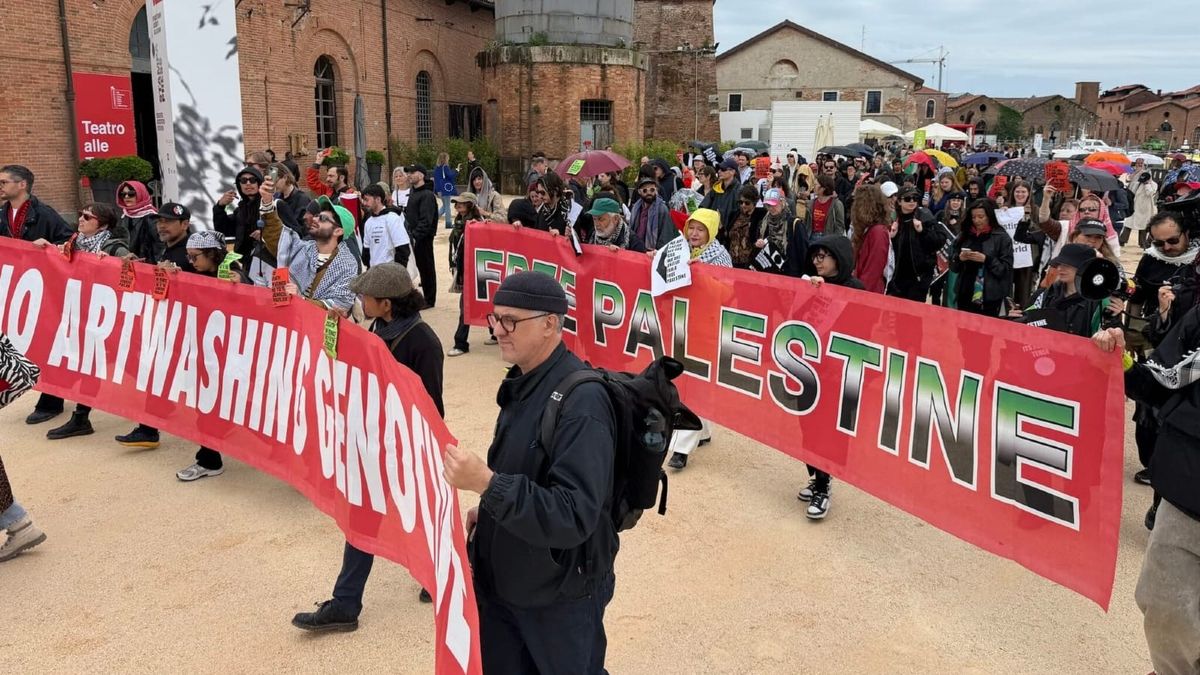
Art Not Genocide Alliance (ANGA) protesting at the Venice Biennale. The group is demanding organizers close the Israeli Pavilion due to the ongoing war. Photo by Sarah Cascone.
This article is republished by Urgent Matter from Sarah Cascone, an arts and culture journalist based in Washington Heights. She was a founding staffer at Artnet News, where she worked for 12 years.
Protesters descended on the Israeli pavilion around 1 p.m. on the first preview day of the 2026 Venice Biennale, temporarily closing the exhibition.
The action, organized by the international collective Art Not Genocide Alliance, saw activists clad in keffiyehs march through the Arsenale chanting “Free Palestine,” “no more artwashing,” and other protest slogans while carrying banners, waving Palestinian flags, and throwing pamphlets decrying the “genocide pavilion.”
“There can be no enjoyment of art, no business as usual, during a genocide,” one of the anonymous speakers proclaimed into a megaphone, accusing the biennale and its organizers of complicity in Israel’s attacks on the people of Palestine.
Sign up for Urgent Matter
This article is provided free with the support of paying subscribers. Please consider signing up for a paid subscription today.
No spam. Unsubscribe anytime.
Israel’s 2024 biennale representative, Ruth Patir, opted to shutter her pavilion unless the nation reached a ceasefire; the biennale provided the nation an alternative site in the Arsenale for this year’s edition due to construction.
ANGA is calling for a 24-hour strike for all biennale cultural workers on Friday, May 8, and encouraging the art community to participate in a public demonstration near the biennale on Via Garibaldi at 4:30 p.m. It is demanding the biennale shut down the Israeli pavilion exhibition featuring artist Belu-Simion Fainaru. His installation, Rose of Nothingness, features a darkened reflection pool inspired by the Jewish Kabbalah.
The ANGA members who protested today are all part of the biennale community, including curators, art workers, and artists participating in “In Minor Keys,” the international exhibition.
The South African artist Nicholas Hlobo, whose work is on view in the Arsenale, took the mic to read the invitation to participate in the show from Koyo Kouoh, the biennale’s late curator, who died unexpectedly last May.
Her words spoke of “beauty in spite of tragedy;” how artists build “intimate and convivial universes that refresh and sustain even in terrible times; indeed, especially in terrible times;” and quoted James Baldwin about the urge to colonize the Moon.
“Sharing this space with a state that is currently in this kind of war, it’s counter to the spirit of the invitation and the exhibition,” Hlobo told me.
The action was far from unexpected in a biennale already marked with controversy long before it opened to the public. In January, the South African government canceled its pavilion after learning that the selected artist Gabrielle Goliath would present “Elegy,” an ongoing series of mournful video works commemorating the deaths of women in Gaza, among other places.
The exhibition is instead on view as an official collateral event at the Chiesa di Sant’Antonin church.
ANGA published an open letter in March calling on the biennale to rescind Israel’s invitation to participate in the event. It has since grown to include 236 signatories, with the national pavilion teams from 18 countries. Alfredo Jaar, Brian Eno, Lubaina Himid, Yto Barrada, and Nina Katchadourian are among the 113 artists who have signed, along with 38 curators and 85 art workers.
The following month, the biennale’s jurors announced that because Israel and Russia were facing charges of crimes against humanity before the International Criminal Court, both nations would be ineligible for the exhibition’s Golden and Silver Lion prizes.
But exhibition organizers pushed back, insisting in a statement that the biennale “rejects any form of exclusion or censorship of culture and art.” Jury members Solange Farkas, Elvira Dyangani Ose, Zoe Butt, Marta Kuzma, and Giovanna Zapperi resigned less than a week before the opening.
The biennale will instead introduce audience prizes for best pavilion and for the best artist in the international exhibition.
This ongoing geopolitical tension manifested itself in three protests on preview day.
A group led by artists from “In Minor Keys” staged a performance protest at the entrance to the Giardini called Solidarity Drone Chorus around noon, as reported by ARTnews. Participants hummed a musical composition, “Drone Song,” by Gazan music teacher Ahmed “Muin” Abu Amsha, to mimic the foreboding sound of the unmanned aerial vehicles dropping bombs in Palestine.
The Russian activist artist group Pussy Riot staged a performance in front of the Russian pavilion, which is hosting an exhibition in the Giardini for the first time since 2022, despite its ongoing invasion of Ukraine. Russia announced late last month that its exhibition would only be open during the biennale’s four preview days.
Stories like this take time, documents and a commitment to public transparency. Please support independent arts journalism by subscribing to Urgent Matter and supporting our work directly.