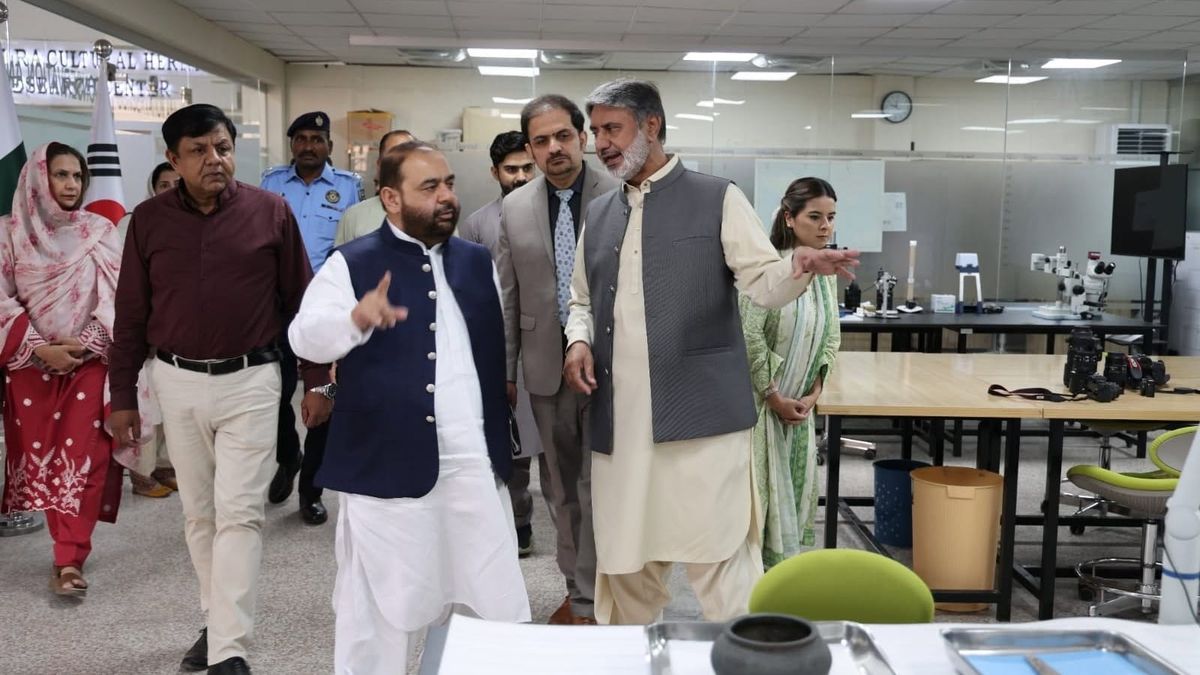
Pakistan will establish an educational museum at Government Graduate College Asghar Mall, a century-old Rawalpindi institution with pre-Partition Hindu roots that was declared a national heritage institution earlier this year, officials said last Wednesday.
Aurangzeb Khan Khichi, the federal minister for national heritage and culture, announced the museum during a ceremony marking a memorandum of understanding between the Department of Archaeology and Museums and the college administration, Pakistan’s Press Information Department said.
The agreement calls for the museum to be developed as a center for learning, research and heritage awareness at the public college. The Department of Archaeology and Museums will provide technical guidance, while the college will allocate space and support museum-related activities, officials said.
“We will work together and establish an academy of museum and heritage learning. We are committed to protecting and preserving the valuable heritage of Asghar Mall College for future generations,” Khichi said.
The museum will house artifacts, photographs, documents and other exhibits related to the college's history and architecture, according to the announcement.
The five-year agreement also calls for lectures, seminars, workshops, educational visits, internships and research opportunities in museology and conservation.
The announcement follows Khichi’s declaration in January that Government Graduate College Asghar Mall had been designated a national heritage institution. At the time, the college head said that archaeology classes had been launched and that support from the Department of Archaeology and Museums would be needed.
The college’s history predates Pakistan's creation in 1947 and was originally established as a school by the Sanatana Dharma Sabha, a Hindu organization, in 1903. The current building was built in 1913. The school became a college in 1948, after Partition, and was the first public-sector college in the Potohar region.
The site has also been the subject of preservation concerns. Dawn reported in January that the institution’s land had shrunk from more than 100 kanals to 96 kanals because of encroachments. The newspaper also reported that a temple once connected to the institution had been separated from the college, leaving an abandoned structure surrounded by commercial buildings and homes.
The June announcement did not say how much the museum will cost, when it will open or whether the project will include restoration work on the old college building. It also did not say whether the museum will address the institution’s Sanatana Dharma origins, the former temple or the reported encroachments.
Urgent Matter has requested additional information from the National Heritage and Culture Division.
Amanullah Khan, director general of the Department of Archaeology and Museums, said the initiative would make the college a model institution for heritage education and public engagement.
He said the museum would serve as an educational and research resource and encourage students to appreciate and protect Pakistan’s cultural heritage.
Stories like this take time, documents and a commitment to public transparency. Please support independent arts journalism by subscribing to Urgent Matter and supporting our work directly.