Artist Pablo Helguera wants your records to build a Latin music archive
Helguera's Fonoteca, opening October 15, will turn lent vinyl collections into a listening space for the exhibition "Historias Reveladas."

Helguera's Fonoteca, opening October 15, will turn lent vinyl collections into a listening space for the exhibition "Historias Reveladas."
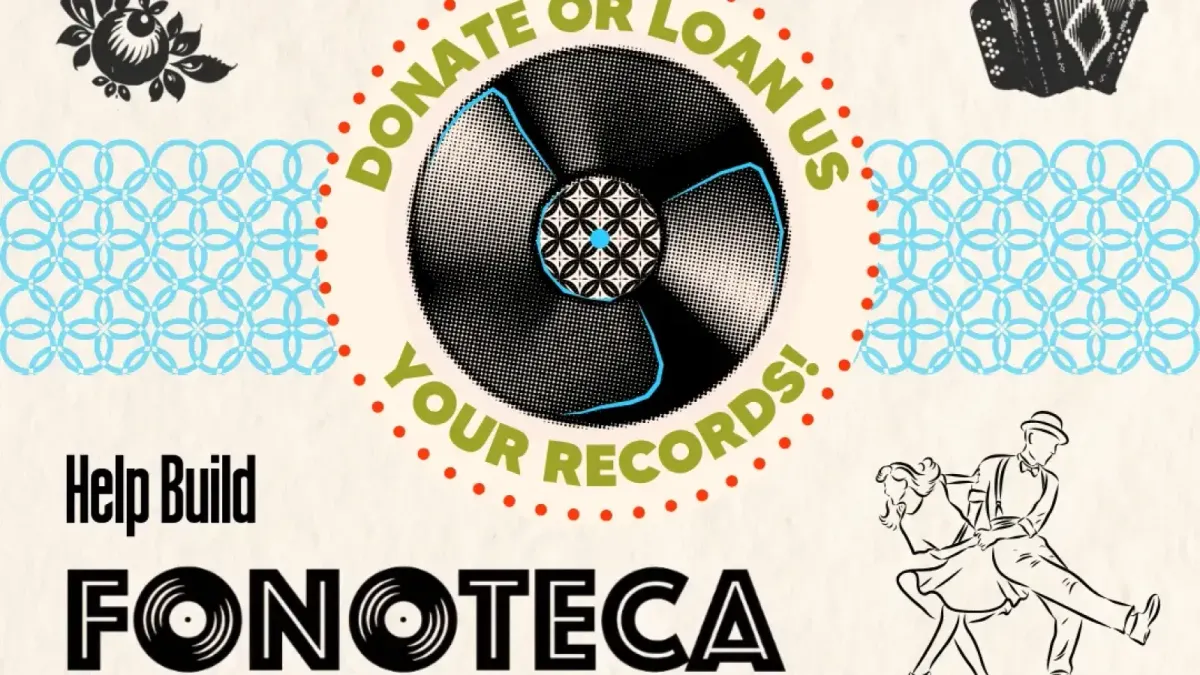
The Clemente Soto Vélez Cultural & Educational Center has opened a call for vinyl, inviting New Yorkers to lend or donate personal record collections—or even just a few of their favorite LPs—to a new public listening archive devoted to Latin American and Latinx music.
The archive, titled Fonoteca, is a project by artist Pablo Helguera and one of the major newly commissioned works for Historias Reveladas, a building-wide exhibition at the Lower East Side institution exploring the impact of Latinx communities on New York City. It opens October 15.
To be considered a collection, participants must lend or donate 10 or more records, which the center said do not need to be rare or in perfect condition. Those who contribute 12 or more will receive a special edition artwork by Helguera.
The call is open to records of any genre, the center said, provided the music is Latin American or Latinx. The artist clarified to Urgent Matter that smaller donations are also accepted.
"We should really be accepting of everything, just as long as it's Latino, Latinx music," Helguera told Urgent Matter.
For Helguera, the records are a way to collect something less tangible.
"Vinyl records, like books, are conversation pieces," he said. "There's an interesting story behind each one of these objects, and we want to gather those stories from people."
Helguera, born in Mexico City and from a family of classical musicians, said the open call extends to Brazilian and Portuguese-language music alongside Spanish-language genres. It spans traditions from salsa and merengue to tango and mambo.
He also pointed to the often-overlooked tradition of Latin American orchestral music, noting that the New York Philharmonic's incoming music director, Gustavo Dudamel, is Venezuelan. Dudamel begins as the Philharmonic's music director in September.
This article is provided free with the support of paying subscribers. Please consider signing up for a paid subscription today.
No spam. Unsubscribe anytime.
The New York connection runs on two levels, Helguera said. Some records are by groups based in or that performed in the city, while others connect through how a genre such as merengue or salsa took root and grew here.
"The records tell stories in a multidimensional way," he said.
Helguera said Fonoteca will be built around listening stations like those in a music library, with staff on hand to help visitors navigate the collections and a schedule of workshops, listening sessions and programs for schools and small groups. Consultants are helping the center assemble a professional listening environment, he said, though he stressed the setting is a library, not a concert hall.
Because the work lives in an art center, Helguera said, the records will be handled with the care given to artworks.
The bulk of the collection will be available for visitors to handle, Helguera said, while rarer items from private collections will be kept in a more controlled setting.
Helguera said he is not concerned about receiving duplicate records, framing repeated titles as a record of what a community was listening to at a given moment.
"There's no preciousness around this," he said. "Some records were super popular in the '80s and '90s and the early 2000s. It's a portrait of what was important in a particular moment in time."
That way of thinking about collections, Helguera said, comes directly from his work as a visual artist.
"In the visual arts, we're much more aware of the importance of collections, because the art world is constructed through museums and collections," he said. "There's a vision behind every collection... I want to rescue that idea."
He said the project is partly a meditation on ownership in the streaming era. A self-described member of "the last analog generation," Helguera noted that when a subscription lapses, a listener loses access to everything. A record collection, by contrast, can be handed down.
"In a time where in many ways we no longer own records or books, we basically rent them," he said. "In a way, it's a portrait of who you are in the collections that you put together."
The idea began on a Brooklyn street, Helguera said, when he came across a pile of LPs left near the trash one weekend — roughly 50 Latin music records that he took home with no plan for them. He later approached The Clemente about building a listening library.
"Sometimes as an artist, you don't know why you're doing what you're doing," he said.
Helguera declined to estimate how many records Fonoteca will gather, saying the project is designed to work at any scale.
"It can work if you only have 200. It can work if you have 20,000," he said.
He said he has already assembled his own records and is in talks with collectors who own thousands. He added that collectors rarely need much prompting to participate.
"If you are familiar with collectors, they love to tell you about their collection," he said. "That's why they collect. They want to show off, and they should. They have put together something that really represents them."
Among his own finds is a record by Los Chiriguanos of Paraguay, a duo whose late-1960s recordings blended Guaraní and Spanish folk traditions, and which Helguera said he had not known before.
The Fonoteca project follows the model of Librería Donceles, Helguera's traveling, pay-what-you-wish Spanish-language used bookstore, first presented in New York in 2013.
Comprising more than 8,000 donated books, the project has traveled to cities including Phoenix, San Francisco, Seattle, Chicago, Boston, Los Angeles and Anchorage, with proceeds in each city going to a local organization. Helguera said it has visited about 15 cities and recently left Minneapolis for Lincoln, Nebraska.
That project drew scholars who turned up long-sought material, Helguera said, and occasionally something far rarer. Among the donations was what he first took for a facsimile of a letter by Simón Bolívar and nearly set aside. On a second look, it proved to be an original.
"We actually got to auction that letter, and that helped support the project for a few years," he said.
He said he hopes Fonoteca creates similar conditions for discovery, while cautioning that authenticating such finds is not his role.
"I'm not a musicologist," he said. "I'm an artist who has lived this stuff."
Part of what he wants to preserve, Helguera said, is the experience of the search itself.
"You get lost in this cavernous store, spend hours digging through records, and finally find this thing that is incredible and very rare," he said. "You might encounter things that for others are not important, but for you, they are."
The aim, Helguera said, is to use personal collections to map a shared cultural memory.
"We are creating collective portraits of a culture through these very simple objects and fragile objects," he said.
Historias Reveladas is the culminating exhibition of Historias, The Clemente's multiyear initiative documenting the contributions of Latinx communities across New York City. Founded in 1993, the center is a Puerto Rican and Latinx multi-arts institution at 107 Suffolk Street, in the Lower East Side neighborhood known as Loisaida.
Records and collection proposals can be submitted through the project's online form.
Stories like this take time, documents and a commitment to public transparency. Please support independent arts journalism by subscribing to Urgent Matter and supporting our work directly.