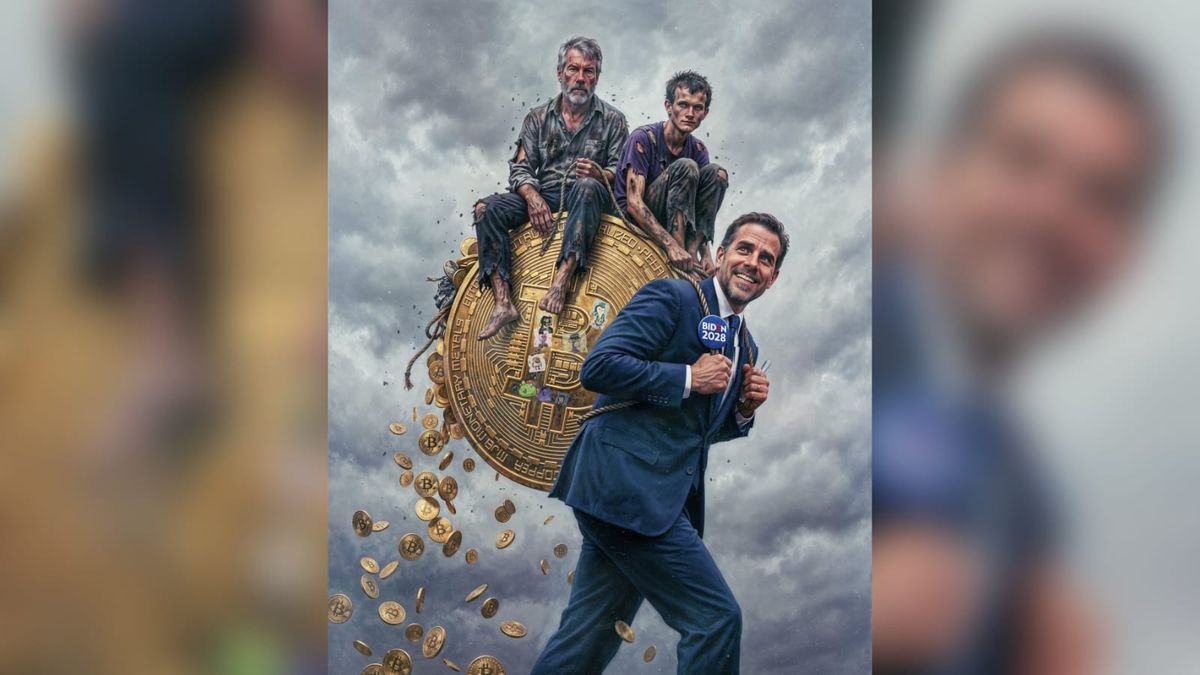
Hunter Biden, the second son of former President Joe Biden who emerged as a painter amid scandal and drug addiction in recent years, was recently revealed to have certified about 100 artworks on the blockchain and started accepting Bitcoin for his art. He received the Beeple treatment for the news on Friday.

Digital artist Mike Winkelmann, better known as Beeple, posted a new artwork online with the caption “Hunter Biden Saving Crypto.” Beeple is known for his surreal, daily satirical digital art pieces that are often politically charged.

Hunter Biden quote-tweeted the art, thanking Beeple and declaring it his new favorite. He also cited Andreas Antonopoulos's book The Internet of Money as inspiration for the move to authenticate his art on the blockchain.

“Thanks, Beeple. I’ve been a fan of your art for a long time. This is my new favorite,” Biden said in his post. “When I decided to sell my art, I wanted every piece on the blockchain and to accept Bitcoin as payment.”

Beeple's artwork is packed with heavy political and crypto-culture satire. The piece prominently features Biden, sporting a "Biden 2028" button in the foreground, wearing a crisp blue suit and a beaming smile, seemingly holding a crack pipe in one hand while pulling a massive Bitcoin on a rope, positioned as the savior of a collapsing crypto economy.

A figure that appears to depict a disheveled Michael Saylor, founder and executive chairman of Strategy, is atop the Bitcoin. Sitting next to him appears to be Vitalik Buterin, the co-founder of Ethereum.

The giant Bitcoin they are riding is leaking smaller gold Bitcoins into a stormy abyss. Plastered on the side of the main coin are small, fading images of iconic NFTs like Bored Ape Yacht Club and CryptoPunks.

Beeple’s artwork comes after the website Pathfounders first revealed that Biden was using the U.K. startup Verisart to certify his works on the blockchain. His Verisart account shows that 99 works by Biden have been authenticated on the platform.

“Every artwork is certified on the blockchain through Verisart, creating a permanent, tamper-proof record of authenticity and provenance,” Biden said in a statement on his website.

Verisart founder Robert Norton told Pathfounders that Biden appeared to have signed up for the service on his own without prior contact with the company. He speculated Biden sought out Verisart because of many fake and parody accounts using his name online.

“This is a good way to provide an additional layer of trust and authenticity to his works,” Norton said.

Norton emphasized to Pathfounders that Verisart has no direct relationship with Biden or his team, is not brokering Biden’s sales, and is not involved with the Bitcoin payment functionality on his website.

In recent days, Biden has become an internet darling for his quippy interactions on social media and his candor in discussing his yearslong drug addiction and subsequent sobriety. But Biden’s embrace of blockchain comes after years of scrutiny over his art sales and his foreign business dealings.

Before becoming an artist, Biden was best known as a lawyer, lobbyist and businessman whose foreign business dealings became a fixture of American politics. His seat on the board of Burisma, one of Ukraine’s largest natural gas companies, drew years of scrutiny from Republicans and from Donald Trump, who accused the Biden family of corruption.

Biden has denied wrongdoing. Reuters previously reported that people familiar with his work at Burisma described him as a non-executive director who advised on legal issues, corporate finance and strategy during a five-year term that ended in 2019.

His turn to art also came with controversy from the start. When Biden began selling paintings through Georges Bergès Gallery, works were reportedly priced from $75,000 to $500,000, drawing immediate questions over whether buyers could use the purchases to curry favor with his father’s administration.

The White House and gallery later used an arrangement to keep buyers’ names confidential, even from Biden himself, to avoid influence concerns, but which also made the sales more opaque.

Biden's new setup creates a transparency paradox in an art market already known for opaque sales. Verisart’s registry ties Biden’s physical paintings to blockchain-based records of authenticity and provenance, creating a permanent record connected to the works themselves.

But the sales are separate from those certificates, and Bitcoin payments can be publicly traceable while still leaving the real-world identity of the buyer unclear without additional disclosure.

Still, Biden appears to be earning the goodwill of the art world.

“Not going to lie,” Beeple said in another post. “Me and Hunter Biden being best friends was not on my 2026 bingo card.”

Stories like this take time, documents and a commitment to public transparency. Please support independent arts journalism by subscribing to Urgent Matter and supporting our work directly.

Share this article
The link has been copied!