Affordable Art Fair’s fellowship gives emerging galleries a subsidized start
Camp Z is the sixth gallery the fair has bankrolled for three editions each, and every prior fellow has stayed on as a paying exhibitor.

Camp Z is the sixth gallery the fair has bankrolled for three editions each, and every prior fellow has stayed on as a paying exhibitor.
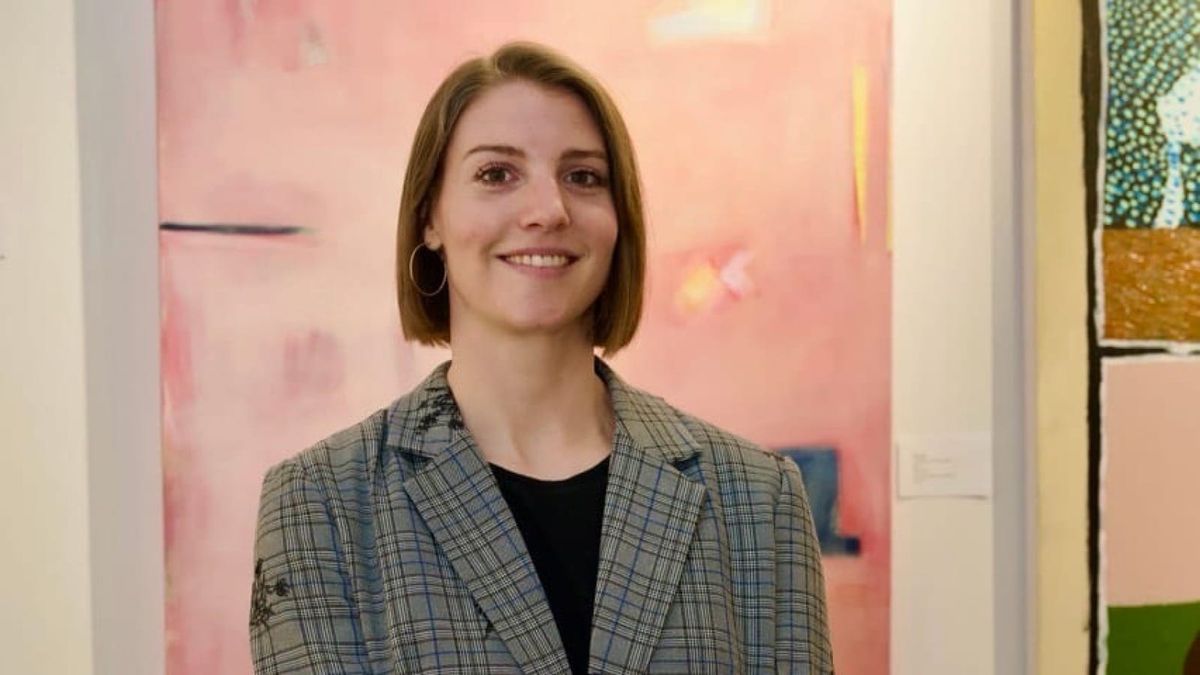
Affordable Art Fair NYC covers the participation cost for one emerging New York gallery at a time across three consecutive editions and guarantees the gallery a standard paying booth after the subsidy ends.
“So far, all of our previous fellows have done that,” said Erin Schuppert, the fair’s director, referring to galleries that stayed on as paying exhibitors after their subsidized run.
The newest of the fellows is Camp Z, the commercial program of the Lower East Side gallery Collective Z, which the fair named its sixth Fellowship Gallery ahead of the fall edition running September 16 through 20 at the Starrett-Lehigh Building in Manhattan.
Schuppert became the fair’s director in 2022 after working at Phillips and Christie’s. She started the fellowship that year to open the fair to galleries that could not afford a booth.
 Adam Schrader
A gallery must have been founded within the past 10 years and show that participation would be out of reach, she said.
“This creates a learning environment where they can really learn how to participate in fairs, hone their curatorial presentation, hone their sales approach over those three editions,” Schuppert said.
The fair also puts a fellow's artists in front of an audience the gallery could not draw on its own: more than 15,000 visitors an edition and 18,000 last spring. "A new gallery might not see that in a weekend," Schuppert said. After the fellowship, a gallery is guaranteed at least one edition as a standard exhibitor.
The arrangement runs as a pipeline for the fair as much as for the galleries. Schuppert said about half the audience changes each edition, which keeps drawing exhibitors back.
“Galleries who are coming back to the fair time and time again are always seeing new potential collectors,” she said.
Camp Z follows five earlier fellows. The first, in 2022, was Established Gallery, a Brooklyn space co-owned by Johnny and Hally Thornton. Johnny Thornton is also executive director of Arts Gowanus, a Brooklyn arts nonprofit. Schuppert said the gallery’s presentations always felt “community first, community forward.”
The others were Sheer, an online-only gallery showing mostly female artists of color; Warnes Contemporary, a Brooklyn gallery she described as consistently polished; Harsh Collective, run by a young gallerist showing eclectic work by young women artists; and 11th Hour Art, an artist-led Brooklyn gallery whose space doubles as studios.
Schuppert said the fellows have changed how she prepares first-time exhibitors, who face a compressed, high-pressure install that “seems old hat” to her team but daunts newcomers.
“It’s a fast and furious process,” she said.
The newcomers have also nudged longtime exhibitors, some showing with the fair for two decades, to refresh their booths. Veterans have come to Schuppert and asked “how I can bring some new artists to my presentation next time.”
The fair caps prices at $12,000 and requires every work to be labeled with its price. Schuppert said this spares buyers the "sticker shock" of fairs where works carry no price.
"You fall in love with a piece. You ask the gallery, there's no price on the label. You ask the gallery about the work and it is way, way, way out of your budget," she said of more traditional fairs. "So that kind of ends the conversation right there."
Now in its 24th year in New York, Affordable Art Fair holds two editions a year and operates in 16 cities worldwide. This fall’s edition will have 91 exhibitors and more than 600 living artists, Schuppert said.
As an example of the fellowship’s reach, Schuppert pointed to Mayowa Nwadike, a figurative painter she said first showed publicly at the fair through an earlier fellow and was later named to Forbes’ 30 Under 30 list. His work anchors the fair’s advertising for the fall edition. A young artist given that platform, she said, “can really take off from there.”
Camp Z arrives with a model Schuppert said the fair had not hosted before, pairing fair booths with limited-edition prints and wearable art. Its founder, Alex Z. Wang, has described the program as a discovery channel of its own, meant to move the artists it introduces onto the roster of his gallery, Collective Z.
Urgent Matter is reader-supported. Please consider subscribing to support independent arts journalism.