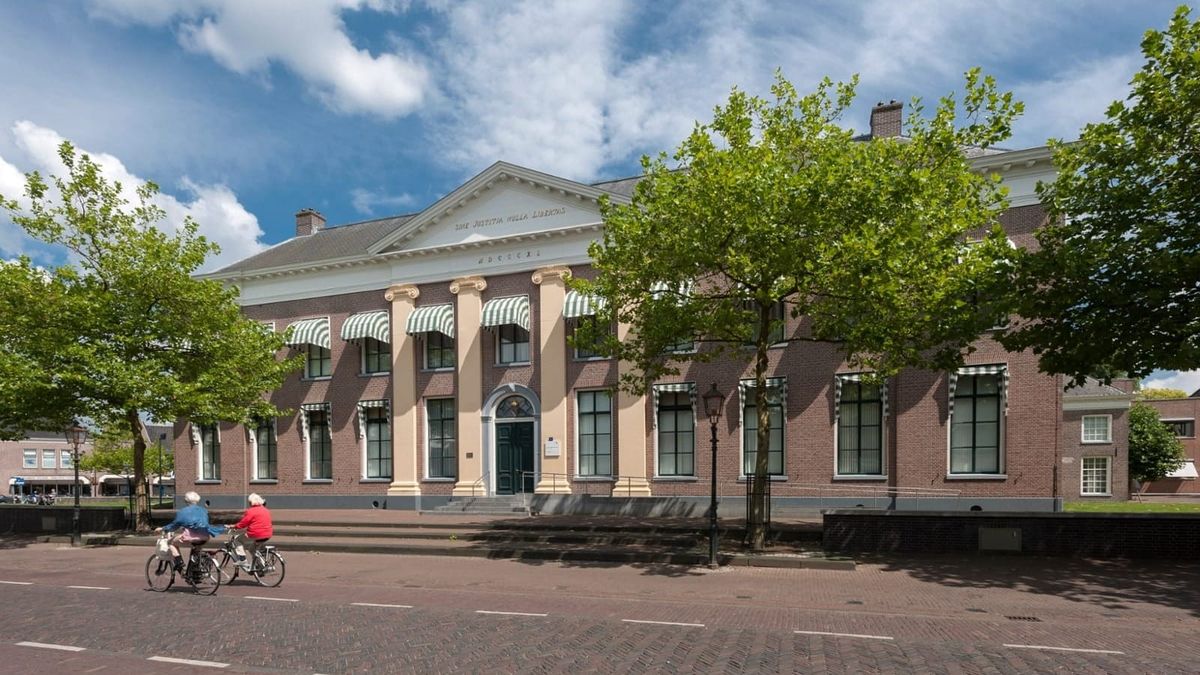
A Dutch court sentenced three men to 47 months in prison Friday for a violent nighttime art theft at the Drents Museum, where thieves used heavy fireworks to break in and steal the Golden Helmet of Coțofenești and three gold bracelets loaned from Romania.
“Given the nature and gravity of the offenses, only a substantial prison sentence will suffice,” the North Netherlands District Court said in a statement.
The Drents Museum said the ruling came after a theft that took some of Romania’s important cultural objects from public view.
“These art treasures had been on loan to the Drents Museum from the National History Museum in Bucharest before they were stolen with unprecedented violence. The judges have imposed sentences which they consider appropriate in the circumstances,” the museum said in a statement.
The museum said most of the stolen objects were recovered earlier this year.
Sign up for Urgent Matter
This article is provided free with the support of paying subscribers. Please consider signing up for a paid subscription today.
No spam. Unsubscribe anytime.
“Thanks to the efforts of the Dutch, Romanian and international investigative services, most of the art treasures were recovered earlier this year,” the Drents Museum said.
“The Drents Museum is pleased that the helmet and two bracelets have now been safely returned to Romania with limited damage. The Netherlands has offered expertise in the field of restoration to our Romanian colleagues.”
One bracelet remains missing, and the museum appealed for help in returning it to Bucharest.
The men were convicted for the January 25, 2025, theft in Assen. The court said they stole the Golden Helmet of Coțofenești and three Dacian gold bracelets from the Drents Museum, caused an explosion with a Ti-Rex flashbanger, and damaged the museum. Two of them were also convicted of stealing a Volkswagen Golf to prepare for the theft.
The court said all three men played important roles, and statements made during an undercover operation also showed they worked together.
On the day of the theft, police were called to the museum around 3:42 a.m. after an alarm. Officers were told en route that an explosion had occurred near the museum. The court said the thieves entered the exhibition room through the museum garden, forced open an emergency door with tools and an explosive, and took the helmet and bracelets.
Camera footage showed three suspects breaking open the emergency exit with tools, followed by a flash of light, believed to be the explosion, the court said. A witness described “a gigantic explosion” that broke a window across the street, the court said.
Inside, the theft lasted about 50 seconds. The court said one suspect went straight to the display case holding the Golden Helmet of Coțofenești, hit it three times with a sledgehammer, took the helmet and put it in a bag.
A second suspect hit another glass case eight times, reached in several times, and removed the three Dacian bracelets, while a third suspect hit another display case seven times but did not break the glass.
The court said fragments found near the emergency exit came from a Ti-Rex flashbanger, which it described as professional fireworks with a net explosive mass of 275 grams.
The stolen objects were part of a collection of Dacian treasures from the Romanian National History Museum that had been loaned to the Drents Museum, the court said. The helmet is about 2,500 years old.
“The art treasures are part of Romania’s past and are of great importance for current and future generations, so that they can learn about that past in this way,” the court said.
“The significance is also reflected in the insured value attached to the art treasures, amounting to 5.7 million euros. At the same time, that is only an amount, while the importance and value of objects like these cannot be expressed in money. They are literally priceless.”
The court said the theft caused unrest in the Netherlands and Romania and likely in the international art world. It said the Drents Museum met all required security standards, according to an insurance report, but was not able to withstand the force used in the break-in.
“At the break-in, heavy fireworks with 275 grams of explosive mass were used; by comparison, an average hand grenade usually contains about 150 to 200 grams of explosive mass,” the court said. “The museum was no match for so much violence.”
The director of the Drents Museum told the court at the hearing that the heist caused pain and sorrow, especially among the employees of the museums in Assen and Bucharest.
Two defendants made agreements with prosecutors before trial. The court said the main purpose of those agreements was to recover the stolen art.
But the court gave all three men the same sentence. It said the recovered treasures partly repaired the harm caused by the theft and that, for reasons of equal treatment, all three defendants should benefit from that recovery.
In one case, the court said the agreement was signed on March 19, 2026, but the transfer of the Golden Helmet of Coțofenești and two Dacian bracelets did not take place until April 1. In another, the court said the agreement was signed March 27, 2026, with the same transfer date.
The court said the agreements were allowed, even though they differed from process agreements in many other criminal cases.
“The agreements made between the defendants and the Public Prosecution Service do not undermine a right to a fair trial and were therefore included in the court’s final judgment,” the North Netherlands District Court said.
The court also found errors in the investigation. It said prosecutors violated the subsidiarity requirement by showing the photo and full first and last names of two defendants in the media without first using less intrusive alternatives. It also said police gave the two men the choice of either cooperating with the investigation or accepting that a news item would air with their photos and full names.
“This constitutes a violation of the ban on pressure, because there was a possibility that the defendants would make a statement that could not be said to have been made freely,” the North Netherlands District Court said.
“These procedural errors must therefore lead to a sentence reduction. This was taken into account in the sentence to be imposed.”
The court said it started from a base sentence of 78 months before reductions. It said the return of the art treasures reduced the harm to society, but the breach had not been fully repaired because the third bracelet is still missing.
“The court considers it justified that account be taken of the return of the art objects,” the court said. “The breach of the legal order is therefore less serious. In other words, because of the return, the damage caused to society has been reduced.”
Follow along with other art crime stories at Urgent Matter’s art crime tracker.