Bahar Behbahani brings Persian garden to Governors Island in bid to bridge cultures
A one-day program used the Damask rose to connect Persian culture with children’s folklore, Afghan traditions and wider diaspora stories.

A one-day program used the Damask rose to connect Persian culture with children’s folklore, Afghan traditions and wider diaspora stories.
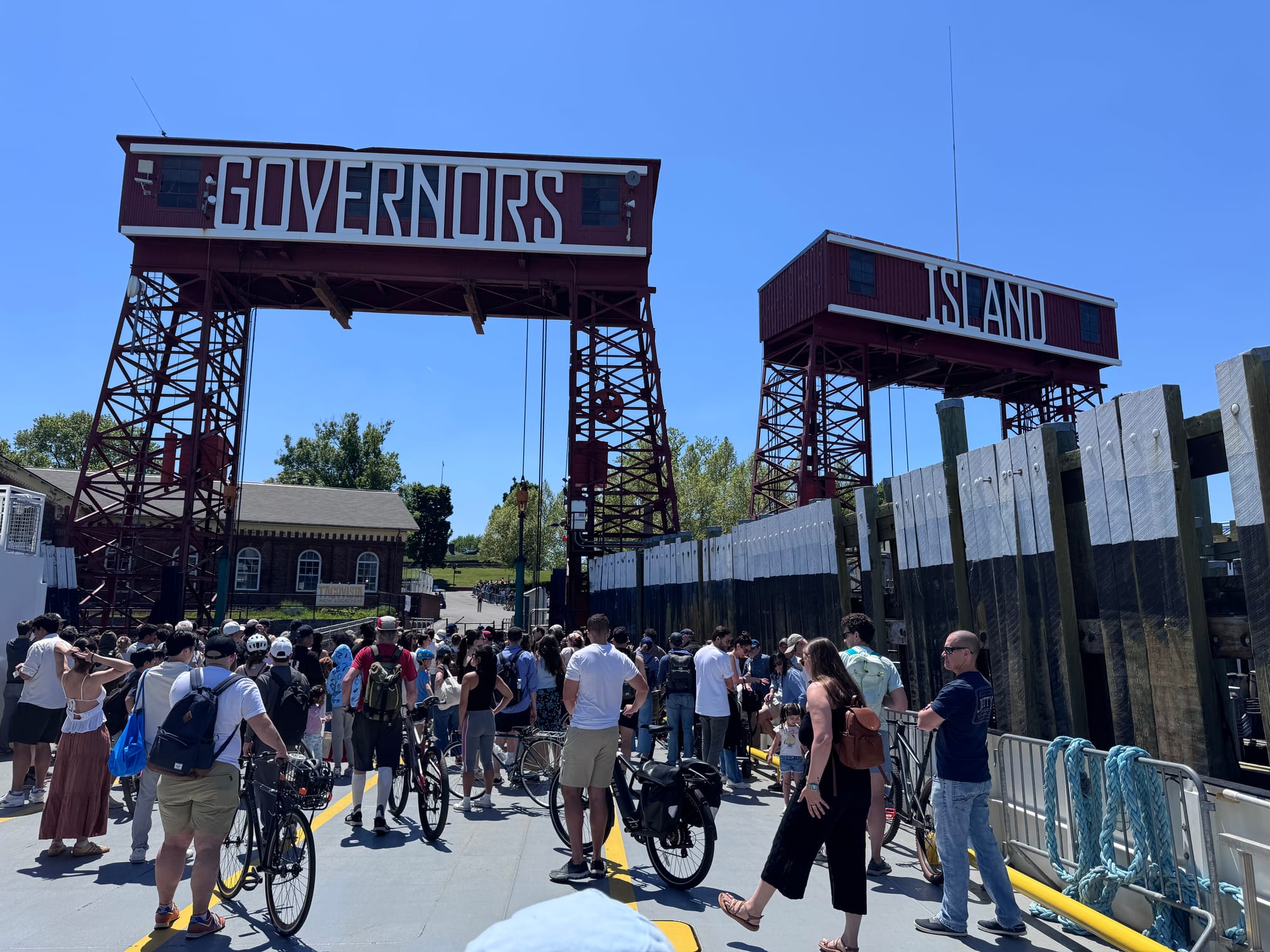
Getting to Governors Island with children is not difficult, exactly. But it’s not a typical New York outing, and the voyage changes your state of mind. I had never been, so the trip began with calculations: the big stroller or the foldable one, did we forget sunscreen, would we make it onto the ferry.
This was not going to be a Chelsea gallery review. The event was in a park, and the park was part of the work. You could not judge the gathering apart from the heat, the distance, the children, the food and the small frictions of attendance—details that would hardly matter in a typical gallery setting.
I arrived at Bahar Behbahani’s “Damask Rose: A Gathering” dripping sweat and sore from navigating an oversized stroller through the subway, scanning for shade and snacks. It was an honest way in and worked in the artist’s favor.
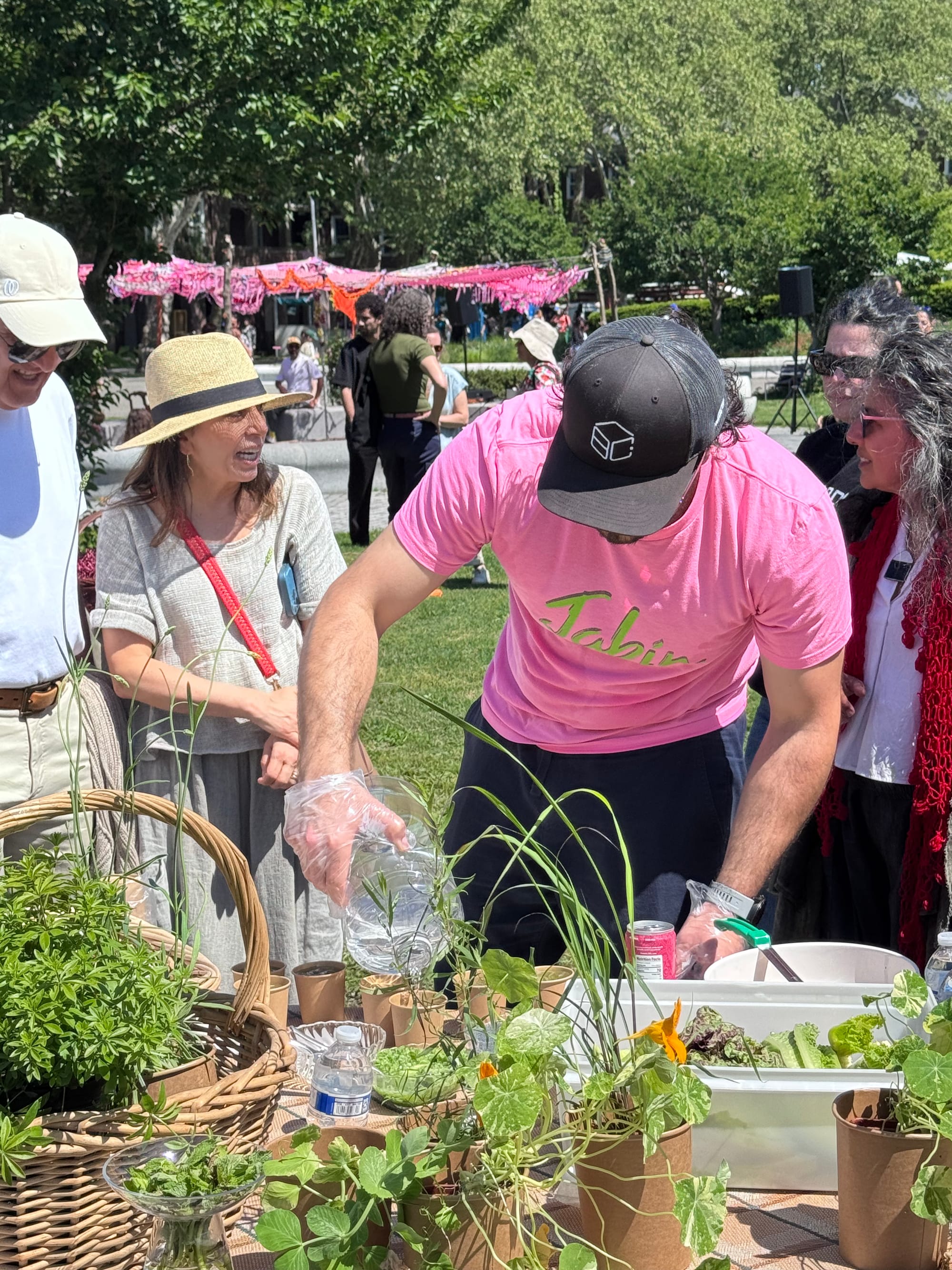
Behbahani’s free public program was presented Saturday at Liggett Terrace as part of Governors Island Arts’ “Interventions” series. The four-hour event brought together music, tea, food, rugs, flowers and activities in a program inspired by Persian garden traditions and organized around the Damask rose as a symbol of migration and hospitality.
The official description used art world language, calling it a performance and installation. That was accurate, but made the afternoon sound more formal than it felt. At its heart, it was a community event showing Persian culture to curious Americans.
That understanding allowed guests to walk away to get a drink, hit the playground or move between the event’s three “pools,” then come back without feeling like they missed anything. The format was loose enough to feel a little unclear at first, like where to go and who to talk to, but that looseness became part of the point.
Ultimately, the event was not some Persian garden fantasy with roses wafting through the air and endless tea and snacks keeping everyone comfortable. I experienced it as a parent in public space, hot and thirsty, dropping $100 at the park cafe for lunch. And I had a lovely time.
The event’s spirit came through most clearly during the children’s programming, “The Daughter of Api,” an interactive rain-summoning ritual rooted in ancient Iranian folklore.
“If a non-Iranian kid comes to one of our events and dances with us and, you know, eats our food and listens to the stories, when they hear the word ‘Iran,’ that's what they remember,” said Sanam Akhlagh, founder and executive director of Pardis for Children. “It's not, you know, all the things that I don't want to talk about.”
Imal Gnawa performing at Bahar Behbahani’s “Damask Rose: A Gathering." Video by Adam Schrader/Urgent Matter
The nonprofit, which produced the children’s portion of the event, is dedicated to educating children about the Persian language and Iranian culture. The performance was given by Bahar Beihaghi, accompanied by musicians Martin Shamoonpour and Parham Haghighi.
“Even for kids that have Iranian heritage, it's important for them to also associate themselves and their culture with all these beautiful stories and color and music,” Akhlagh said.
During the performance, children hung objects from the rain doll, which Akhlagh said is given as a gift to the daughter of Api, the protector of underground water. She said the doll and rain-summoning ritual still exists in some villages.
“People just come and walk around, and if they feel engaged, they sit around, and they just go from pool to pool. That's the way it's supposed to be,” Akhlagh said when asked about the turnout for the event. “I think it's nice. I think it's very organic. It's not a forced thing.”
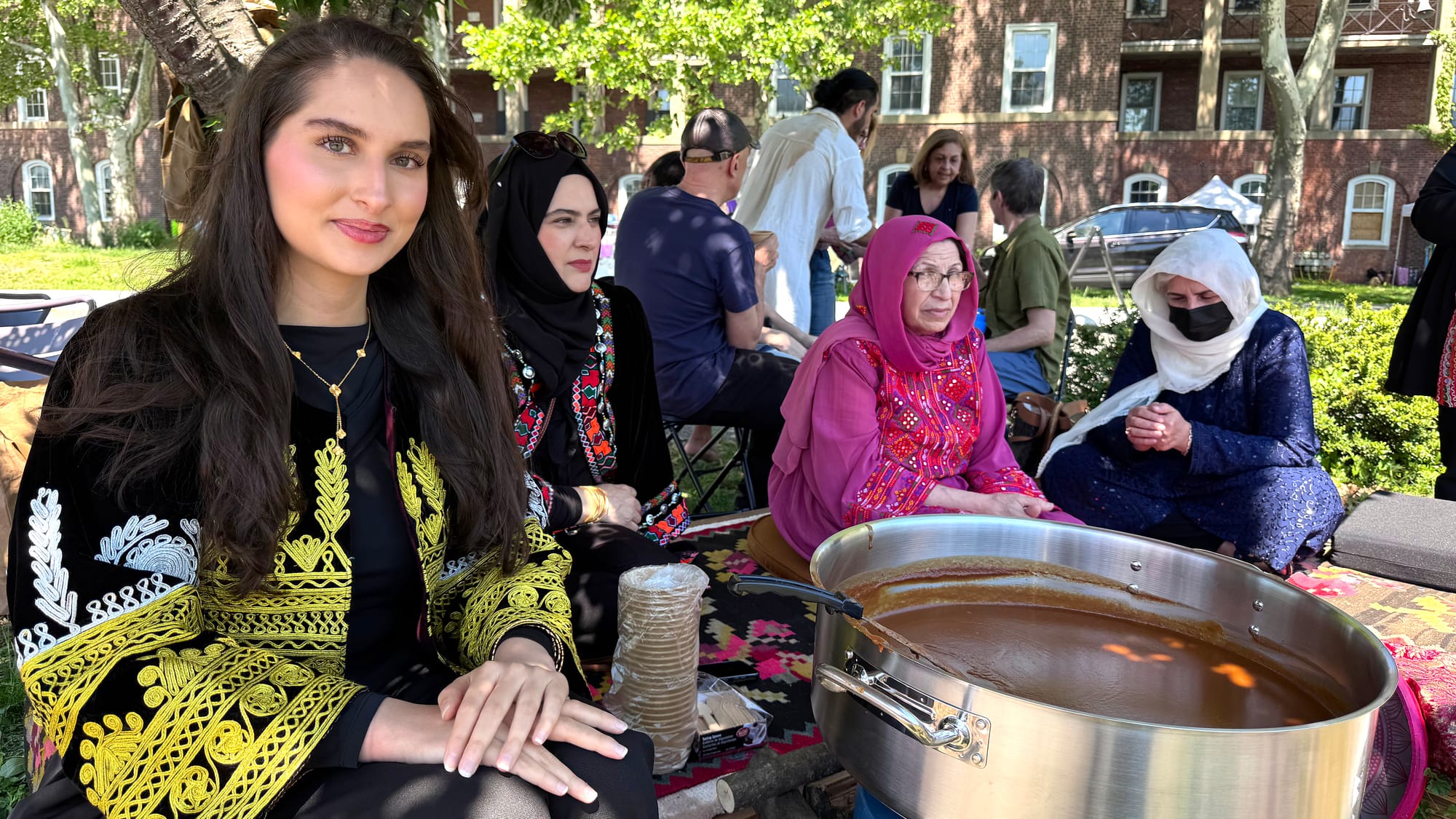
Attendees were also served samanak, an Afghan dish made from sprouted wheat cooked for hours until it becomes naturally sweet. The labor-intensive pudding is often prepared for Nowruz, a celebration of the spring equinox across Central Asia.
Zainab Akbarzai was among a group of Afghan women who prepared and served the dish and described the communal process for creating it.
“It's a one-ingredient dish that takes about 24 hours to cook,” she said. “We usually make it with friends and family, taking turns stirring and making it together.”
Akbarzai said foods like samanak offered visitors a direct way to experience the event's cultural traditions.
“I feel like it's a really great idea to learn from each other, to learn from each other's cultures, and how we celebrate the start of a different season,” Akbarzai said.
Children participate in “The Daughter of Api,” a rain-summoning ritual produced by Pardis for Children during Bahar Behbahani’s “Damask Rose: A Gathering. The program was rooted in ancient Iranian folklore and invited children to dance, sing and help create a shared doll honoring water. Video by Adam Schrader/Urgent Matter
The event also gave the Damask rose a register different from the one it often occupies in cultural heritage disputes. Urgent Matter previously reported that the flower has become part of a quiet regional fight over heritage recognition, with Syria, Saudi Arabia and Iran each tied to rose cultivation and rosewater traditions.
UNESCO has recognized Syria’s Damask rose practices and Saudi Arabia’s cultural practices related to Taif roses, while Iran’s bid was delayed as officials worked to expand the application. Talking about samanak, Akbarzai described culture less as property than as overlap.
“I’ve been to Iran, Iraq, Turkey. There are so many other countries that celebrate this,” Akbarzai said. “It just shows that we all share similar things, similar cultures, similar ingredients. Our clothing. These things all make our unique identity. I think it’s a really great idea to show our unique identity to the world.”
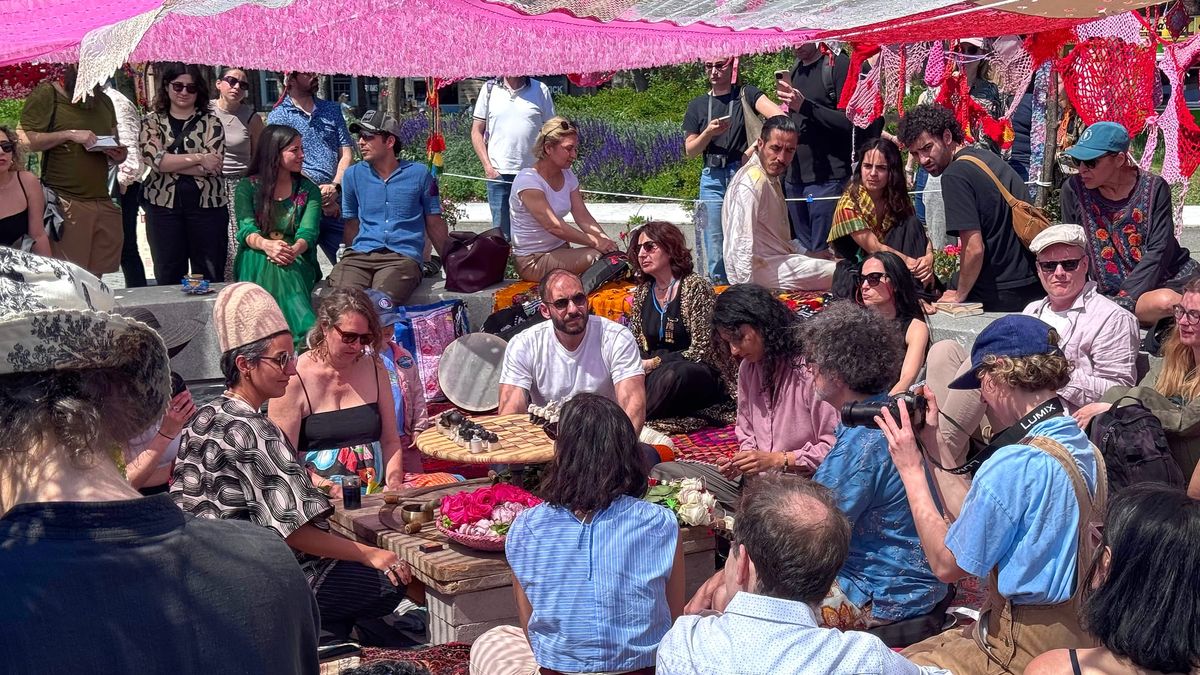
Hrag Vartanian, the co-founder of Hyperallergic, was among the organizers of “Hikayat: Dreamweaving” — a collective performative discussion in which participants shared stories over rose-infused tea and sweets.
Vartanian opened the discussion with a ball of orange yarn, holding one end and asking participants to pass the rest across the circle. Each person held a section as it moved inward and outward, slowly turning the group into a visible web.
“I want you to think about what connects us, what separates us,” Vartanian told the group, asking participants to consider “how we create those sections” as the yarn linked them together.
He then read from “The Story of My Body,” his essay about Armenian diaspora, memory and the body, published in the anthology We Are All Armenian: Voices from the Diaspora. In his essay, Vartanian weaves together the physical sensations of his own body with the weight of the Armenian genocide, displacement, and the assimilative pressures of American life.
“We are kind of sharing our experiences, knowing that we have so much in common—that unfortunately, the SWANA communities are communities that have gone through many genocides, probably as a region more than any other in the last century,” Vartanian said.
“We have had so much pain, but we've also had so much to celebrate, and so many movements that we are all part of in different ways, so I just want to share this passage.”
One attendee, who said their family was not from the Middle East, said the discussion still resonated with their own family history as the descendant of Ashkenazi Jews from Odessa, in present-day Ukraine, who came to New York more than a century ago after fleeing violence.
Growing up, they said, people often asked where their family was “from,” but the answer never felt as simple as Ukraine. Their relatives had lived there, they said, but spoke Yiddish and were Jewish rather than Ukrainian in the national sense.
The attendee said confusion once led them to draw the Israeli flag as their national flag for a school assignment. They said they later rejected that identification after learning about the Nakba and Zionism and began looking instead toward the lost Jewish culture of Eastern Europe.
For them, the discussion at “Damask Rose” echoed a larger question about how nation-states flatten identity, divide people and erase cultures that do not fit neatly inside borders.
“I think for a big part of me and my own personal activism has been rebuilding the culture that was lost and providing solidarity to other groups,” he said. “And I would say that I also take a lot of intellectual inspiration from a lot of the stories of groups shared here.”
Alice Hunsberger, a scholar of Persian literature who teaches Islamic studies and comparative religions at SUNY Old Westbury, said the event’s loose structure was part of what made it work.
Hunsberger, who previously worked at Asia Society and with a museum organization that toured exhibitions nationally, said “Damask Rose” showed how Persian culture could be centered without being sealed off from neighboring traditions.
“I think this is really important for bringing Persian culture together,” Hunsberger said, noting the event’s mix of Iranian, Moroccan, Chinese tea and Silk Road references.
Hunsberger spent the most time in “Hikayat: Dreamweaving,” and said the exercise captured the event’s larger interest in threads — sewn cloth, woven stories, family memory and the links between communities.
“Everything doesn’t have to be a Metropolitan Museum of Art level,” Hunsberger said. “There is a whole lot of creativity at the ground level, at the street level, at the gritty level.”
Hunsberger said the afternoon reminded her of the events of the 1960s and 1970s, with Behbahani less visible as a central performer than as the person who created the conditions for the gathering.
For Hunsberger, who devoted much of her life to Persian culture, the event also answered a public hunger she had seen before. At Asia Society, she said, programs on Iran often drew people wanting to know more about Persian culture and Iranian art, including Iranians themselves.
“To have another event, a Persian-centered event, that's also pulling in the other cultures around, and sitting there together, that was important,” she said.
The kids needed to leave about 4 p.m., thirsty, sweaty and tired from climbing on the nearby playground. We left just as one of the things I had most wanted to hear, a performance by the Moroccan group Imal Gnawa, was beginning. The sounds of the guembri and qraqeb carried us back to the ferry.
Stories like this take time, documents and a commitment to public transparency. Please support independent arts journalism by subscribing to Urgent Matter and supporting our work directly.