Tim Makepeace lands museum show inspired by NASA’s James Webb Telescope
The show traces nearly a decade of work shaped by rare NASA artist access amid growing uncertainty about public support for science and the arts.

The show traces nearly a decade of work shaped by rare NASA artist access amid growing uncertainty about public support for science and the arts.
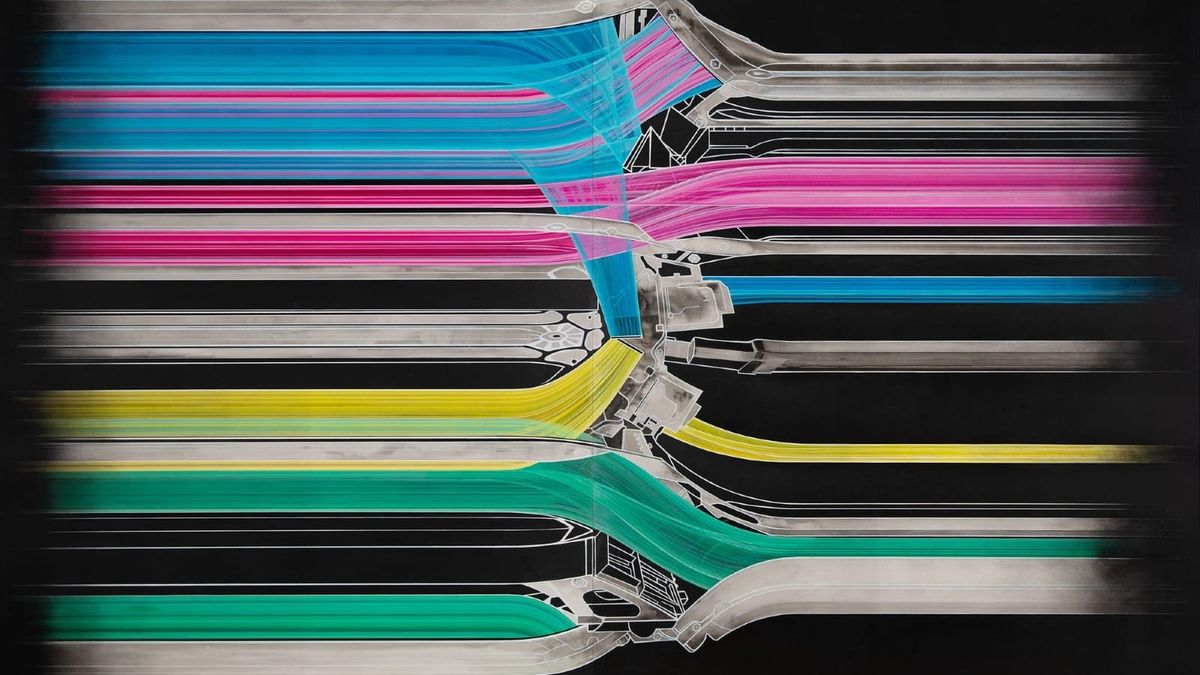
Artist Tim Makepeace will show work inspired by NASA’s James Webb Space Telescope starting June 13 at the American University Museum in Washington, D.C., after witnessing its assembly at Goddard Space Flight Center.
Beyond the intrigue of his blend of science and art, the show serves as a case study in what can be accomplished through increasingly rare collaborations between artists and the federal government as funding cuts threaten both science and the arts.
Makepeace’s interests have long centered on constructivism, industrial architecture and geometry. Originally a sculptor, he turned to drawing and works on paper rooted in his own photographs.
“In 2017, I entered some little contest that NASA had for artists. It was an open call,” he said. “It just came up on my Facebook feed, as much as you want to hate Facebook.”
Makepeace said he was selected through that open call and invited twice to visit NASA’s Goddard Space Flight Center in Maryland. The invitation ultimately led to years of continued engagement with NASA and the telescope project.
“It changed my life. So thank you, Facebook,” Makepeace said. “But I'm interested in anything scientific, and space is cool. Who doesn't like space?”
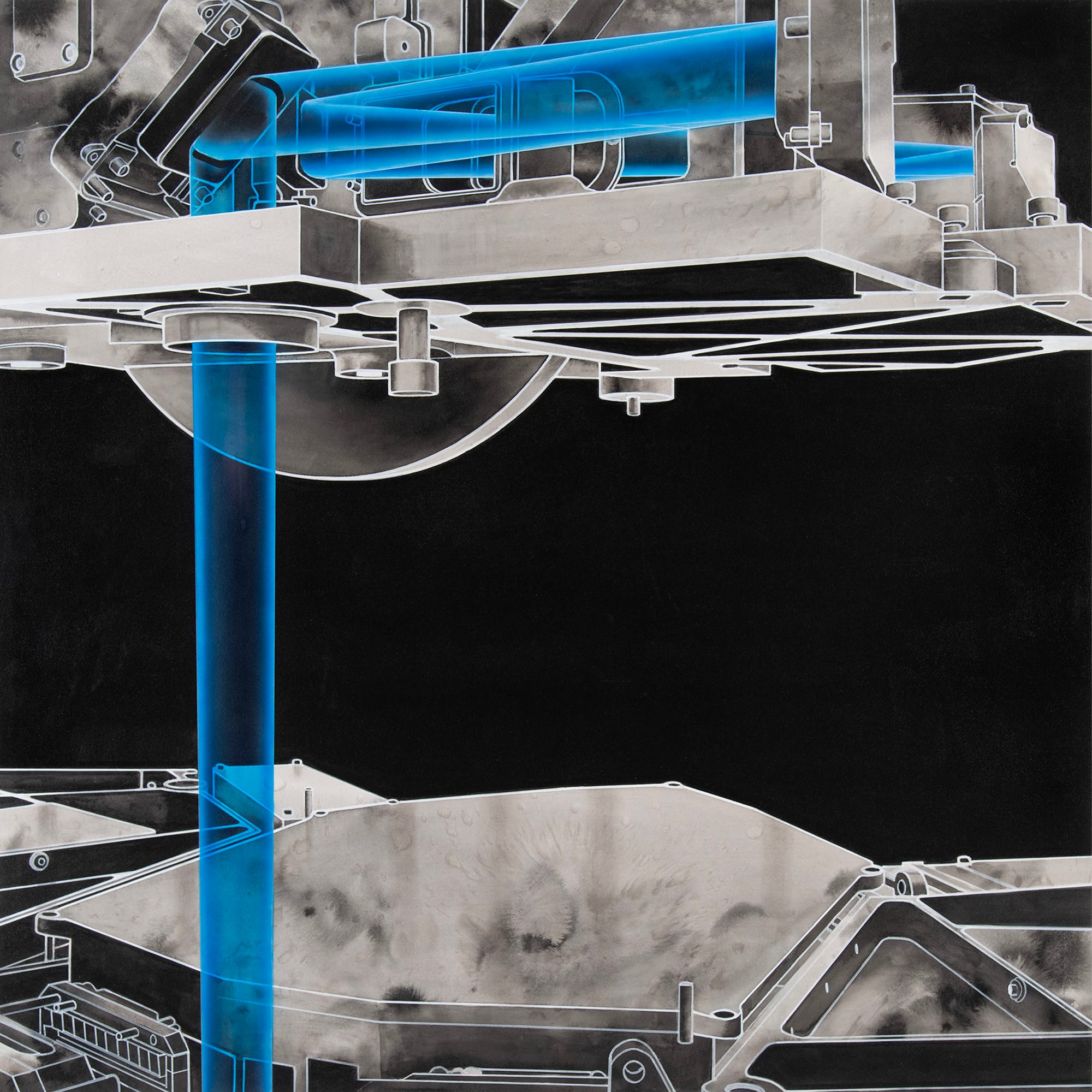
Makepeace said that when he applied for the open call, he might have heard about the JWST once but didn’t really know anything about it.
“I'm not interested in astronomy, I live in the city, I can't see any stars, what's the point?” Makepeace said. “By the time I got out there, I had done a bunch of homework and realized, ‘Holy shit, this is the ultimate machine man has ever made.’”
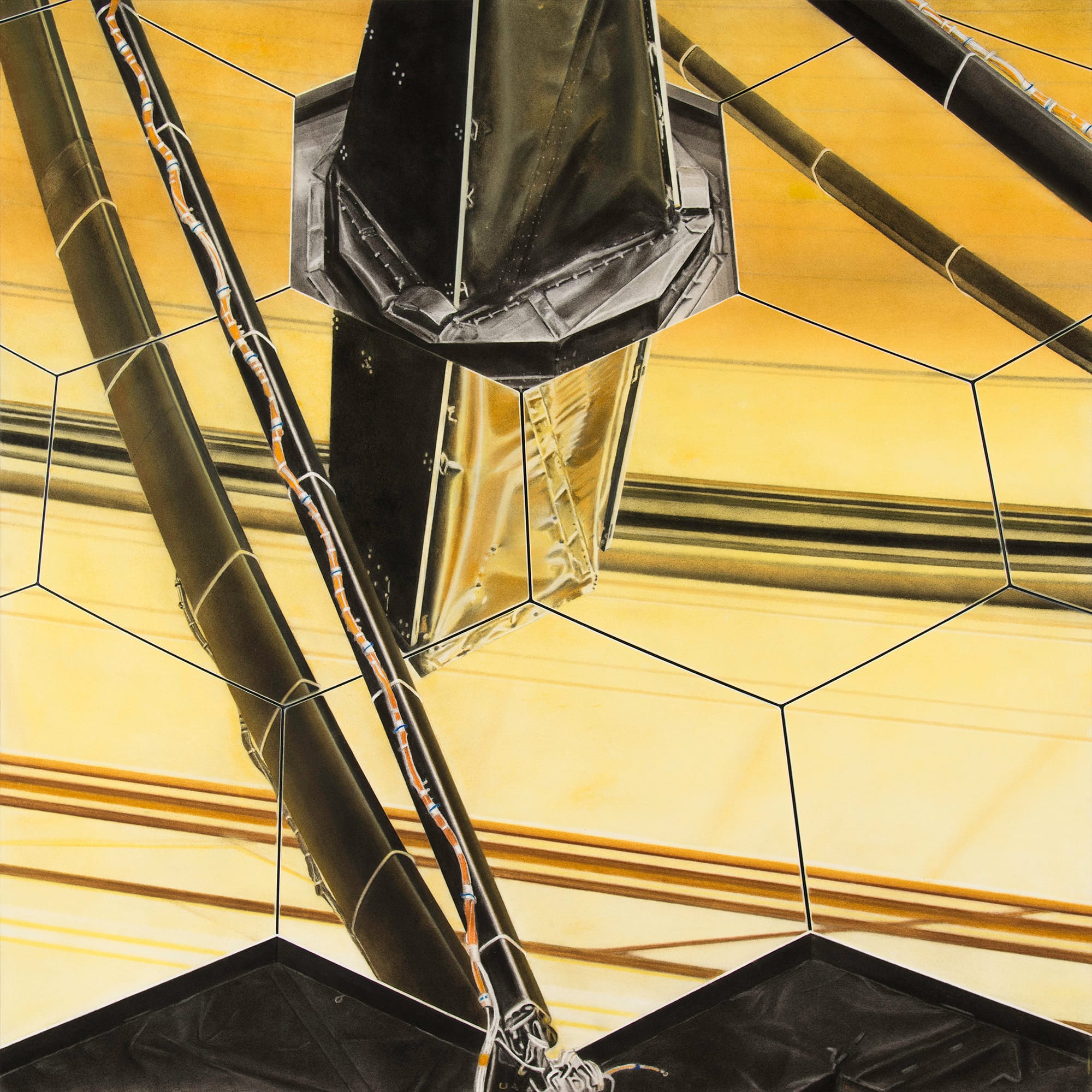
He said the massive telescope was “very sculptural,” and he took photographs of it during his tour. Those photographs first turned into drawings shown in an exhibition at Goddard that same year.
Makepeace then approached the National Academy of Sciences, whose cultural program exhibits work at the intersection of art and science. He said it “took a couple of years to get through the gates.” His work was shown there from October 2021 to January 2022. The telescope launched during the show’s run.
As part of that show, titled “Reflections on a Tool of Observation,” Makepeace gave a tour attended by top scientists at NASA. He said he was intimidated by the prospect of summarizing the scientists’ research back to them, but they were interested in hearing how the telescope translated into another form.
“They wanted to hear how some numbskull artist explains their work,” Makepeace said.
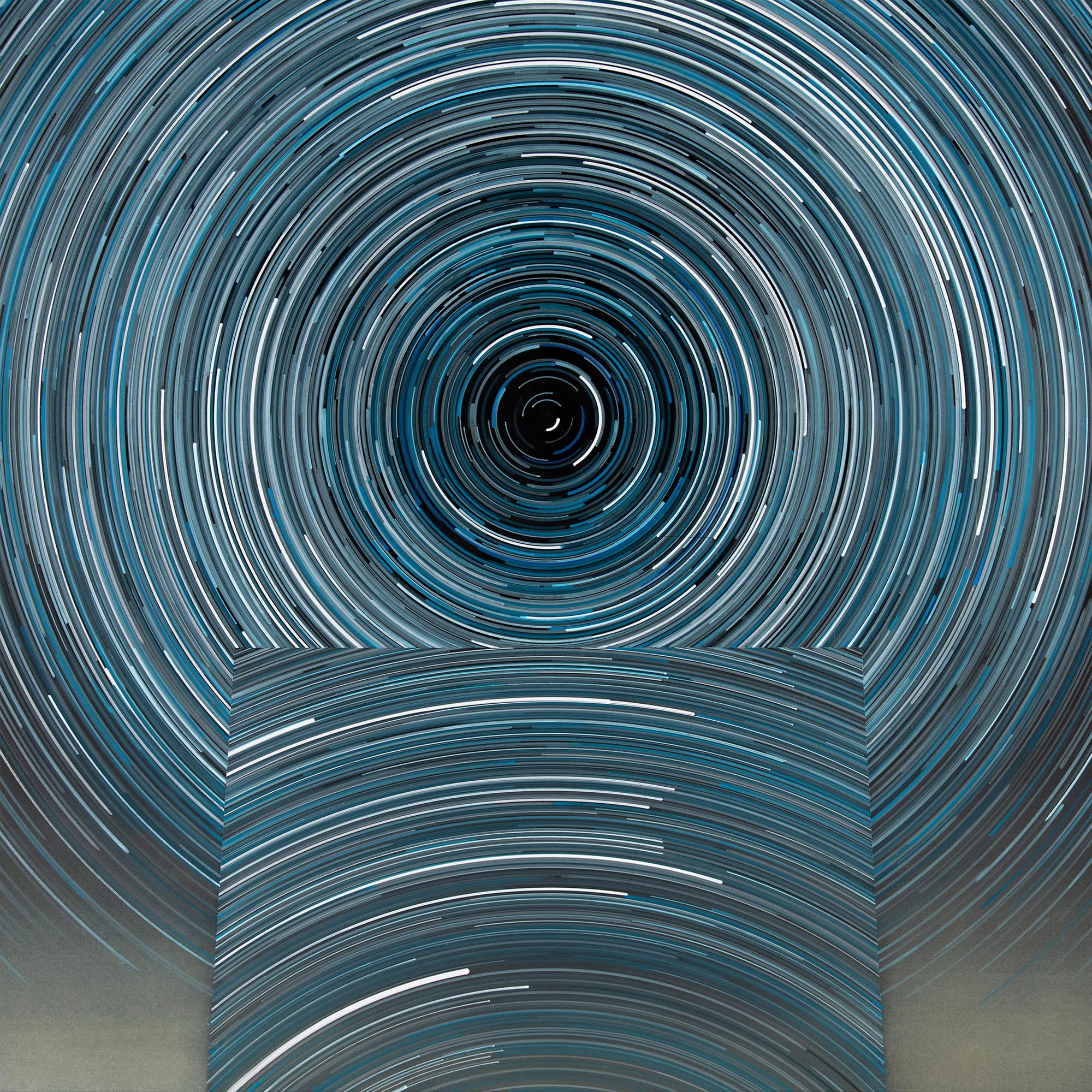
The American University Museum exhibition, titled “Ghost in the Machine,” will occupy the entire first floor, Makepeace said. It includes two site-specific works responding to the building’s unusual architecture, including a 5-foot-by-25-foot unstretched canvas drawing designed to wrap around one of the museum’s curved walls.
The drawing, he said, is divided between the tangible and intangible sides of the show. One side refers to the camera inside the James Webb Space Telescope and the path the light takes through it. The other refers to Sagittarius A*, the black hole at the center of the Milky Way.
“Anytime you're talking about black holes, you're talking about infinity,” Makepeace said. “Singularity, things like that, which are intangible. It's unknowable, right?”
Because the work wraps around the wall, viewers cannot see the entire drawing at once. Makepeace said this requires viewers to move through the space, adding an element of time to the work.
“You have to travel to see the picture, and when you're traveling, there's an element of time,” Makepeace said. “It also relates to space-time. Space is tangible, time is not.”
The second site-specific work was made for a concave wall and consists of nine works on paper arranged in a 3-by-3 grid. Each sheet is about 52 inches, making the full array about 13 feet across, Makepeace said. The work was made with Sumi ink and acrylic on paper.
Some of the works are data-driven. Makepeace said he became interested in positional data from NASA’s Jet Propulsion Laboratory and imagined what the telescope’s path would look like if photographed from his backyard over time.
“If you took a time-lapse photograph every night at midnight from my backyard and stitched them together into a single image, and plotted those points, what would the path of the telescope look like?” Makepeace said. “Because the orbital mechanics of this thing are super cool.”
The result, he said, became a “crazy pretzel shape” that appears abstract but is based on data.
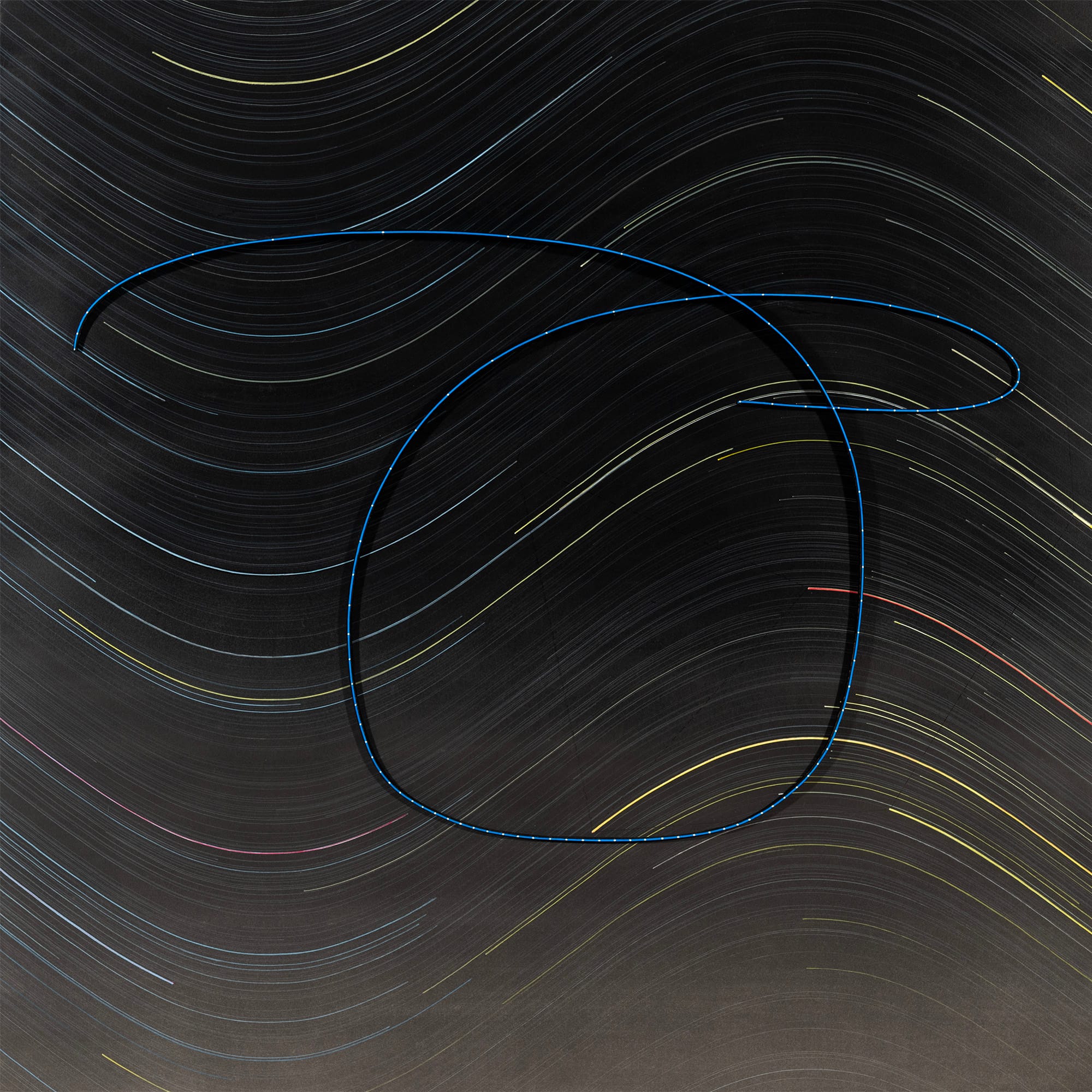
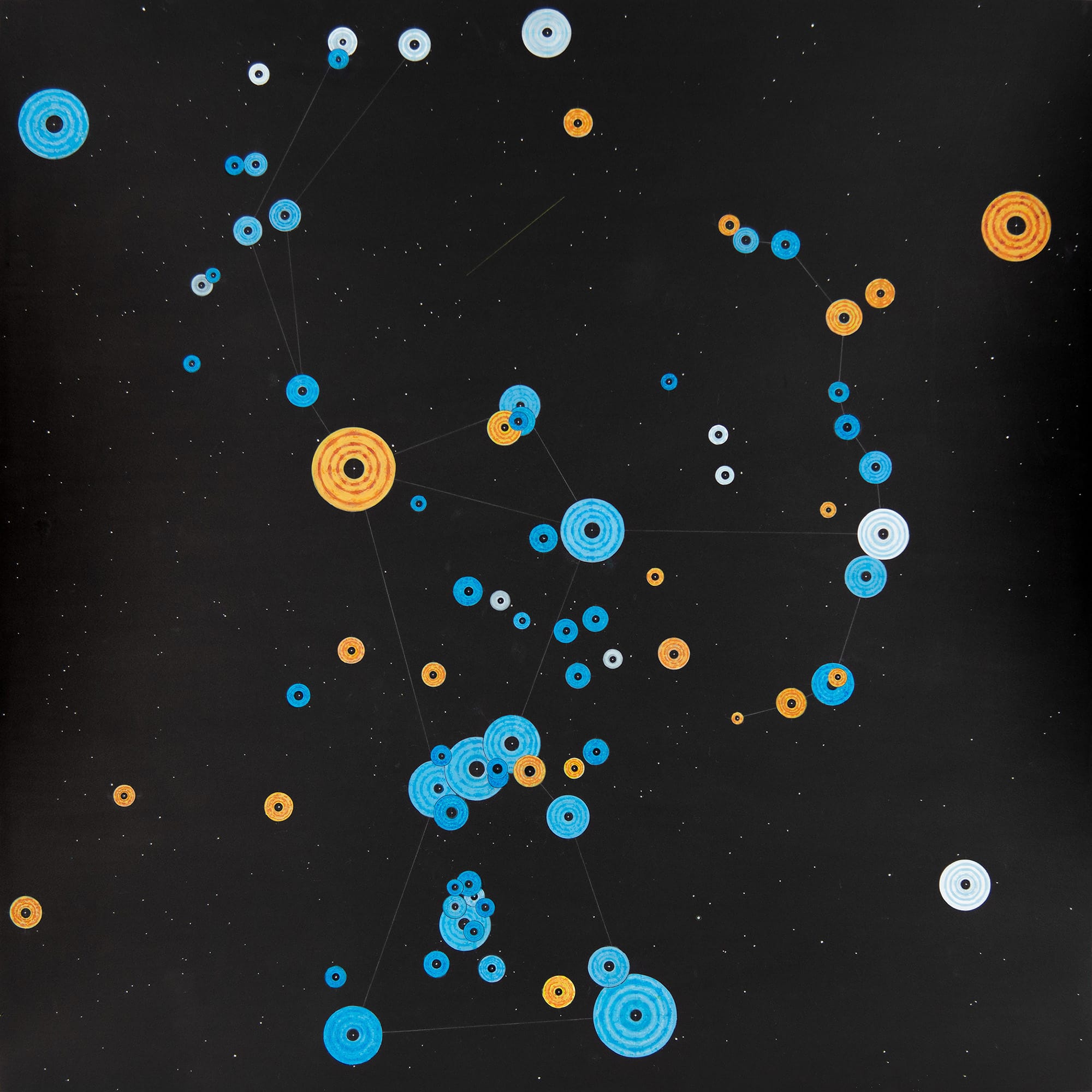
Makepeace said his wife gave him a telescope for Christmas, and he became interested in what happens when stars are deliberately thrown out of focus. A star that normally appears as a small white dot becomes larger and blurrier, revealing more color.
One work depicts the constellation Orion with defocused stars. But the actual subject is a small line showing the James Webb Space Telescope traversing the sky, based on positional data from NASA’s Jet Propulsion Laboratory.
“That is the wide-angle view of what I took pictures of. I was 30 feet away from it at one point, and now it's a million miles from us,” Makepeace said.
The emotional pull of that distance became part of the work. Makepeace said he remembered the feeling after the telescope launched when he wondered whether anyone would ever see it again.
“When they launched the telescope, I wasn't alone in feeling, like, will we ever see it again?” Makepeace said. “It's going to go way out there. Will you ever see it again?”
Makepeace said that while NASA focused on the data the telescope would send back, others wanted to see the object itself. He described finding imagery made by someone with access to a university-level telescope who used positional data to capture a time-lapse of the JWST moving across the sky.
“I just thought that was very emotional,” Makepeace said. “There it is, the thing I've spent years studying every nut and bolt of, drawing it carefully. I had this intense connection with it; I was right next to it, and now there it is a million miles away.”
That led to one of the works in the exhibition, a drawing Makepeace said does not look like much without the story behind it: stars, white dots and a tiny line.
“I titled it, Letter Home, because it’s like it's sending a few photons back to me, like a letter home, just like a little postcard from afar saying I'm still here,” Makepeace said.
The project has also shaped Makepeace's thinking about the value of artists engaging with science. He said artists may not solve scientific problems directly, but they can translate scientific work into another visual and conceptual language. “You see things differently,” he said.
Makepeace sees the project in the context of declining government support, highlighting why collaborations are needed as opportunities shrink.
“It's a tricky subject. First, there’s no money,” Makepeace said. “They've destroyed every government agency.”
Makepeace pointed to NASA’s historic art program, which featured artists including Robert Rauschenberg and Andy Warhol, as an earlier moment when the agency more actively invited artists into its orbit. But he said artists and government have often been uneasy partners.
“Artists and government is generally not a good mix,” Makepeace said. “Artists are nothing but trouble. You never want to deal with artists. They're just the worst.”
Still, he said, NASA’s public-facing work with artists can help translate the agency’s science to broader audiences, especially at a time when public understanding can shape whether agencies are politically vulnerable.
“They were trying to do it via artists because theoretically we have a big Instagram feed or something, and Congress has a harder time cutting their budget if the public knows all the good things they're doing,” Makepeace said.
Makepeace said NASA recently reached out again through a new open call for “content creators,” a category he said he does not fully understand. He was one of nine people selected to visit Goddard and view the Nancy Grace Roman Telescope, which is under construction.
He said he continues to work with the imagery and ideas that came from the JWST, including additional works based on light paths through the telescope’s camera.
He is less certain about where the work leads next.
“I don't know, it's not that easy,” Makepeace said. “Not much out there. I mean, D.C. is just hollowed out.”
Stories like this take time, documents and a commitment to public transparency. Please support independent arts journalism by subscribing to Urgent Matter and supporting our work directly.