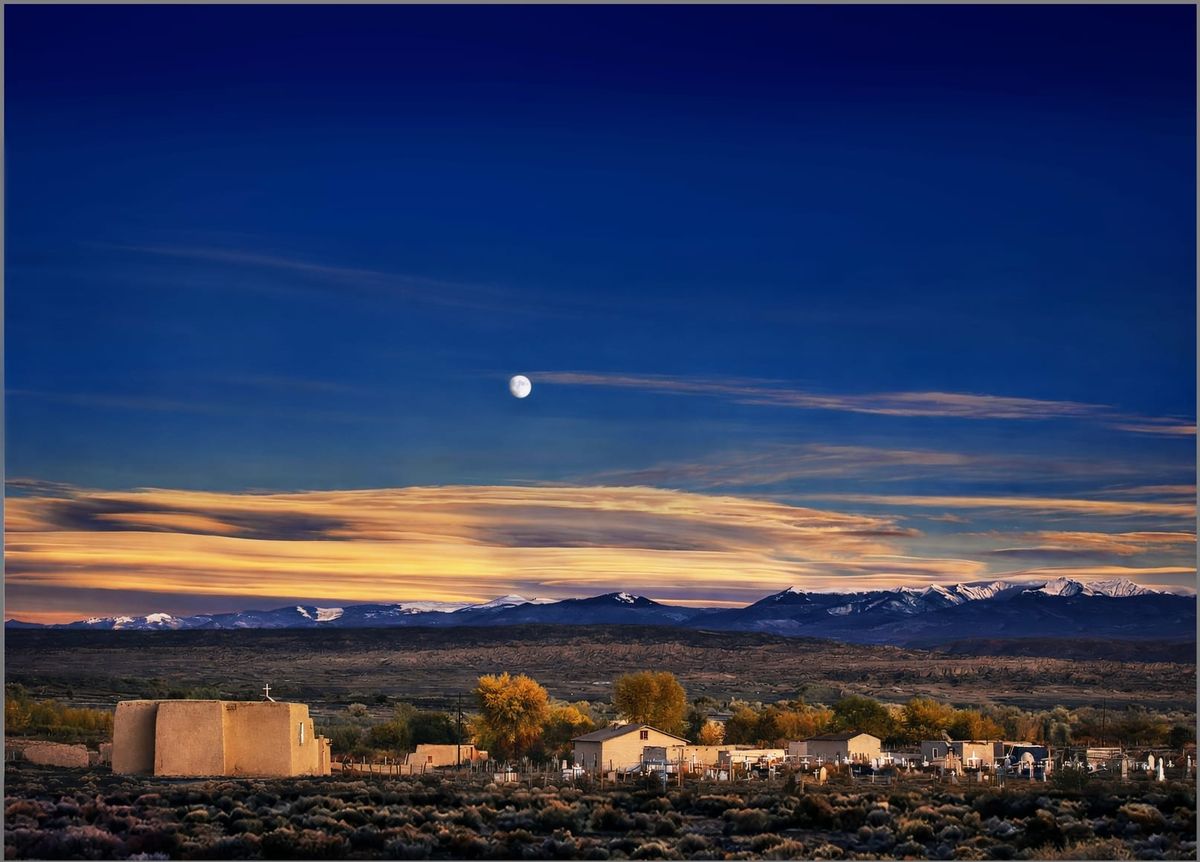
The Ansel Adams Publishing Rights Trust said New York dealer James Danziger has mischaracterized its position in the dispute over his version of Moonrise, Hernandez, New Mexico, which was colorized using artificial intelligence.

The trust, established by the famed photographer before his death in 1984, rejected any suggestion it had not contested Danziger’s claim that the image is in the public domain.

"James Danziger stated in a published interview that The Ansel Adams Publishing Rights Trust has not disputed his public-domain assertion regarding his A.I.-generated color version of 'Moonrise, Hernandez, New Mexico.' That is incorrect," the trust said in a statement posted to Instagram over the weekend.

"The trust has not accepted or conceded Mr. Danziger's legal position. His statement mischaracterizes the trust's position and treats unresolved factual and legal questions as settled.”

The trust said it “reserves all rights” and would address issues over the A.I. artwork “in the appropriate forum.”

The statement was shared through the official Ansel Adams account with trustee David Hume Kennerly as collaborator. It did not name the interview it referenced, and the disputed assertion does not appear in the written statement Danziger posted to his gallery's website on May 25.

The exchange is the latest turn in a dispute that began last month over a print Danziger generated using A.I. and offered for sale at The Photography Show presented by the Association of International Photography Art Dealers in April.

Urgent Matter previously reported that the trust condemned the gallery in a May 23 statement, saying it "did not authorize, endorse, consent to, or acquiesce in" the work. The trust said it asked Danziger to remove the print after learning of it and alleged he instead leveraged Adams's name while pursuing a proposed commercial A.I. colorization venture involving other artists' estates.

Danziger answered those criticisms in his May 25 statement, defending his right to make and sell the work.

"As the image is in the public domain I had every right to create a new and transformative work," he said.

Danziger said he had sought legal advice before proceeding.

"I had long believed the image was in the public domain but to confirm this beyond doubt, I hired one of the most respected copyright lawyers in the country," he said, adding that the image was confirmed to be in the public domain.

Danziger said A.I. served only as a starting point and the final print involved "extensive human intervention, editing, proofing, and refinement over many months." He said the work was made "with great respect to the image and the artist" and was clearly labeled as A.I.-generated at the fair.

"Public domain works have long served as foundations for reinterpretation, experimentation, and new creative dialogue across generations of artists," he said.

Danziger, who said he has spent a 50-year career defending photographers' rights, apologized for one aspect of the project.

"I would like to apologize for not informing them in advance of this project," he said.

He also said he had declined interview requests from several publications, framing the work as artistic rather than provocative.

"My intent was not to create controversy but to create something beautiful and interesting," he said.

Danziger closed his statement by quoting Adams himself — a 1983 remark, posted to the official Adams Instagram account, in which the photographer mused about the unexplored potential of the "electronic image."

Stories like this take time, documents and a commitment to public transparency. Please support independent arts journalism by subscribing to Urgent Matter and supporting our work directly.

Share this article
The link has been copied!