Researchers have identified a new species of small, feathered predatory dinosaur from a fossil site in northwestern China prized for its early birds. It is the first non-avian dinosaur skeleton found there and likely explains what was hunting the site's ancient avians.

The animal, named Jian changmaensis, belongs to the microraptorines, a group of small-to-medium feathered theropods and distant relatives of Velociraptor. Some carried long feathers on all four limbs and may have glided.

The species was described in the journal Annals of Carnegie Museum on June 4. The study was led by Ling-Qi Zhou of the Gansu Geological Museum in Lanzhou, China, where the holotype is held.

Matt Lamanna, a vertebrate paleontology curator at the Carnegie Museum of Natural History in Pittsburgh, served as the corresponding researcher. Others came from the Gansu Agricultural University, Chicago's Field Museum, the University of Nebraska State Museum and the Chinese Academy of Sciences in Beijing.

The fossil is modest, a single articulated left shoulder and forelimb. It is one wing's worth of bone, comprising the scapulocoracoid, humerus, radius and ulna.

That lone limb inspired the name. The genus honors the Jiān, a one-winged bird of Chinese mythology. The species name refers to Changma, the village near where it was found.

"For decades, the Changma site has been renowned among paleontologists for its extraordinary bird fossils," Lamanna said in a statement. "Now, with the discovery of Jian, we finally know what was eating them."

Paleontologists have recovered more than 100 bird skeletons from the Changma Basin, most belonging to the early bird Gansus yumenensis, but only this one non-avian dinosaur, the study said. At the site, fossils of more advanced, skeletally modern birds outnumber those of other bird lineages by roughly ten to one.

The predation is more than inference. Specimens of Microraptor, Jian's close relative from northeastern China, have been found with birds and a lizard preserved in their stomachs. This is direct evidence that these dinosaurs preyed on the kinds of animals that dominate Changma, the study said.

Jian is the first definitive microraptorine from northwestern China, extending the group's confirmed range roughly 2,000 kilometers west of the northeastern Chinese sites where its relatives have turned up.

The team set Jian apart from its relatives by three unique traits: an unusually long coracoid, a shoulder bone proportionally longer than in any other microraptorine; the elbow-end knobs of its upper arm bone positioned on the bone's front face, a configuration otherwise seen in birds; and a well-developed opening on the forearm's radius not documented in any other known dromaeosaurid.

The fossil's rare three-dimensional preservation also distinguishes it. Most microraptor specimens are found crushed flat, but this shoulder and arm survived intact, which the study said may help scientists reconstruct how the wing moved and how powered flight evolved in birds.

Jian lived about 120 million years ago during the early Cretaceous. A clumped-isotope analysis of the fossil quarries points to a seasonally warm, arid setting with a mean annual air temperature of about 68 Fahrenheit, the study said.

The specimen has been a long time coming. It was collected in 2008 by a Gansu excavation team and first reported in a 2010 conference abstract, the paper shows.

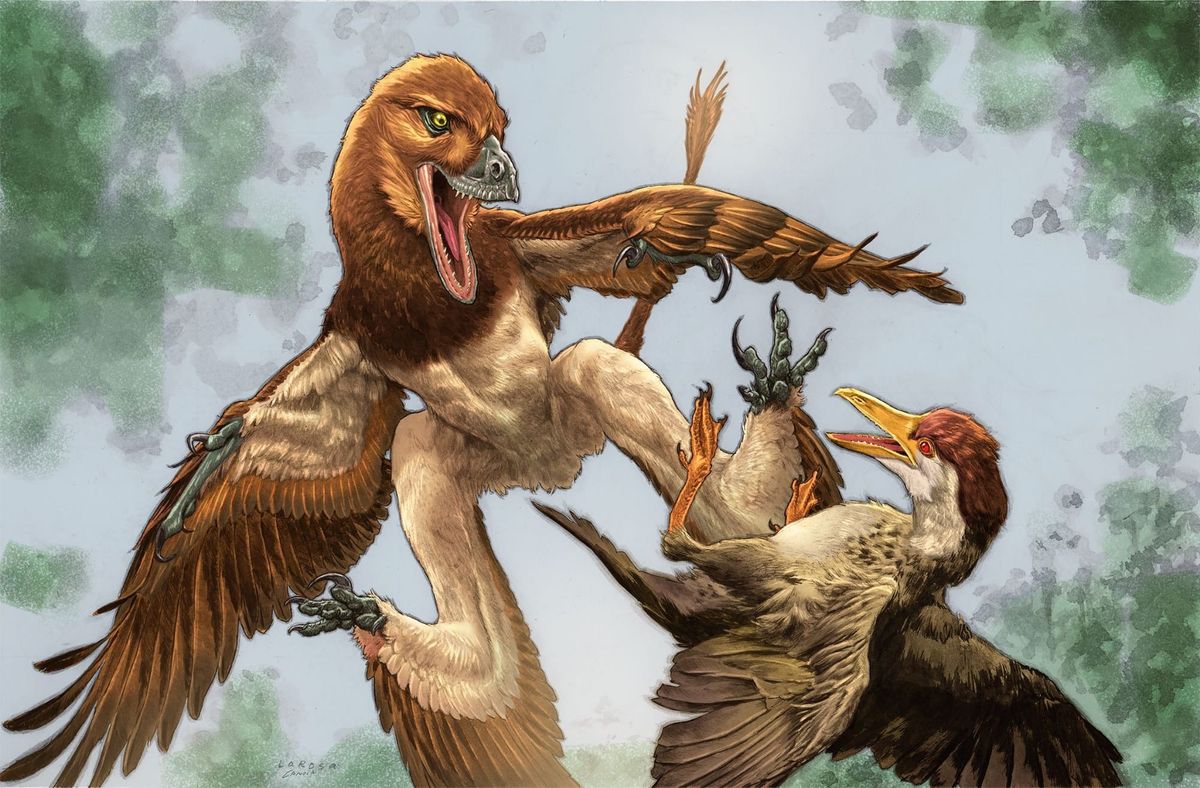
An accompanying illustration by Lewis LaRosa, colorized by Jão Canola, renders the encounter in mid-action. A russet-feathered Jian lunges from the left, jaws open over rows of small teeth and a clawed forelimb thrown wide. A Gansus, pale and mottled with a rust-colored crown and yellow beak agape, tumbles backward under the strike.

Set against a hazy green wash of foliage, the scene stages the paper's central claim as a single frozen moment: the bird site's long-missing predator, caught mid-kill.

Carey Miller, the museum's interim director, called the find "a meaningful contribution to our understanding of life on Earth" in a statement.

Lamanna has worked at the intersection of Chinese fossils and U.S. institutions before. In 2015, he helped Homeland Security Investigations identify a smuggled feathered dinosaur recovered after a Florida man was convicted of mislabeling fossils shipped from China as replicas.

That specimen was briefly displayed at the Carnegie Museum of Natural History before being returned to Beijing.

Share this article
The link has been copied!