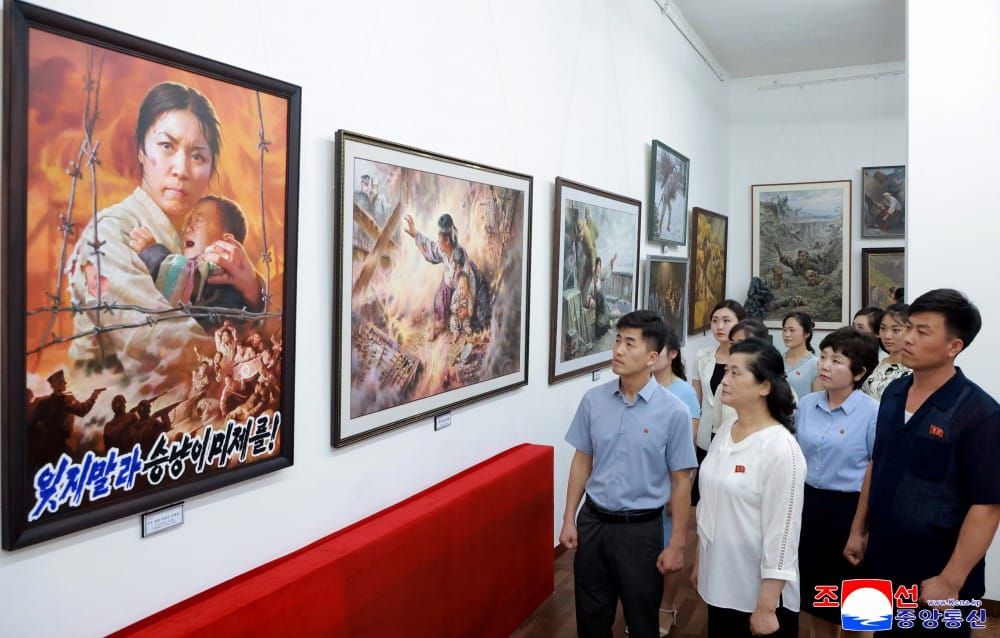
North Korea has opened an art exhibition on "class education," filling a Pyongyang gallery with paintings and calligraphy depicting alleged U.S. and Japanese wartime atrocities and urging visitors toward revenge, according to state media.
The exhibition opened June 23 at the Pyongyang International House of Culture, two days before June 25, which North Korea observes as the Day of Struggle Against U.S. Imperialism and the anniversary of the Korean War's outbreak in 1950. It runs through July 30, the state-run Korean Central News Agency reported.
The works "show the class nature of the U.S. imperialists and other sworn enemies," KCNA reported.
The show is part of an annual June campaign where Pyongyang stages rallies, lectures and cultural programs to reinforce anti-American sentiment.
In the same week, state media reported schoolchildren gathered at the Youth Park Open-Air Theatre and the plaza of the Victorious Fatherland Liberation War Museum to hear about the works and pledge revenge on the U.S., making children part of the exhibition's intended audience.
The programming follows a directive Kim Jong Un issued at the Workers' Party's Ninth Congress in February, telling the country's literature and arts sector to focus on raising "revolutionary consciousness" and mobilizing the public behind party policy.
The largest and loudest work is a propaganda poster. A young woman with a bloodied face clutches a screaming child against a barbed wire fence, set against a wall of orange fire and, below, a churning battle scene. Red Korean lettering across the bottom translates roughly to "Never forget the wolfish U.S. imperialists."
Nearby, an oil painting shows a figure reaching through the flames of a collapsing traditional house.
Much of the exhibition consists of oil paintings in the Socialist Realist style. In one large canvas, soldiers raise the North Korean flag on a smoky battlefield, one of them shielding his eyes toward the horizon. In another, a young woman in military dress grips a rifle, lit by a warm interior glow. A panoramic history painting stages a chaotic battle at a traditional Korean gate.
Not every work depicts battle. A warm-toned genre painting shows a thatched-roof farmhouse, with a woman resting in the courtyard while a man loads a wooden cart with grain. A soft, misty ink painting shows a girl at her handicraft among reeds and baskets, the gentlest image in a hall otherwise filled with combat.
The exhibition mixes three traditions: oil painting, chosonhwa, the traditional Korean ink-and-wash, and seoye, or calligraphy. The calligraphic scrolls, rendered in bold black brushwork and mounted like classical hangings, carry the show's slogans. One poster on display is titled "Let us take revenge upon class enemies a thousand-fold!" state media said.
Several works draw on Sinchon, a county where North Korea says U.S. and South Korean forces killed tens of thousands of civilians in the winter of 1950. The parallel schoolchildren events invoked the deaths of 102 children there.
The Sinchon history is disputed. South Korean and independent historians have attributed much of the killing to local violence between Communist and anti-Communist Koreans, and the death toll North Korea cites is not accepted outside the country.
The exhibition continues a pattern where Pyongyang uses visual displays as ideological instruction.
In January, North Korea opened a national photo exhibition at the Okryu Exhibition House celebrating the "immortal exploits" of Kim Jong Un. It has increasingly repurposed cultural-heritage frameworks, registering pastimes such as sledding as "intangible cultural heritage" to project legitimacy.
North Korea remains largely closed to outside observers, making state media the primary public record of its cultural life. That makes it difficult to independently verify the exhibition's contents or how it is received, beyond the images and descriptions the state chooses to release.
Urgent Matter is reader-supported. Please consider subscribing to support independent arts journalism.