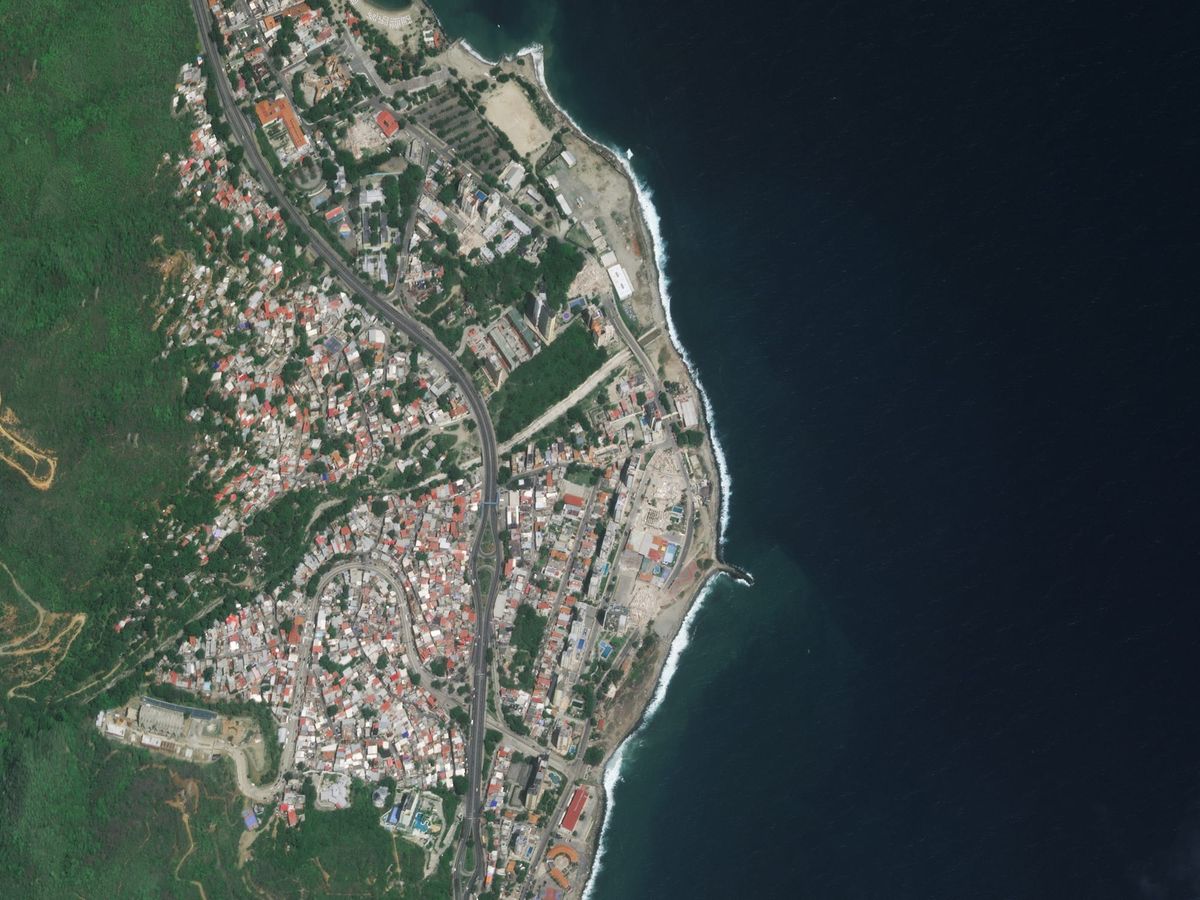
Satellite imagery of Venezuela's earthquake-stricken central coast shows extensive destruction around two notable 20th-century cultural landmarks but does not establish the loss of either, imagery reviewed by Urgent Matter shows.

Twin earthquakes of magnitude 7.2 and 7.5 struck northern Venezuela about 40 seconds apart on the evening of June 24. The coastal state of La Guaira, just north of Caracas, was declared a disaster zone.

At least 1,450 people had been confirmed dead and some 3,150 injured as of June 28, the president of the National Assembly said, with the toll expected to rise.

The hardest-hit areas include the neighboring coastal towns of Macuto and Caraballeda, which hold the Hotel Miramar and the Residencia Caraballeda, a 1970s seniors' home whose chapel contains an in-situ work by the kinetic master Alejandro Otero.

In before-and-after frames of Macuto provided by Planet Labs, the Miramar's distinctive cruciform footprint and open central rotunda appear in both images, surrounded by mature vegetation growing through the structure. The fresh debris visible in the later frame is around the monument, not within its walls.

That reading is consistent with the building's documented condition. Miramar's upper domes collapsed in 2016 after heavy rains, according to records from the heritage catalog IAM Venezuela, and the monument is described as in complete abandonment. The hotel was designed by the architect Alejandro Chataing, inaugurated in 1928 and declared a National Historic Monument in 1994.

Lists of collapsed structures circulating since June 25 include an entry for "Miramar," grouped with modern residential buildings such as Rocapark, La Mar Suites and Oasis Beach. But the imagery shows the historic hotel appears to remain standing.

The waterfront hotel reported destroyed in Macuto is the Hotel Eduard's, which stood across from the Jorge Luis García Carneiro stadium and collapsed completely, according to the outlet El Estímulo. Families of Delfines de La Guaira and Guerreros de Lara baseball players had been staying there.

As for Caraballeda, the most at-risk cultural site is just outside the satellite footage. The Residencia Caraballeda, designed by the Venezuelan architect Carlos Gómez de Llarena and inaugurated in 1973, sits in the hills above the Caraballeda waterfront. The residence is the only work Gómez de Llarena built outside Caracas, records from IAM Venezuela show.

The residence's chapel is round and deliberately spare. Otero made colored glass for its cross-shaped roof, carried on four paired columns, so that the room takes daylight only from overhead, through his panels, records from the Fundación Arquitectura y Ciudad show. Otero completed the work in 1974, according to catalogs of his work.

Otero, who died in 1990, is regarded alongside Jesús Soto and Carlos Cruz-Diez as one of Venezuela's foremost kinetic artists.

The georeferenced Caraballeda imagery reviewed by Urgent Matter, captured June 19 and June 27, shows widespread new collapse and debris across the lower town and seafront between the two dates. The residence and its chapel lie in the hills above that strip and are not contained in the frames. The imagery, therefore, cannot speak to the chapel's condition.

But the Anala and Armando Planchart Foundation, which manages the residence, has posted appeals for aid on its Instagram account.

Residents and staff are sheltering in the chapel, the foundation wrote. Eight residents have no family in the country. The residence has no gas, water or electricity, and access to Caraballeda is severely limited. The foundation requested donations and supplies, including adult diapers, dry food, a generator and oxygen equipment.

Access worsened further on June 26, when a magnitude 4.7 aftershock brought down the bridge linking Caraballeda to the rest of La Guaira and set back relief operations, according to news accounts.

Imagery of Caracas reviewed by Urgent Matter, covering Altamira and Los Palos Grandes and captured June 14 and June 27, shows a debris field where built structures stood in the earlier frame. The change is consistent with reports that a 22-story building in Altamira collapsed. The Residencial Petunia, a 14-story building, and a Bancaribe building were also reported to have fallen in Caracas.

Venezuela's principal national art museums, including the Galería de Arte Nacional and the Museo de Bellas Artes, sit in the Los Caobos museum plaza and are not within any of the images provided.

Official damage assessments do not yet state whether the Miramar, the Residencia Caraballeda or the bulk of the country's cultural institutions and sites sustained structural damage in the earthquakes. The full extent of the losses is not expected to be known for days or weeks.

The disaster has already claimed figures from Venezuela's cultural life. The four members of the rap-rock band Van Der Dijs died when a building collapsed during a rehearsal in Tanaguarena, in La Guaira, news outlets reported.

Urgent Matter is reader-supported. Please consider subscribing to support independent arts journalism.

Share this article
The link has been copied!