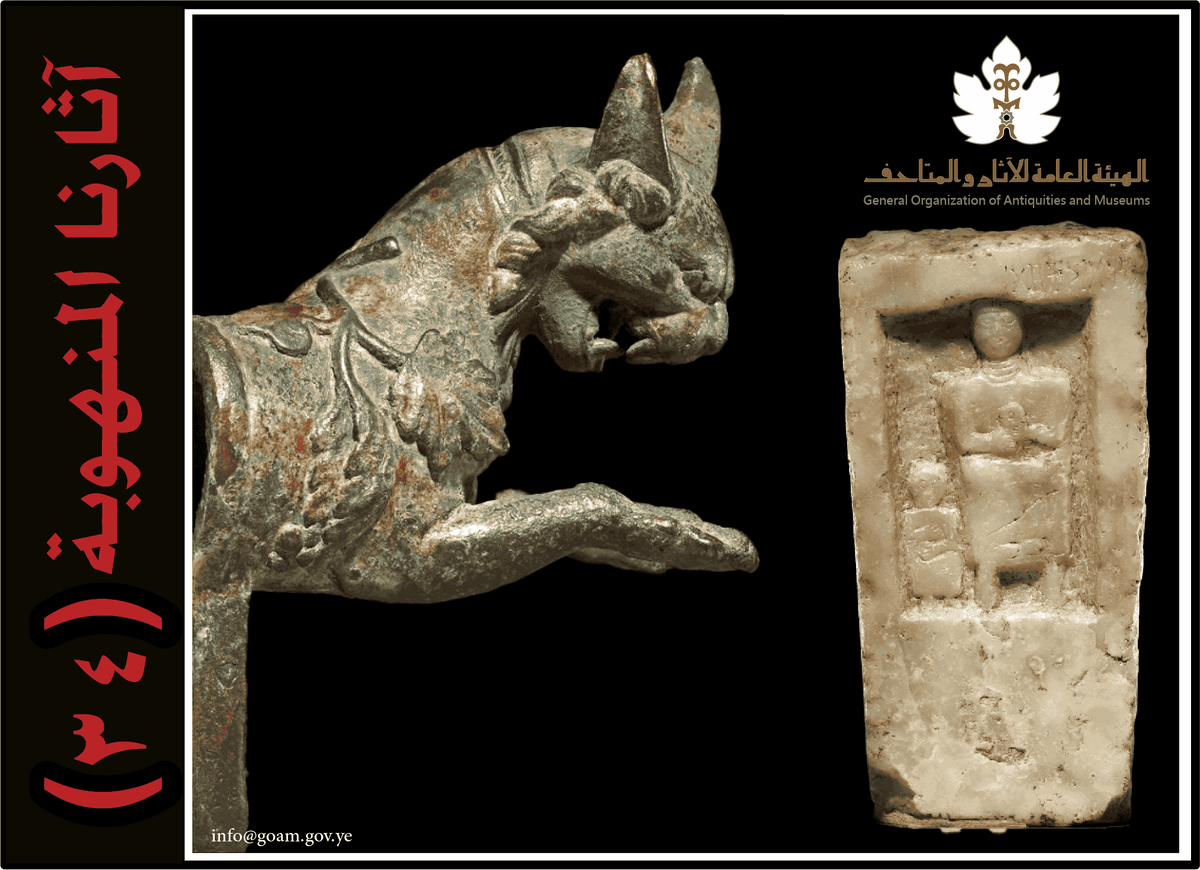
Yemen’s antiquities authority has identified 28 objects — 20 held by the British Museum and eight offered for sale in early July at two London auction houses — as looted pieces of the country’s cultural heritage, the latest entry in a rolling series of public lists tracking Yemeni artifacts abroad.
The General Authority for Antiquities and Museums published the group as List No. 34 in a June 29 release on its official website. It said it had notified relevant international bodies about the pieces and posts the lists under the banner “Our Stolen Antiques.”
The first eight objects — statue heads, a statue, an inscription and funerary stelae — were offered for sale in early July at Bonhams and at Apollo Art Auctions in London, the release states.
Bonhams’ July 2 antiquities sale included lots cataloged as “A large South Arabian alabaster head of a man” and “A South Arabian alabaster head of a woman,” both sold. The male head brought £5,120 with premium.
Auction catalogs commonly describe objects from present-day Yemen as “South Arabian” or “Ancient Arabian,” ARTnews reported.
The remaining 20 pieces are in the British Museum and include incense burners, seals, inscriptions in the ancient Musnad script, tablets and statues, according to the release. The authority said the objects left southern Yemen during British rule in Aden.
Some were acquired by Colonel William Francis Prideaux, an administrator in the British colonial government of Aden, and entered the museum by gift or purchase. The authority said his son, Lieutenant L.A.R. Prideaux, sold several artifacts and coins to the museum in 1915.
The list also attributes pieces to the British dealer Henry Oppenheimer, who the authority said joined Maurice Rosenheim in giving Yemeni antiquities to the museum in 1919.
Sign up for Urgent Matter
This article is provided free with the support of paying subscribers. Not ready for a paid subscription? Sign up for a free account today.
No spam. Unsubscribe anytime.
The June list is the 34th the authority has issued. The series extends beyond the United Kingdom. The 27th list, published in August 2025, named 53 items the authority said were displayed at the Museum of Islamic Art in Kuwait.
Earlier lists this year followed the same template. List 33, issued June 1, included 58 pieces: 45 objects described as gold jewelry and a stone vessel from Wadi Bayhan, in the ancient kingdom of Qataban, now in the British Museum, and 13 offered in May and June at Freeman’s and Artemis Fine Arts.
The Bayhan group entered the museum in 1977 through British dealer Nicholas Wright, after passing through a local sheikh, the authority said. It singled out two objects in follow-up posts: a gilded box-shaped ornament and a strand of eighteen gold beads.
List 32, issued April 24, listed 41 pieces in three groups. Among them were 23 tied to the French Aden merchant Antonin Besse, whose collection passed to the British Museum under his will after his death in 1951, and a group linked to British dealer Geoffrey Turner, a former Christie’s employee active since the 1960s.
The authority has estimated that more than 13,000 antiquities have been smuggled out of Yemen since 1994, about 8,000 during the past decade of war, ARTnews reported. The Housing and Land Rights Network put the Sana’a-based authority’s wartime figure at 8,000 and cited outside estimates ranging from 10,000 to 14,000 Yemeni artifacts abroad.
Yemen’s 1994 antiquities law bars the sale and export of movable archaeological objects without a permit and provides for the state to seek the return of anything exported illegally, according to a 2018 press kit from the International Council of Museums.
At the request of the U.S. State Department that year, ICOM published an Emergency Red List of Cultural Objects at Risk for Yemen, launched at the Metropolitan Museum of Art and distributed to customs agencies, INTERPOL, museums and dealers.
Four of Yemen’s five UNESCO World Heritage sites are cultural — the Old City of Sana’a, the Old Walled City of Shibam, the Historic Town of Zabid and the Landmarks of the Ancient Kingdom of Saba in Marib — and all four are inscribed on the List of World Heritage in Danger.
Yemen’s museums have been hit hard since the war began in 2014. The Housing and Land Rights Network reported that 12 of the country’s 22 museums were looted or damaged. The Regional Museum in Dhamar and its roughly 12,500 pieces were destroyed, and one antiquities expert estimated about 60% of the National Museum in Sana’a’s holdings were taken.
Some Yemeni material has been recovered through the country’s internationally recognized government. In February 2023, the United States repatriated 77 objects and placed them under a two-year custodial agreement with the Smithsonian’s National Museum of Asian Art, which has shown some of them in its exhibition “Ancient Yemen: Incense, Art, and Trade.”
“With the current situation in Yemen, it is not the right time to bring the objects back into the country,” Mohammed Al-Hadhrami, the Republic of Yemen’s ambassador to the United States, said at the time.
In 2023, the Victoria and Albert Museum agreed to care for four Yemeni funerary stelae recovered by London’s Metropolitan Police from an East London shop until they can safely return.
Those returns ran through the recognized government, which is based in Aden and maintains the embassies that signed the U.S. and British agreements. The lists come from the antiquities authority headquartered in Sana’a, the capital held by the Houthi movement since 2014.
Follow this dispute and other claims at Urgent Matter’s restitution tracker.