New play turns Lilith’s Eden into art at The Tank
The play revisits the medieval story of Adam’s first wife, recasting Lilith as a woman navigating religious authority, sexual violence and freedom.

The play revisits the medieval story of Adam’s first wife, recasting Lilith as a woman navigating religious authority, sexual violence and freedom.
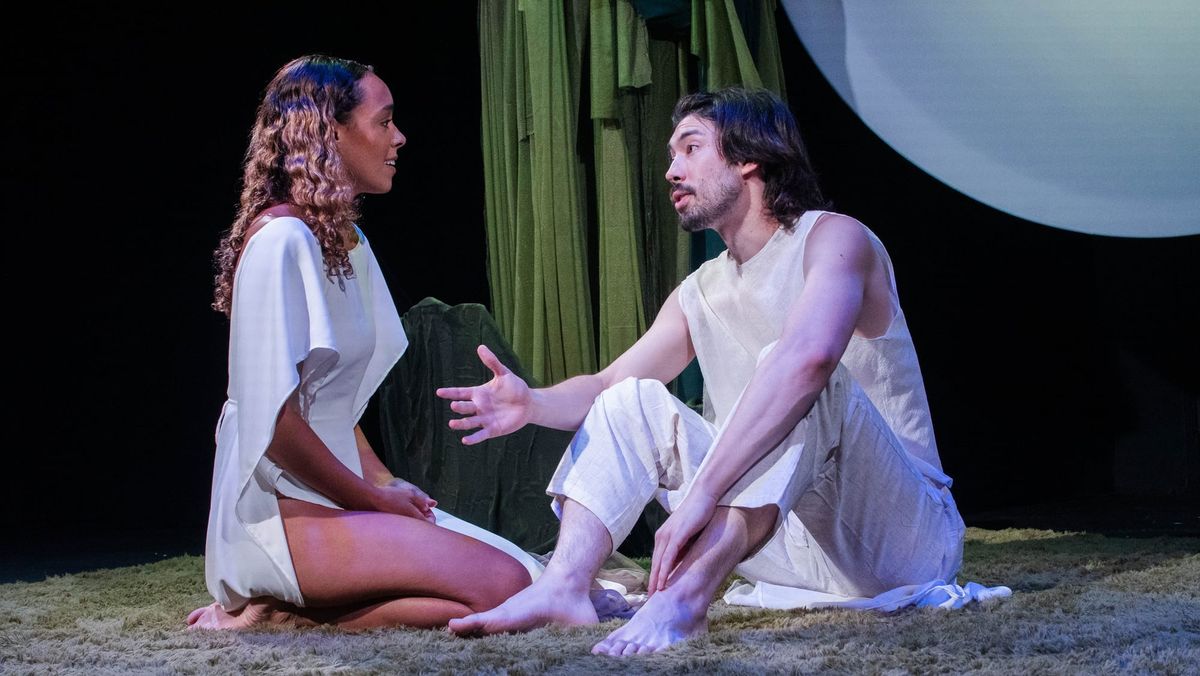
A new play about Lilith, the mythological first wife of Adam, turns Eden into an installation—a green rug, a tree-like column, a giant moon and almost nothing else.
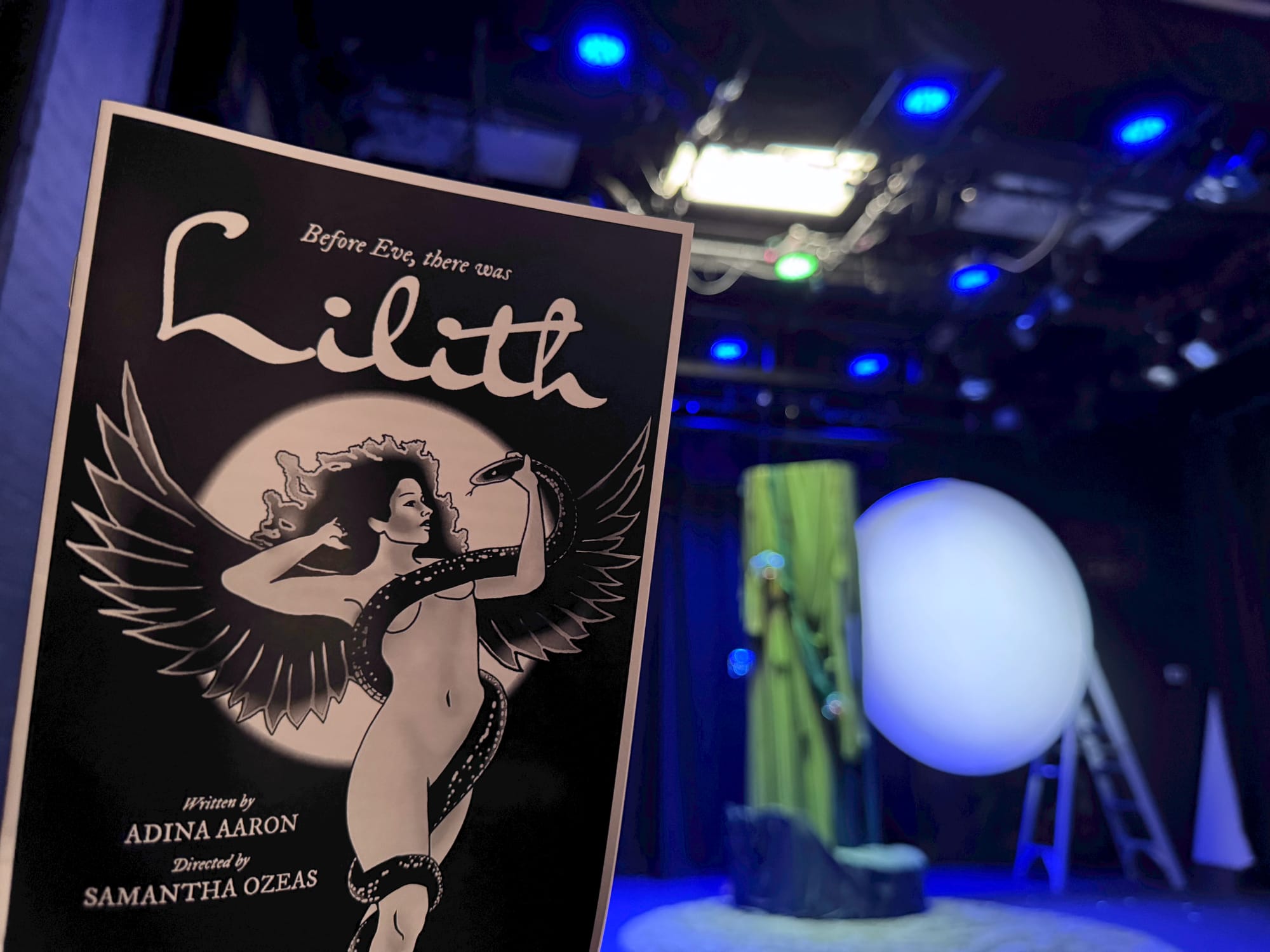
The 90-minute production, Lilith, is the first full staging of the play and the playwriting debut of Adina Aaron, who wrote and co-produces it. It runs through August 22 at off-off-Broadway venue The Tank in New York.
Samantha Ozeas directs. It is presented by Bhavani Rao in association with The Tank, and stars Sofia Victoria Deler as Lilith, Erik Ohno Dagoberg as Adam and Bryanna Marie Felipe as Eve.
The Lilith myth was first introduced in the Alphabet of Ben Sira, a medieval Jewish text that contains the first known written story of Lilith as Adam's first wife, who was made from the earth at the same time as Adam. Lilith does not appear as a named character in the canonical Bible.
Aaron told Urgent Matter she set out to imagine the character folded back into Genesis. Her idea was that the story “could fit into the biblical canon of Adam and Eve, as if Lilith had simply been taken out of the story and forgotten.”
Aaron’s version casts Lilith as a woman who existed before Eve and refused to submit to Adam. “Most religions know about the creation story, but what if Eve wasn’t the first woman?” Aaron said. “What if she didn’t come from Adam? What if she challenged what existed before her?”
In the Alphabet of Ben Sira story, Lilith refuses to submit to Adam, leaves Eden and later becomes associated with demons who threaten children in Jewish folklore. The program’s playwright note describes how, in pursuing knowledge and freedom, she “became known as a demon, a midwife of miscarriages, an evil force.”
In Aaron's version, Adam rapes Lilith, who challenges him and leaves Eden. Eve is then made from Adam’s rib but is often left alone in the garden as he seeks communication with God. Lilith secretly returns to the garden, growing romantically close with Eve, who is unaware of Lilith’s identity as the first woman. Conflict brews and the play reaches a tragic ending.
Dagoberg said playing Adam as the antagonist was freeing. “If I’m not bad, if I’m not quite an asshole, if I’m not quite a douchebag, if I’m not quite controlling, the story isn’t told the same way,” he said.
Aaron, who said she grew up “at the temple and in a Jewish day school and community,” described the play as a way to question religion’s role in gender and sexuality without endorsing or rejecting faith. Her program bio says she was raised in a Reform Jewish rabbinical family and later explored Buddhism.
“A lot of the time, people use religion to dictate how people should live their lives, especially women and queer people,” Aaron said. “I wanted to speak to the way that religion can actually hinder our freedom, yet at the same time, it’s what connects us to the source of our life.”
The play was first drafted while Aaron was an undergraduate at the University of Michigan and was selected for the school’s New Works Festival in 2023, the program states. It later moved through The Bechdel Group’s 2023 fall workshop season and staged readings in Los Angeles and New York. The most recent reading was in summer 2025.
For Ozeas, the script’s appeal was its stage directions. “I was excited by how many stage directions were included,” she said, listing several she first considered impossible to stage: “Lilith sprouts wings on stage. A snake comes and wraps around Eve. Gates are thrust up in the garden.”
The play relies heavily on poetic soliloquies. Dagoberg said the cast talked about Shakespeare while working through the poetic text. Aaron said such language was absent from her first draft.
“Our first draft did not have that language,” she said. “It unlocked a quality of the world and the conversation with God, because I see God as its own character in the piece.”
Ozeas said pairing the stage directions with the play’s poetry “was an exciting challenge I wanted to run headfirst into.”
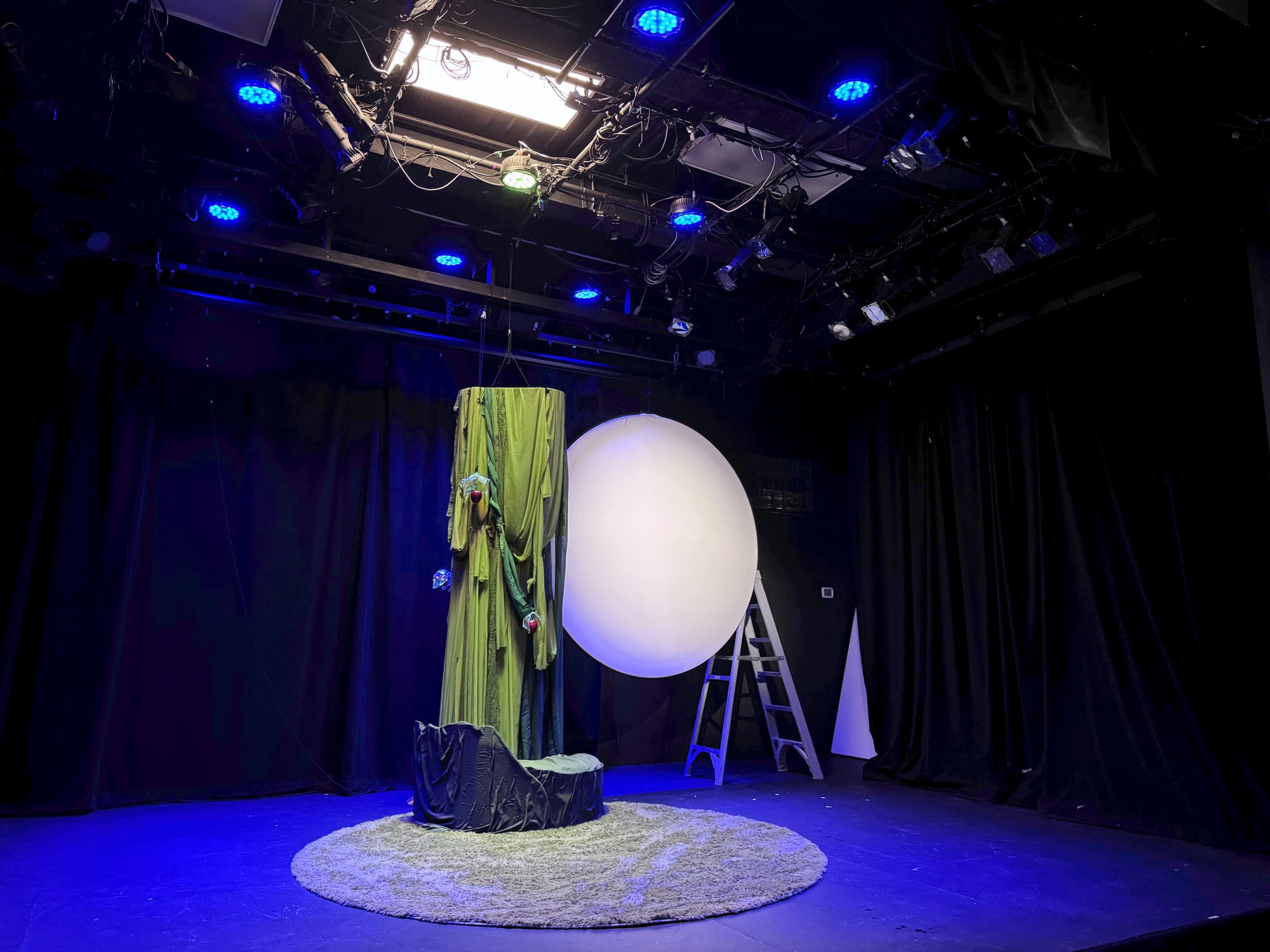
Ozeas said she and scenic designer Ningning Renee Yang approached the set as installation art early on, limited by a small budget. The two “talked a lot about how we wanted Eden to look like a piece of art that could tell the story,” she said.
The set is simple. A green column representing the Tree of Knowledge of Good and Evil rises from the center of a circular green rug. Stage-left, a massive white orb represents the moon. A stepladder sits beside it. No props were used, except at one point when Lilith sprouts wings.
Rather than build every effect literally, the team worked backward from the script’s imagery, Ozeas said.
“It was a matter of identifying those magical moments and reverse-engineering the scenic design to support them,” she said, citing “the wing coming out of the tree, Eden being a purposefully very small square footage in the middle of the play that they’re not really able to escape.”
Aaron said the production treats celestial bodies as stand-ins for its leads. “We were talking a lot about how the moon represents Lilith and the sun kind of represents Adam,” she said.
The costuming inverts Lilith’s traditional look, Aaron said. Lilith—now a common figure in pop culture and media—is often seen as demonic, dressed in black. Costume designer Paola Castañeda wanted to challenge that with a lighter image. Aaron said the white costuming places any sense that Lilith is demonic in the eyes of other characters rather than in her appearance.
The play contains no nudity. Aaron said Castañeda’s costumes allude to it instead.
The production carries advisories for sexual content, sexual assault, blood, self-harm, simulated childbirth and strong language. Aaron said an earlier version depicted Lilith's assault explicitly, but she ultimately chose to stage it through poetry instead.
“Especially for people with trauma and history of sexual assault, I think it’s not necessary to see that on stage,” she said.
Aaron said the play also lets Lilith love the man who harms her. She wanted to show that “even the person who really hurt you and you know is not right for you, the love can still remain and exist.”
The production is fiscally sponsored by Women of Color Unite, according to the program, which also points audiences toward organizations including the National Organization for Women, Planned Parenthood, the Center for Reproductive Rights, RAINN and Safe Horizon.
The cast said they reached outside theater for reference points. Deler, attached to the play since Aaron’s first reading in her senior year of college, said she prepared partly by reading a biography of performance artist Marina Abramović during the pandemic and by picturing the play as a nature program on Nat Geo Wild.
Deler, who said the role fits her closely, liked imagining she was “watching human beings in their most raw, kind of animalistic and pure.”
“It feels like putting on like a pair of jeans that fits well,” she said. “It’s not a stretch.”
Felipe said she modeled Eve on newly created beings in literature and film, mainly Frankenstein and Emma Stone’s Bella Baxter in Poor Things. She called Eve “a very somatic character.”
She described Eve as someone who navigates the world through her body.
“Through Eve’s lens, she is learning so much and trusting what she knows to be true at the beginning,” Felipe said. “And since she can’t rely on her mind, she relies on her body and what everything feels like.” She said the play returns repeatedly to intuition: “Whether you call that God, intuition, or Inanna, it doesn’t matter. It reminds you to continue having bodily autonomy and being curious.”
Speaking to the play’s ending, Aaron said Eve is written as a foil, a woman who chooses safety over solidarity.
“Eve ultimately represents this side of womanhood, like women that aren’t feminists, or women that go against other women out of favor of their own comfort and safety,” she said. “And she could’ve had a choice for freedom, but she ultimately needed to choose what was safe for her.”
Urgent Matter is reader-supported. Please consider subscribing to support independent arts journalism.