Trump-appointed commission approves arch despite fierce opposition
The revised design advanced in a 4-0 vote after near-total written opposition.

The revised design advanced in a 4-0 vote after near-total written opposition.
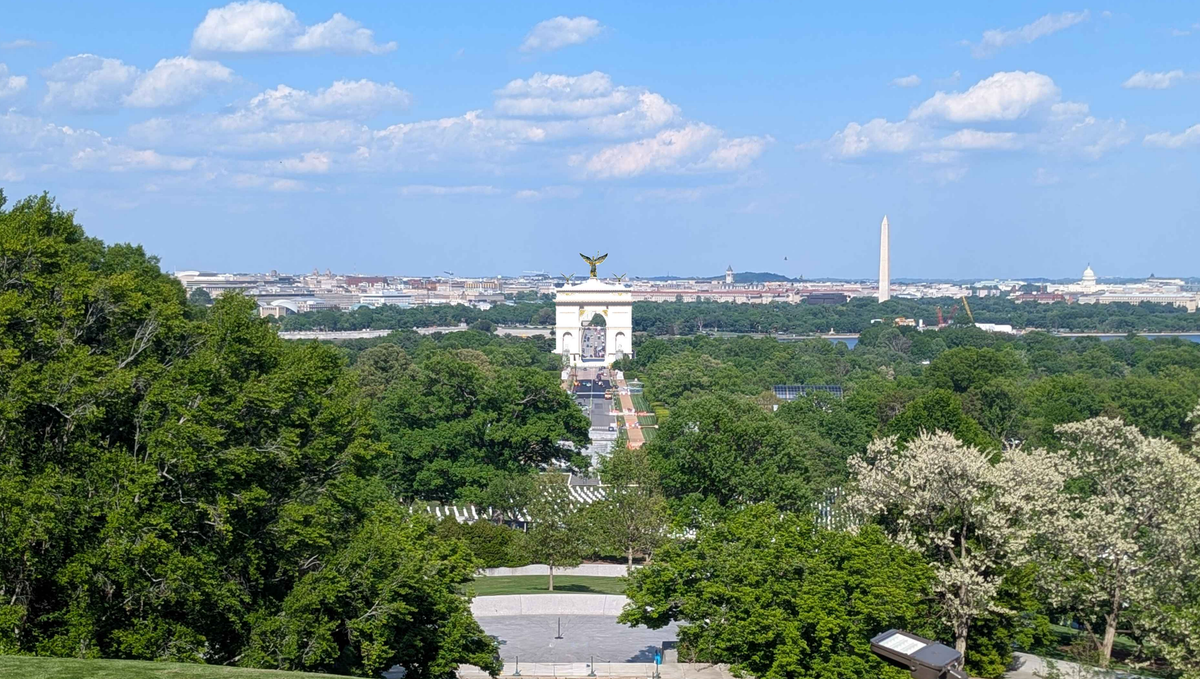
The U.S. Commission of Fine Arts approved the design for a monumental arch near Arlington National Cemetery after a hearing Thursday that drew objections from preservation groups, veterans and residents who said the project would disrupt one of Washington’s most symbolic landscapes.
The commission voted by voice to approve the revised concept for the arch at Memorial Circle, at the Virginia end of Arlington Memorial Bridge, advancing a project championed by President Donald Trump despite public opposition to its scale, symbolism, location, and review process.
The vote came about four months after Trump appointed all seven current members, of the commission to four-year terms.
At its January 22 meeting, the newly appointed commission elected Rodney Mims Cook Jr., founder and president of the National Monuments Foundation in Atlanta, as chairman and James C. McCrery II, once Trump’s chosen architect for the White House ballroom, as vice chairman.
The Commission of Fine Arts’ official agenda listed the arch as a revised concept for a new monumental arch submitted by the Executive Office of the President and the U.S. Department of the Interior.
The project is proposed for Memorial Circle, where Arlington Memorial Bridge meets the approach to Arlington National Cemetery and Arlington House.
Thomas Luebke, the commission's secretary, said the agency had received about 600 additional public comments since its previous review. Nearly all opposed the proposal, he said, with only three comments in support, two proposing significant design changes.
Nicolas Charbonneau, principal of Harrison Design, presented the revised arch as a gateway to the capital commemorating the nation’s 250th anniversary. He said the main structure would be 166 feet tall, or 191 feet above sea level, including site elevation. With the statuary above, the monument would reach 275 feet above sea level.
“The president considered the commission’s suggestion to look at the arch without the sculptural figures on the roof, but elected not to pursue such an option,” Charbonneau said.
The revised design removed some elements that drew criticism during the prior review. Charbonneau said the proposal no longer includes tunnels for pedestrian access, a raised platform, stairs and ramps around the base, or lions and pedestals that previously flanked the monument design.
Gregory Wischer, deputy chief of staff for policy at the Department of the Interior, said the National Park Service worked with the Department of Transportation, the Volpe Center, and the Federal Highway Administration on traffic plans. He said the plan prioritizes pedestrian and vehicle safety and efficient traffic movement, including access to Arlington National Cemetery.
Opponents said those changes did not address the project’s central problems.
The National Trust for Historic Preservation urged the commission to reject or defer the project, saying the proposal raised issues under the Commemorative Works Act and that review under Section 106 of the National Historic Preservation Act had not been completed.
Betsy Merritt, the National Trust’s deputy general counsel, said the arch would interrupt the deliberate relationship among the Lincoln Memorial, Arlington Memorial Bridge, Arlington National Cemetery and Arlington House, a view preservation groups described as central to the capital’s post-Civil War landscape.
Rebecca Miller, executive director of the DC Preservation League, also opposed the project, saying the view between the Lincoln Memorial and Arlington House carries national meaning because it links Lincoln’s memorial with the former home of Robert E. Lee.
Nord Wennerstrom, director of communications for The Cultural Landscape Foundation, said the arch would alter a landscape shaped by the McMillan Plan and the work of Frederick Law Olmsted Jr.
He cited earlier-rejected bridge designs with towers, arches and sculptural programs and said the current proposal revived problems that earlier planners had avoided.
Several public commenters also urged the commission to delay or reject the project.
Susan Douglas, a public commenter, criticized the speed of the approval process and said the arch should not proceed while legal, aviation, soil, and historic-preservation questions remain unresolved.
“Democracies do not build memorials to living presidents,” Douglas said.
Gary Langston, who said he served 29 years in the Army and whose parents are buried at Arlington National Cemetery, asked the commission to require additional view studies from inside the cemetery and nighttime renderings of the arch.
“I seriously question the underlying purpose of the arch, which is a monument, as opposed to a memorial,” Langston said.
John Ayers, a D.C. resident, said Arlington Memorial Bridge should be understood as part of the ceremonial approach to Arlington National Cemetery, not merely as a crossing.
“I have no objection to a monument for the living, I just don’t think it belongs here on our way to the cemetery,” Ayers said.
Mary Anne Carter, the chair of the National Endowment for the Arts and a member of the commission, said during the discussion that she appreciated the removal of some ornamentation and urged the design team to remember the simplicity of Arlington’s grave markers.
“The gravestones in Arlington are very simple white markers,” Carter said. “Losing a bunch of the adornments is actually very helpful.”
Carter spoke before a break in the hearing, but did not return for the final vote. The four commissioners present voted unanimously to approve the arch.
Cook and McCrery rejected the argument that the arch would block the historic view. They said its scale would allow the structure to frame rather than obstruct the view. Cook also argued the main structure’s 166-foot height had been conflated with the taller total height, including the rooftop statuary.
McCrery said the project team addressed a major concern by showing the arch in context and discussing its relationship to the long ceremonial connection between the Lincoln Memorial and Arlington House.
He also said the commission’s role was limited to reviewing the design, not resolving every legal, political, or procedural objection raised by opponents.
The hearing came amid broader scrutiny of Trump’s reshaping of federal architecture and commemorative review bodies.
 Adam Schrader
Records released to Urgent Matter by the National Endowment for the Arts show Carter was being onboarded for her return to the commission in January. In a January 15 email, Luebke congratulated her on her reappointment by Trump.
“I got the official word— congratulations on your reappointment by President Trump to the Commission of Fine Arts!” Luebke wrote.
The final motion on Thursday prompted some confusion over whether the commission was approving only the revised concept, the main structure, or the full design, including rooftop sculpture.
Luebke asked Cook to clarify whether the approval included the winged sculptures on top. Cook said the approval covered the full concept, including the rooftop decoration, while the commission still expected to see more detail on the sculptural program.
“The approval is for the entire concept, with the decoration at the top, and the 166-foot-tall building, and we want to see the sculpture as to what it’s going to ultimately look like,” Cook said.
After the vote, McCrery praised the model and said it showed the arch’s relationship to the Mall and Washington’s major monuments.
“The model is very persuasive,” McCrery said.
The arch is expected to receive further review from the National Capital Planning Commission. The Commission of Fine Arts’ action does not by itself authorize construction.
Stories like this take time, documents and a commitment to public transparency. Please support independent arts journalism by subscribing to Urgent Matter and supporting our work directly.