Radiohead’s Motion Picture House brings Kid A Mnesia dread to Brooklyn Navy Yard
A 75-minute film anchors the installation, but the surrounding gallery gives Radiohead’s early-2000s visual world much of its force.

A 75-minute film anchors the installation, but the surrounding gallery gives Radiohead’s early-2000s visual world much of its force.
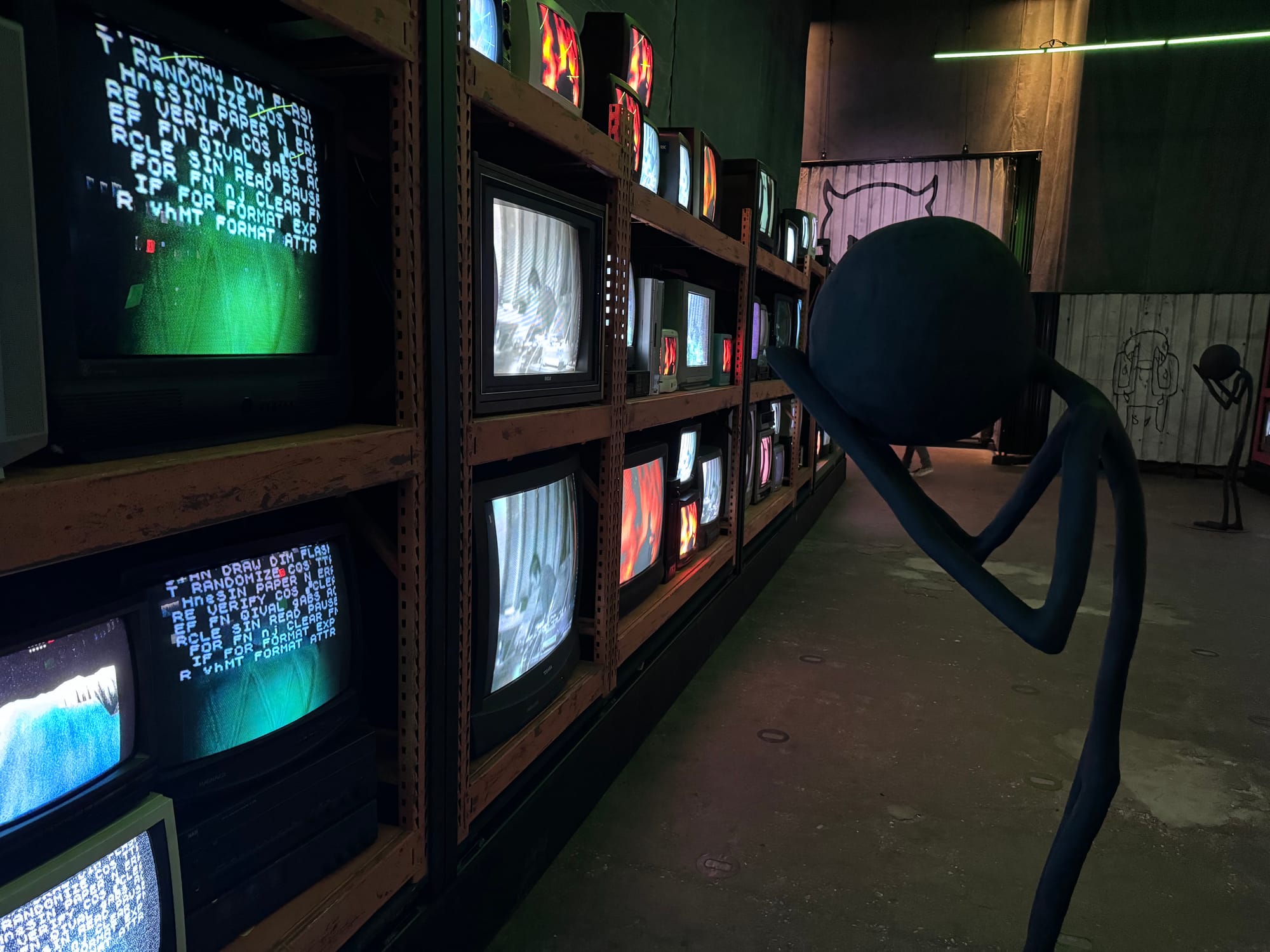
Inside a dark warehouse at the Brooklyn Navy Yard, a stick figure bows before a wall of flickering tube televisions, a sharp-toothed bear looms large from corrugated metal and red light washes over concrete floors.
This is Motion Picture House, Radiohead’s touring Kid A Mnesia installation. It centers on a 75-minute film using music and visuals from the Kid A and Amnesiac era, when Radiohead turned away from the guitar-driven expectations after OK Computer and split material from the same sessions into two albums.
The albums were political in a poetic way, circling fears of globalization, corporate power, surveillance, war, climate change, nuclear anxiety and everyday life increasingly filtered through machines.
Radiohead would make some of those concerns more explicit on Hail to the Thief in 2003, but on Kid A and Amnesiac, they arrived mostly through distorted voices, broken slogans, electronic textures, bunker imagery and a visual world of fires, mountains, televisions, maps and monsters.
Before entering the screening room, fans have half an hour to explore the surrounding gallery. It includes drawings, paintings, sculptures, and CRT monitors with blown-up fragments from Thom Yorke and Stanley Donwood’s visual universe.
I am not a neutral observer. I have the sharp-toothed Modified Bear from the Kid A and Amnesiac era tattooed on my bicep. But I am not the kind of fan who can identify every scrap of lore, side project, old web page, or creature in the band’s mythology.
Motion Picture House is installed in the Agger Fish Building at the Brooklyn Navy Yard. The smell of fish from the river wafted in as visitors entered. The venue felt like a natural match for Radiohead’s visual world with concrete floors, high ceilings, and warehouse energy.
Upon entering the gallery, dueling rows of old tube televisions flicker from metal shelving. Static, fire, landscapes, error messages and strange animated versions of Yorke’s face repeat across the screens. A bowed stickman faces the monitors like someone trapped in a surveillance room no one remembered to shut down.
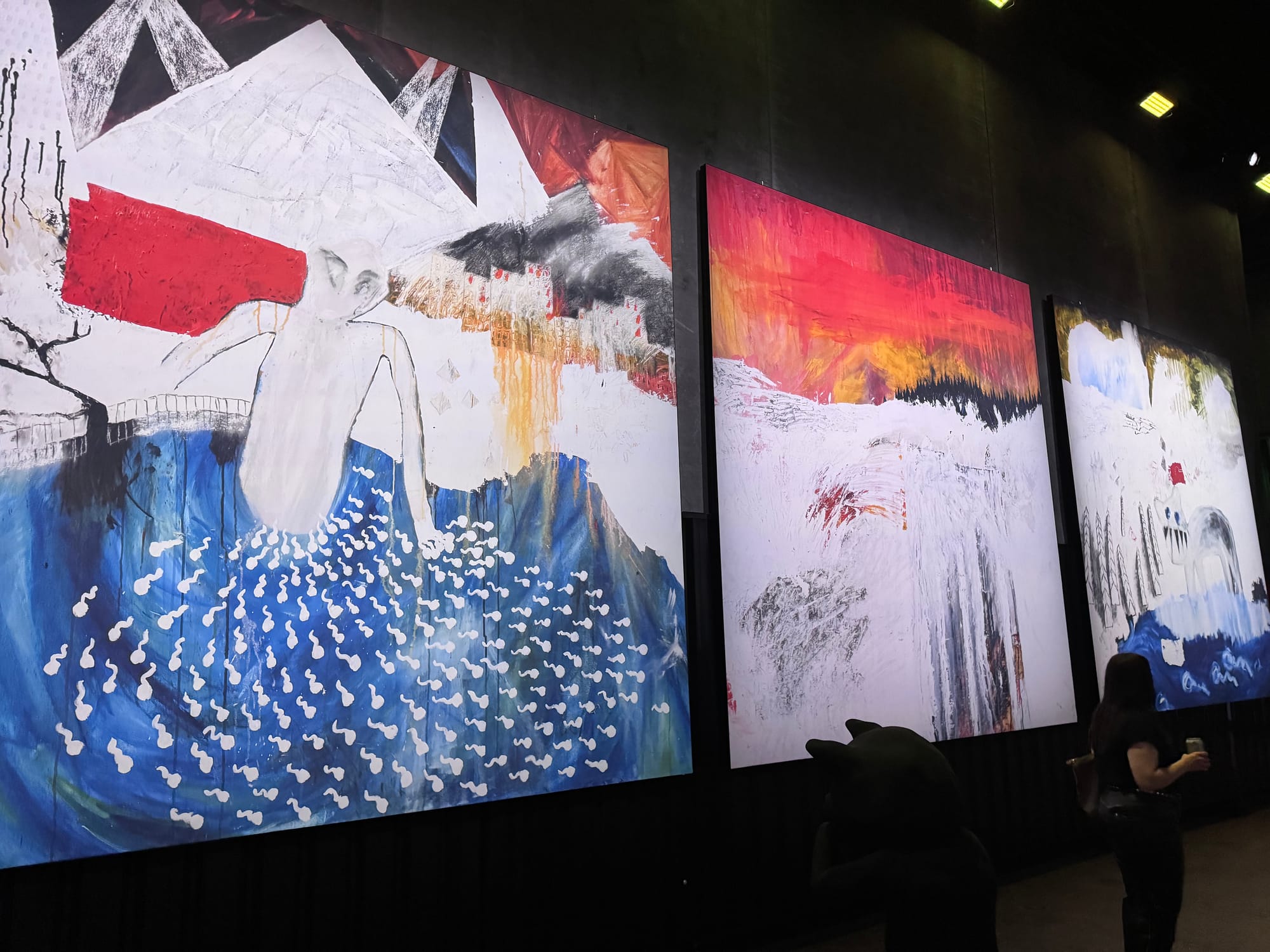
In the next room, prints of paintings by Donwood mirror the artist’s style used in Kid A’s cover art with jagged, snow-covered mountains, burning red-orange skies, and surreal, fragmented figures. One piece shows a ghostly white humanoid emerging from turbulent blue waters dotted with tadpole-like shapes.
The rooms are so dark, so green and red and theatrical, with the lighting muting the colors of the works. I kept wondering what these works would look like in direct daylight.
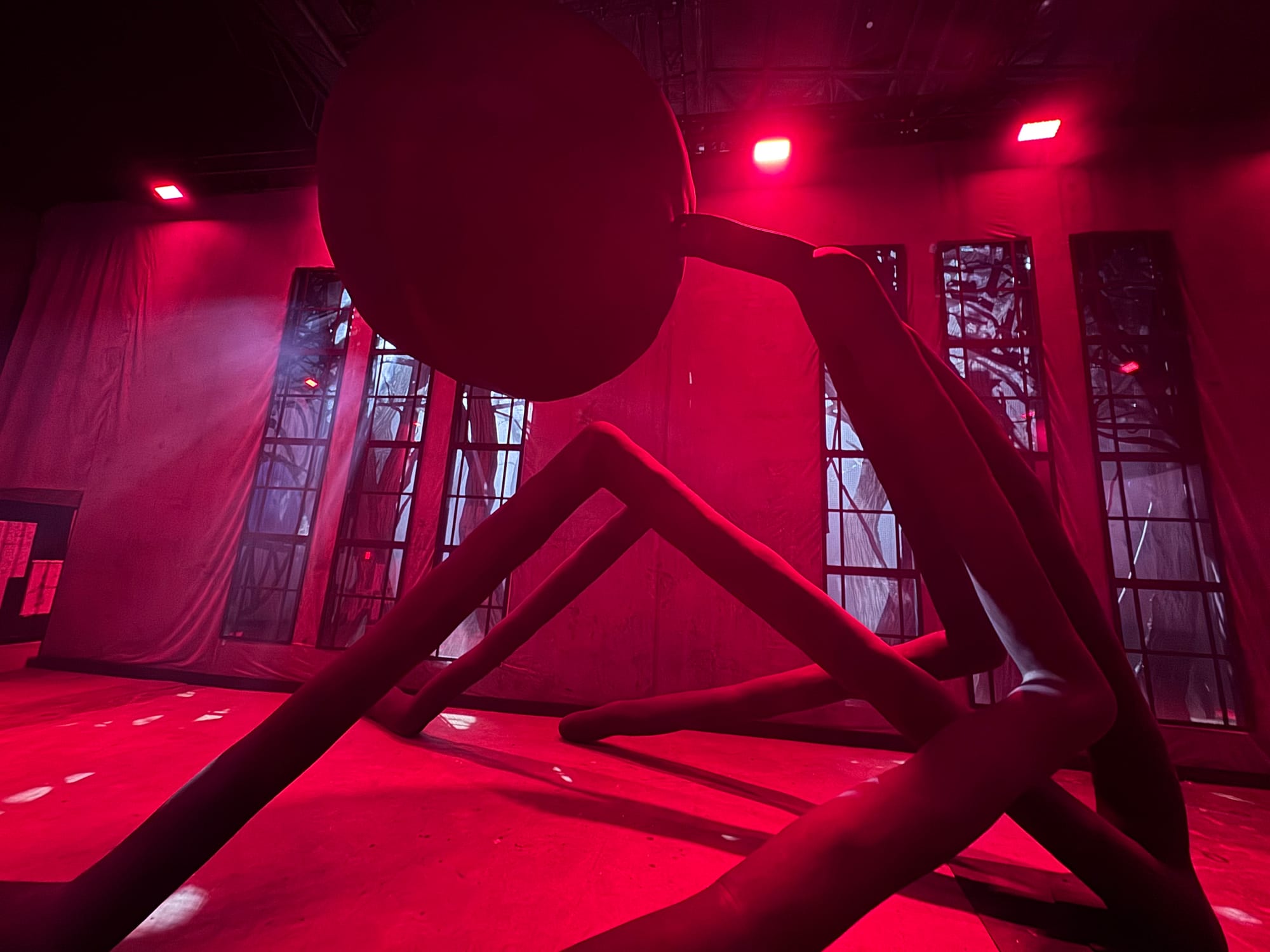
Two corridors then lead past the film screening room to a third gallery space, in which a giant sculptural version of stickman sits with his knees up, and his head bowed between them. A winter landscape and tree-branch shadows appear in windows behind him.
The walls of the corridors leading from room to room are covered with images and text that blur the line between artwork, lyric sheet, notebook, warning sign and fake evidence. One drawing reads, “we are not scaremongering, this is really happening,” a line from “Idioteque,” above a frantic image of people looking upward as Modified Bears fill the sky.
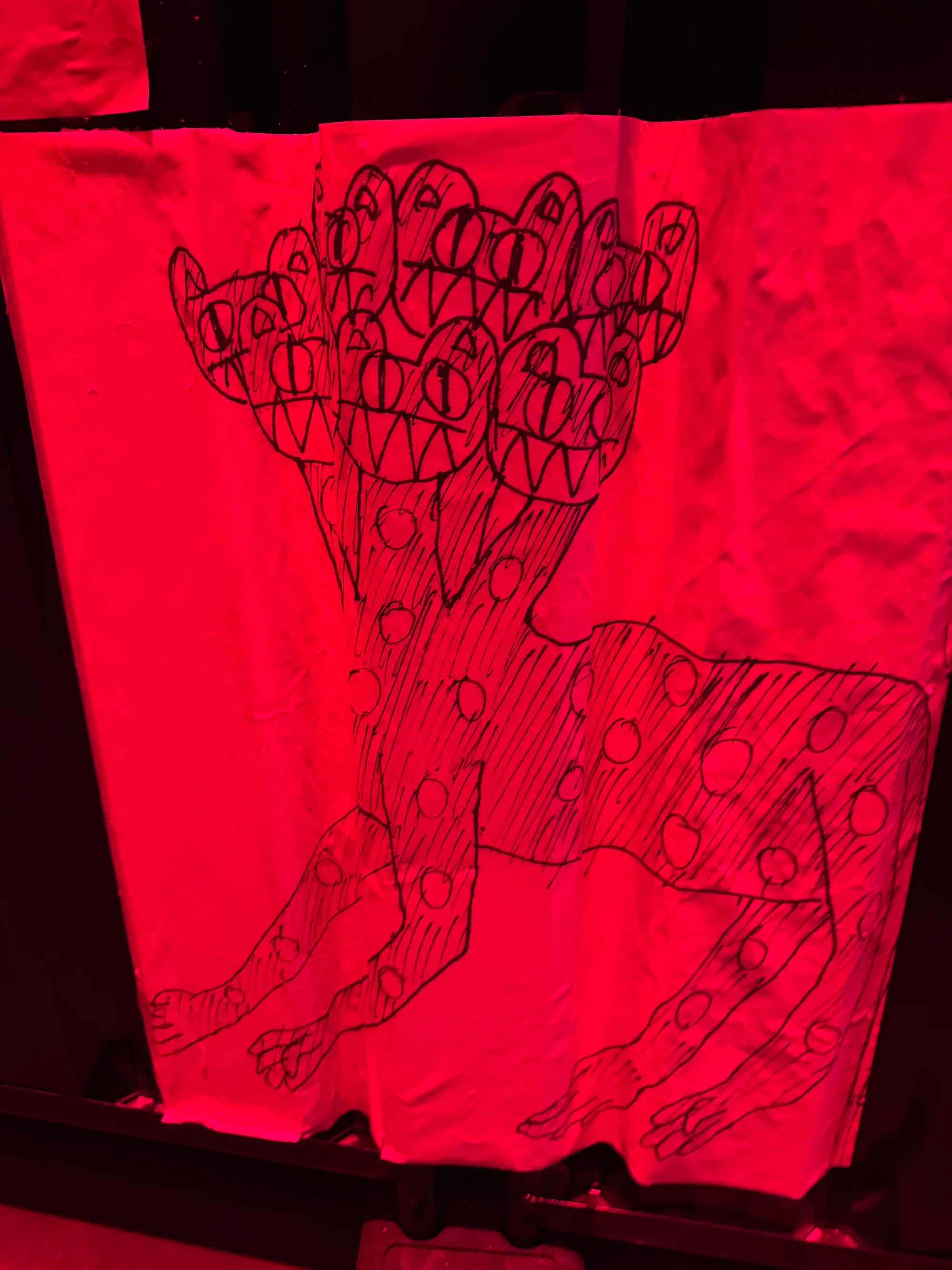
The Modified Bear also becomes more than a logo. In various drawings echoing mythology, it becomes Cerberus-like, a multiheaded guardian animal. In another image, it appears as Charon with a scythe, the ferryman of the dead, or as Cupid.
Other scraps are stranger, like a receipt from Tibet blown up on a wall with the deadpan texture of an archival document. Nearby, handwritten and typed fragments look like drafts, complaints, lyrics, and jokes. Some dated or official-looking material made me wonder how much was truly archival and how much was staged to feel archival.
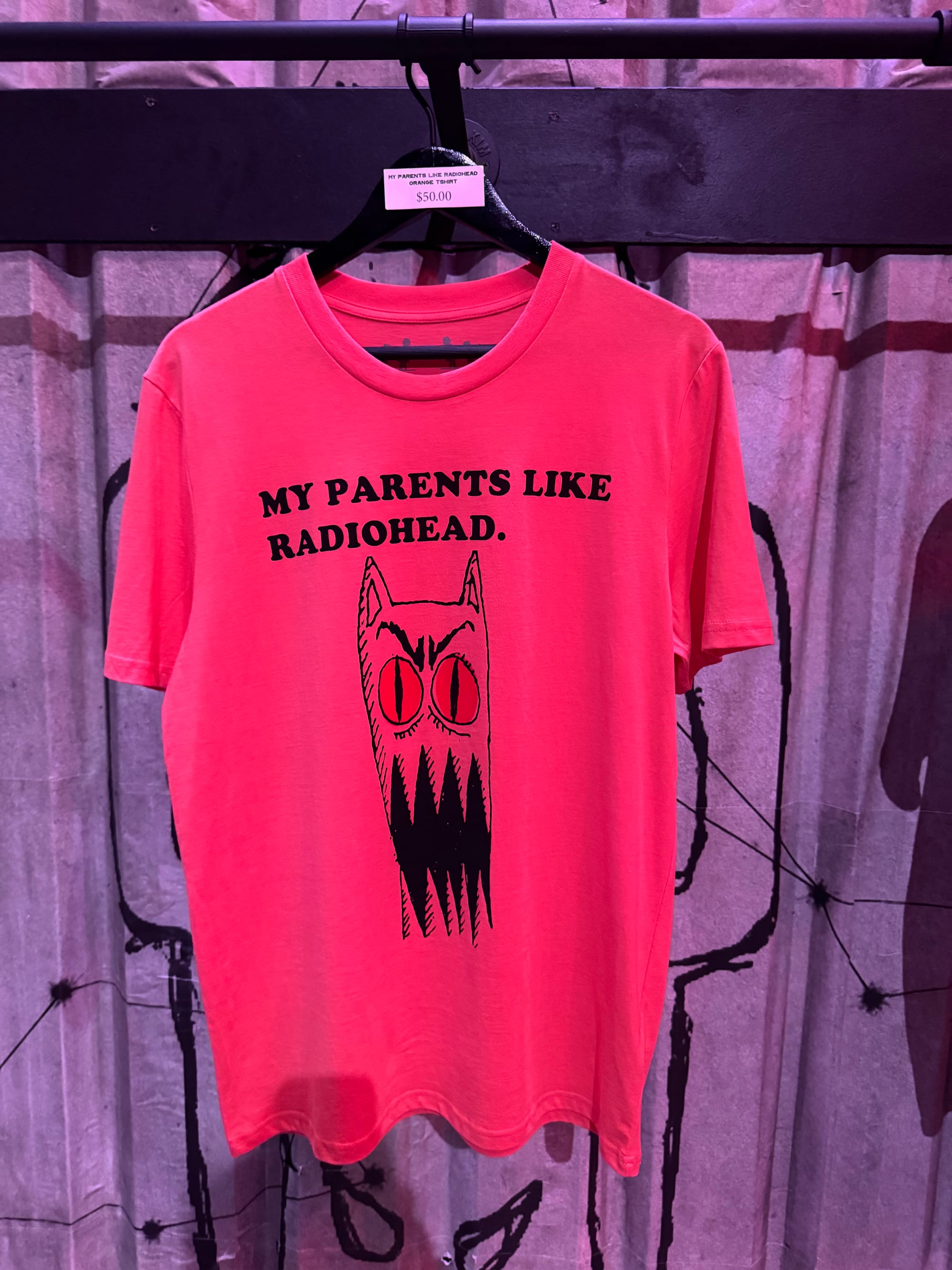
The band notoriously offered a “pay what you wish” model for its 2007 album In Rainbows. But the experience inevitably ends at the gift shop. The shirts are expensive, $50 each for a band that once let you name your price. But a shirt reading “My Parents like Radiohead” made me laugh. I wish it came in kid sizes.
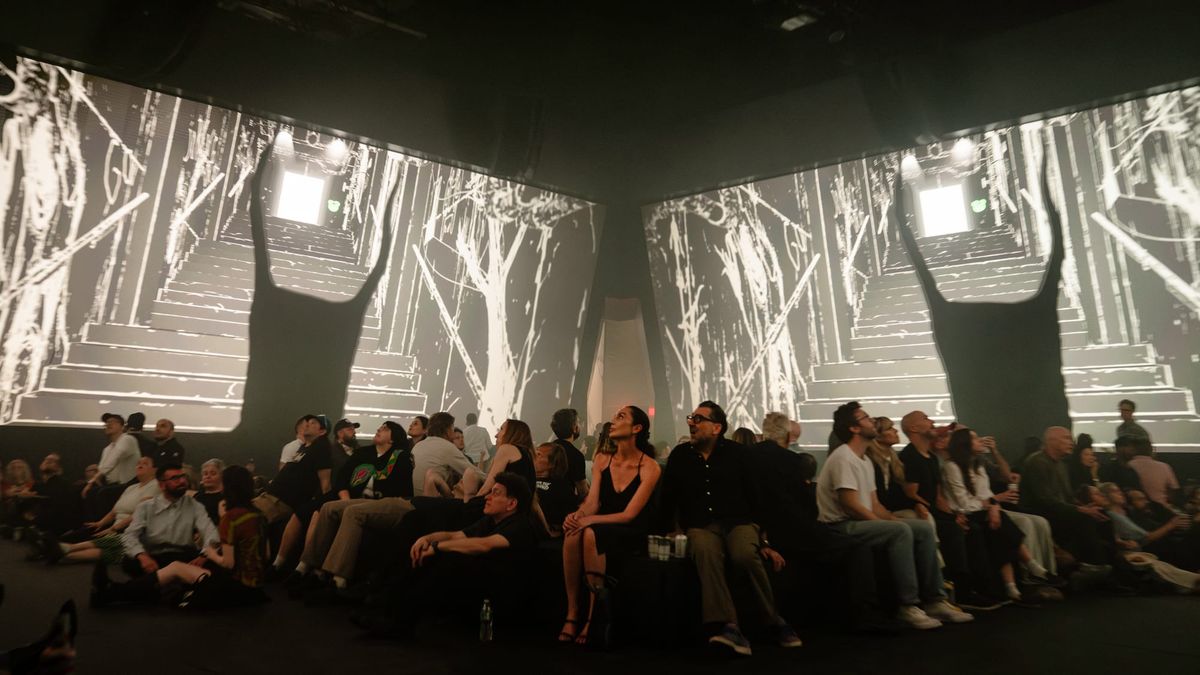
But the main attraction of the experience is the film, projected on four massive screens in a cushioned room where visitors can sit, lean or lie down. It is closer to being inside a video game panic attack.
The story seems to follow a little horned protagonist I called the “eyeless goblin,” who walks from scene to scene with fear, curiosity, and resignation. The trick is not to over-explain him. Don’t think too hard. Let him be your little guide.
He moves through a world that seems post-apocalyptic, or maybe pre-apocalyptic, or maybe simply Radiohead’s version of the present tense. He sees screens. He encounters stickmen. He passes through bunker-like spaces. He witnesses destruction and keeps moving. At one point, one stickman appears to have murdered another.
The music is the reason this all works. Sometimes Yorke’s voice feels isolated, almost peeled away from the songs. Other times, the tracks arrive closer to memory, still familiar but physically altered by the room with new mixes.
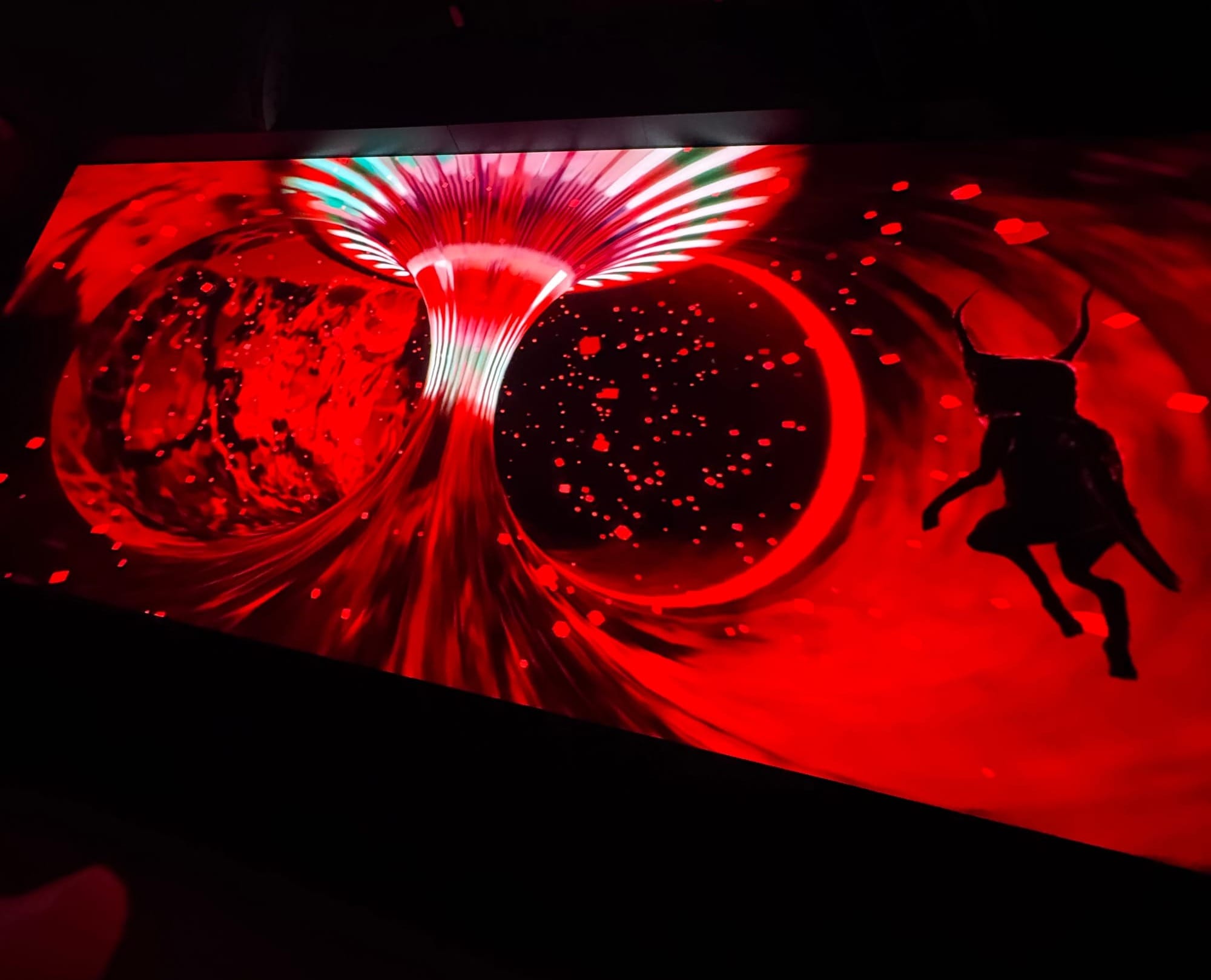
The song “Hunting Bears” gains force from a propulsive drumbeat, while “How to Disappear Completely” comes with visuals depicting a nuclear winter. And “The National Anthem” sounds metallicized, as if dragged through machinery. At one point, a luminous Kaaba-like box of light appears as the viewer feels vibrations from the spatial audio in their bones.
Watching the film feels like watching a dance performance with the movements of the little creatures choreographed with the music. There are stretches in the film when it would almost make sense to have live performers in the room.
Late in the film, the eyeless goblin runs up the spirals of a space reminiscent of the Guggenheim. The film's final moments are unexpectedly moving. The world burns. The little guy keeps going. He finds another figure like himself. It is not quite hope, but it is company.
The show is expensive. The film is probably too long for some, while the time to browse the gallery beforehand is too short for others. Anyone looking for Radiohead to explain itself will be frustrated. Anyone expecting a traditional art exhibition may wonder where the labels went.
But for me, a not-quite-superfan with the Modified Bear permanently inked into his arm, it worked because it did not flatter fandom too much. And the cost is worth it for the incredible spatial sound.
There is also a political shadow around the show. Radiohead has faced renewed criticism and boycott calls over Israel, particularly around Jonny Greenwood’s collaborations with Israeli musician Dudu Tassa and the band’s past decision to perform in Tel Aviv.
In a 2025 interview with The Sunday Times, Yorke said he would “absolutely not” perform in Israel under the government of Benjamin Netanyahu.
While Motion Picture House’s politics are rooted in early 2000s fears, those same fears of climate change, alienation, technology, surveillance, and nuclear war still feel prescient, from a band that insists it is not scaremongering.
I saw people online joking about taking mushrooms before going. I understand the impulse. The show is dark, loud, colorful and disorienting. But that also seems unnecessary. Radiohead’s appeal has always been making normal consciousness feel unstable without needing much help.
Stories like this take time, documents and a commitment to public transparency. Please support independent arts journalism by subscribing to Urgent Matter and supporting our work directly.