Free guide coaches artists to resist censorship as the NEA case it cites reaches appeal
NCAC released the resource this month, days after leading a brief in the appeal of the gender-ideology grant ruling it holds up as precedent.

NCAC released the resource this month, days after leading a brief in the appeal of the gender-ideology grant ruling it holds up as precedent.
The National Coalition Against Censorship has published a free guide to help artists defend their own work when an institution tries to cancel it.
The coalition this month released the resource, titled "The Artist's Guide to Defending Artistic Freedom,” which is free to download on its website and walks artists through what to do when an exhibition, performance or commission is pulled over a work's perceived message.
It was published days after the coalition led an amicus brief, a legal document submitted by an outside party to advise the court on a case, in a federal appeal over arts funding that the guide itself cites as precedent.
The guide points artists to a September 2025 decision in Rhode Island Latino Arts v. National Endowment for the Arts. A federal judge ruled that the NEA's policy of disfavoring grant projects seen to "promote gender ideology" was unconstitutional.
Documents show U.S. Senior District Judge William E. Smith found the policy a "viewpoint-based restriction on private speech" and arbitrary under the Administrative Procedure Act. The policy implemented Executive Order 14168, which President Donald Trump signed on January 20, 2025, directing that federal funds not be used to promote what it termed gender ideology.
The government is appealing that ruling to the U.S. Court of Appeals for the First Circuit. On June 12, the coalition led a brief urging the court to uphold it, joined by Poets & Writers, Electric Literature, the Authors Guild, the Dramatists Guild and the theater director Annie Dorsen.
Melissa Ford Gradel, executive director of Poets & Writers, said in a statement that the agency's review criteria are "clear as mud." Erika Sanders, counsel at the coalition, said the administration is trying to flatten artistic expression into a single acceptable view.
Much of the guide is tactical. It tells artists to keep a paper trail, warning that organizations often deliver censorship decisions by phone or in person to avoid written evidence. In states that allow one-party consent, an artist may record the conversation for documentation, the guide says.
It also coaches artists to respond to specific objections, such as that a work creates legal risk, will cost donors, raises safety concerns, or clashes with an institution's values.
On safety, the guide says the answer is added security and staff preparedness, not cancellation. On values, it argues that cultural institutions are "not moral arbiters" but stewards of expression, and that no museum can be assumed to share the views of every artist it shows.
The guide urges institutions to adopt a standing statement on artistic freedom so that a single work need not be read as the organization's own position.
 Adam Schrader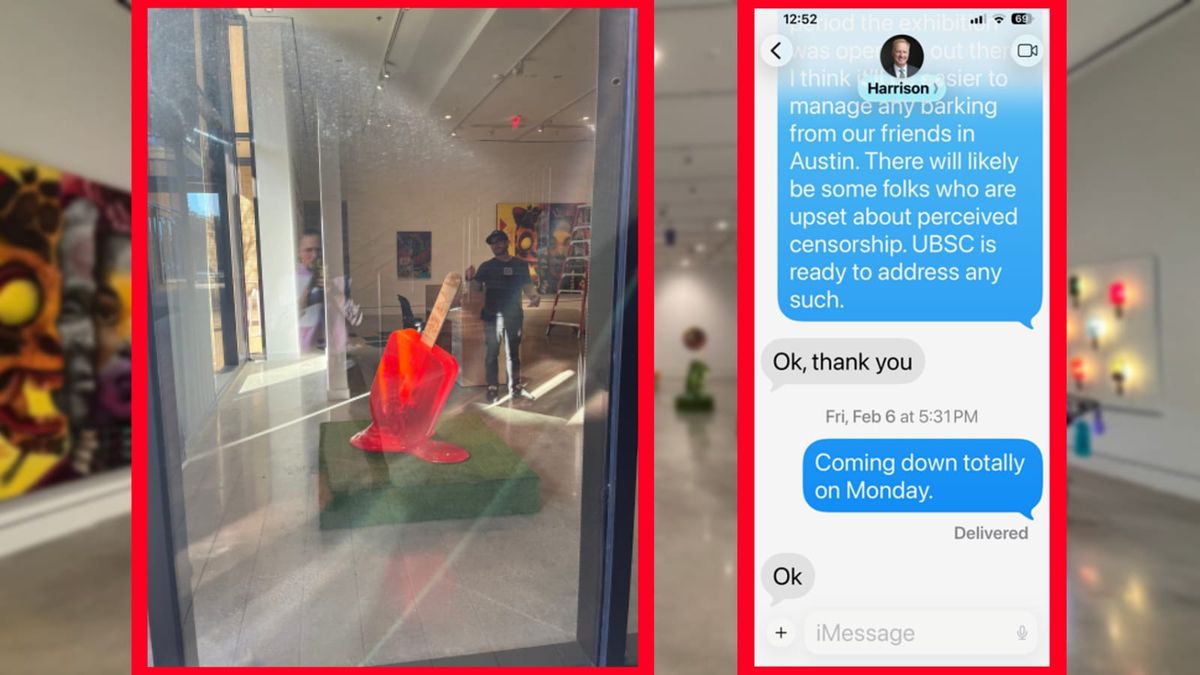
It leans on the "Streisand Effect," the tendency of censorship to draw more attention to what it tries to bury, and lays out how to take a case public through social media, op-eds and reporters.
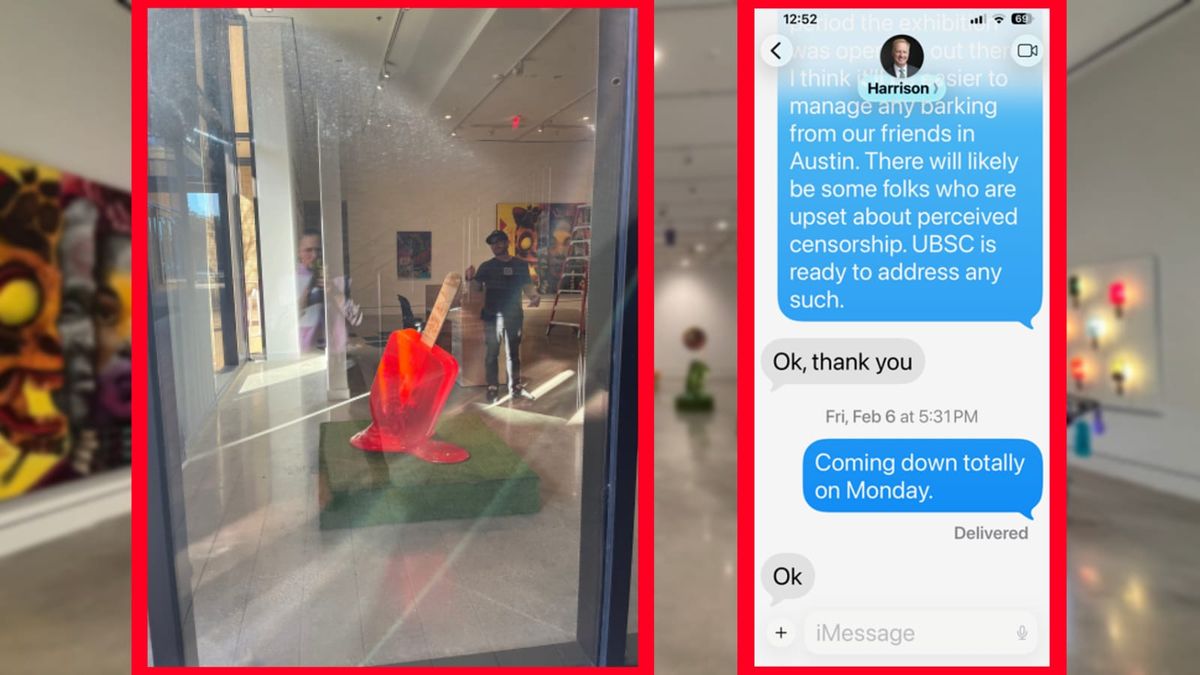
The guide also comes after text messages between University of North Texas leaders showed that administrators worried about “barking from Austin” over an exhibition featuring artworks critical of U.S. Immigration and Customs Enforcement, which was canceled earlier this year.
And University of Texas at Austin officials privately reviewed an anti-fascist student art exhibition over concerns it could “negatively impact the department” or strike “a chord with the wrong party."
Any artists who face censorship are invited to contact Urgent Matter at adam@urgentmatter.press.