Frantz Zéphirin’s first U.S. survey explores Haitian politics, Vodou spirits and visions
The Fort Lauderdale exhibition brings together more than 30 works by the Haitian artist.

The Fort Lauderdale exhibition brings together more than 30 works by the Haitian artist.
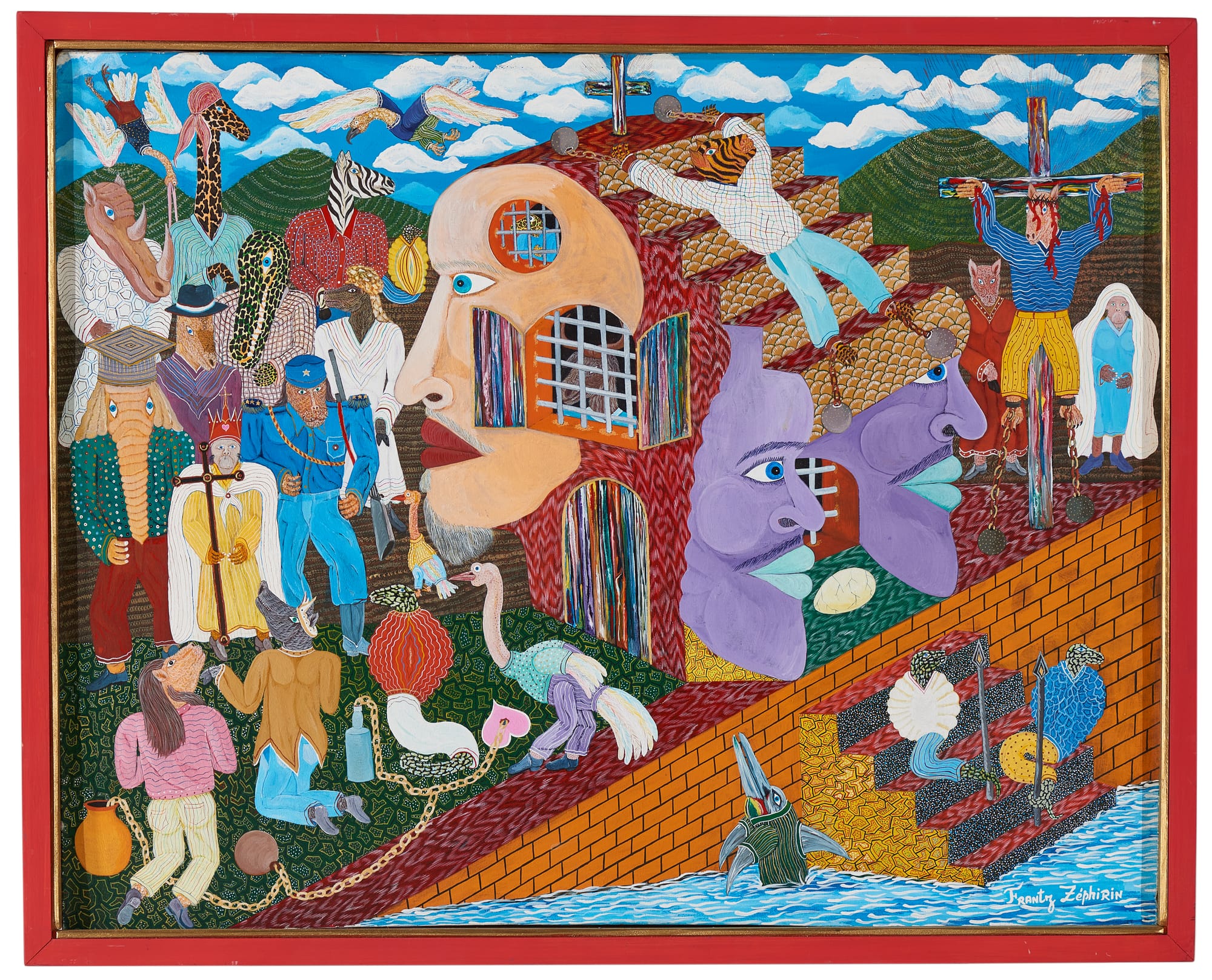
Haitian artist Frantz Zéphirin said he used animals in his paintings to hide political figures at a time when naming them directly could be dangerous.
Those coded paintings are now part of “Frantz Zéphirin: The Messenger,” the artist’s first survey exhibition in the United States, which has opened at NSU Art Museum Fort Lauderdale with more than 30 works spanning four decades.
In one 1986 painting, Crucifixion, Zéphirin used animals and other figures to portray people involved in the fall of Jean-Claude “Baby Doc” Duvalier and those who kept power after he left Haiti, he and curator Ariella Wolens said in an interview. Duvalier fled to France on February 7, 1986.
Jean-Claude Duvalier had ruled Haiti since 1971, when he succeeded his father, François “Papa Doc” Duvalier. Their family dictatorship lasted nearly three decades and was enforced through political repression and the feared Tonton Macoutes paramilitary force.
“At that period, that was dangerous, so I used animal figures to represent the people,” Zéphirin said.
He said the animal figures let him paint politics without naming people directly. But that did not mean the work was restrained.
“My work is not censored,” Zéphirin said. “I don't block my imagination.”
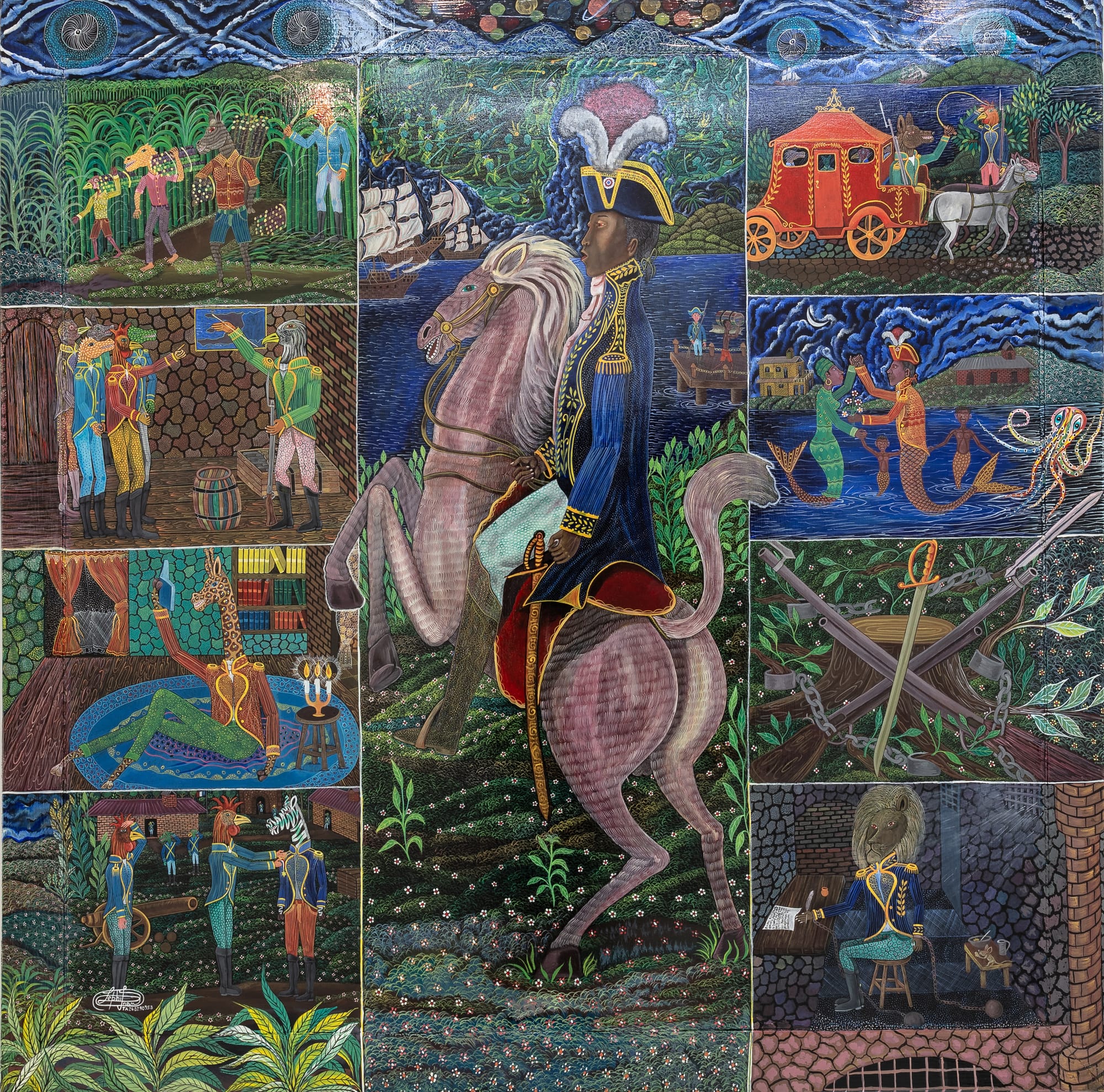
The exhibition, on view through October 4, includes paintings of animals, spirits, political figures and scenes from Haitian history. It spans works from 1981, when Zéphirin was 13, to a large 2023 painting of Toussaint Louverture, a leader of the Haitian Revolution, Wolens said.
The museum described the show as the first museum exhibition devoted to Zéphirin, a self-taught Haitian painter who was born into a family of artists that included his uncle, Antoine Obin, a master of the Cap-Haïtien school. But the museum said Zéphirin moved away from Northern Haitian narrative painting toward his denser symbolic style.
Wolens said loans came from the museum’s regional network, collectors with long ties to Haiti and a major Haitian art collection in Iowa. Some works came from former diplomats, aid workers and Haitian art advocates who spent time in Haiti or built collections in the United States.
Carol Horning, a former U.S. diplomat who worked in Haiti in the 1990s and later became a museum docent, donated many works to the museum’s Haitian art collection. The Haitian Art Society lists Meg Gilroy on its emeritus board, and its newsletter said Gilroy hosted a private collection visit during the society’s 2024 conference, where Zéphirin appeared as a guest artist.
Because the museum is in South Florida, Wolens said many Haiti-linked collecting networks led back to the region. The interest from diplomats and aid workers is striking because Zéphirin’s paintings can be politically critical. But Zéphirin and Wolens said foreign visitors have often been more interested in Haitian art than some Haitian audiences.
“The tourists and the people who come from USAID buy Haitian art, because they are more interested,” Zéphirin said.
Those loans gave the exhibition a “sort of national representation” of Zéphirin’s work, though the show was limited by conditions in Haiti, Wolens said.
“I think if things weren't so perilous in Haiti, we could have made the show twice as big,” she said. “There is still a lot of work there.”
Zéphirin compared his coded political images to the fables of Jean de La Fontaine, where animals stand in for human behavior. “I make my own metaphor like La Fontaine, to represent the politic,” Zéphirin said.
The political readings are not limited to works in the exhibition. Wolens said a Zéphirin painting not included in the show, Absolute Power, helped her understand how his work can appear surreal before its political context is explained. She said the painting depicts former Haitian President Jean-Bertrand Aristide floating down a river, surrounded by faces.
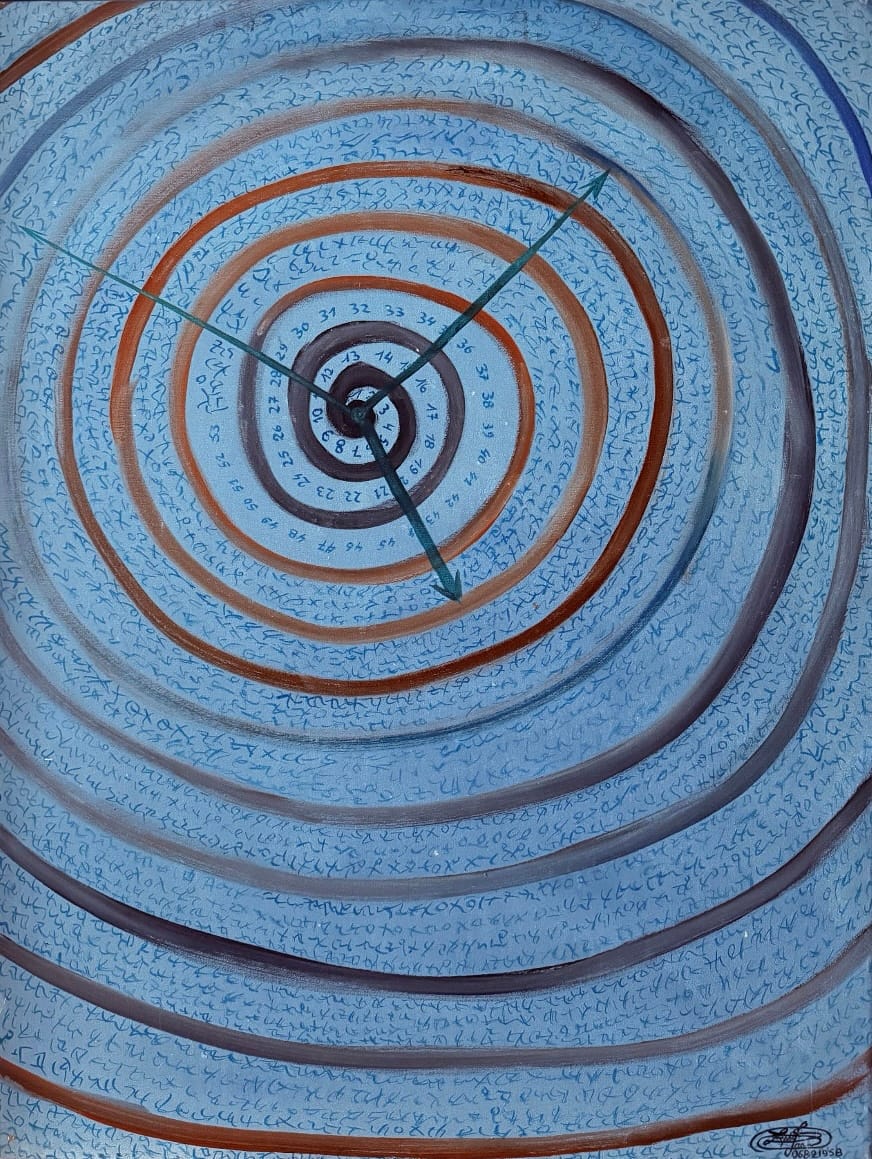
The exhibition also presents Zéphirin as an artist whose paintings sometimes seem to anticipate events. Wolens described one work as a spiral that Zéphirin turned into a clock. It was painted in 2008, but after the 2010 Haiti earthquake, Zéphirin titled it Earthquake Timer, Wolens said.
“Sometimes I look the thing before they arrive, and I put them on my canvas,” Zéphirin said.
That sense of painting before or beyond the event has followed Zéphirin’s work in public before. The New Yorker put his 2007 painting “The Resurrection of the Dead” on its cover in January 2010 after the Haiti earthquake, while noting that it had not been painted in direct response to the disaster.
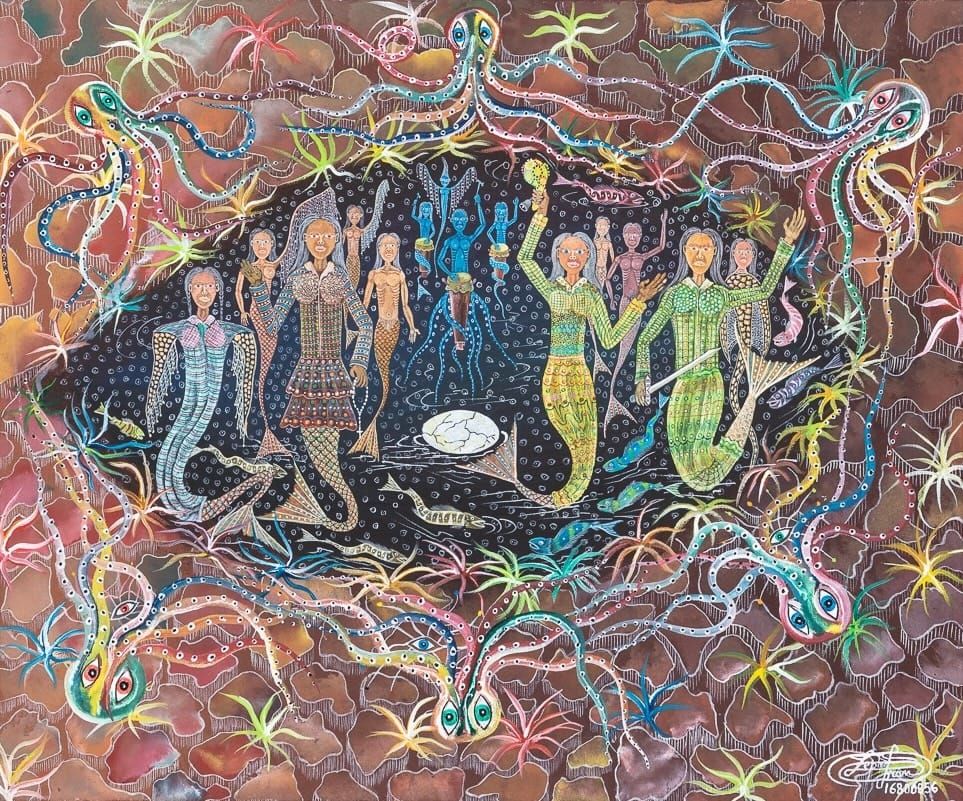
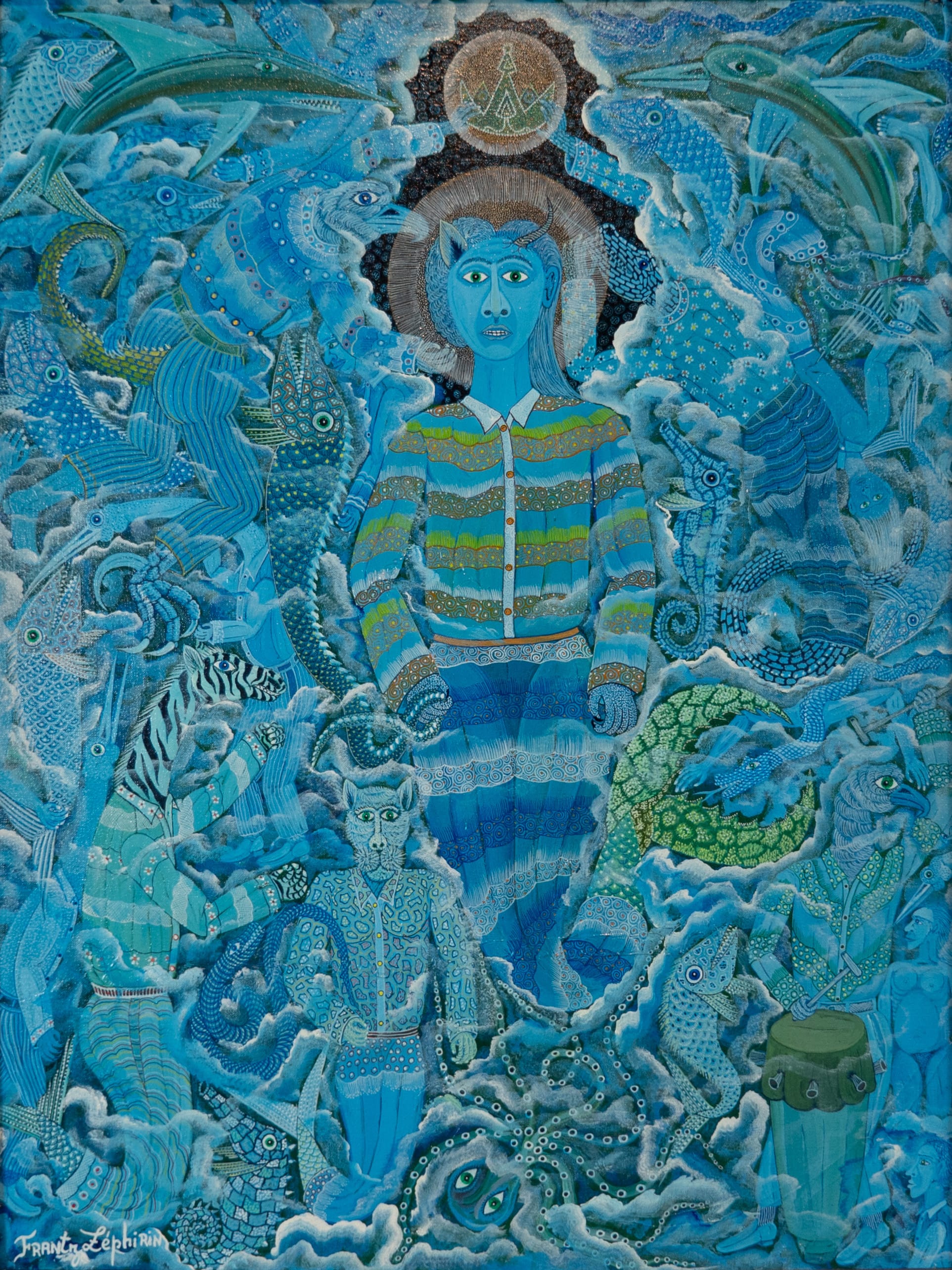
Zéphirin is also an Oungan, or male Vodou priest. The museum said his images were created under the instruction of Zeïde Medji, a sea goddess who became his muse. The museum also said that since 1988, Zéphirin has painted more than 2,000 visions of underwater sirens under her guidance.
In the interview, Zéphirin described Zeïde Medji as a spirit connected to the Erzulies, spirits associated with love, abundance and protection.
“She's someone who, as spirit, who lives inside of the ocean,” Zéphirin said.
Wolens said viewers do not need deep knowledge of Vodou to enter the paintings, though she said the works reward that study.
“You can tell that this is somebody who thinks on another level,” Wolens said of Zéphirin.
Zéphirin said he paints Vodou subjects, but not only Vodou subjects. He also paints from the Bible and said he sees spirituality as broader than any single religion.
“Spirituality is not limited,” Zéphirin said. “A Vodou painting is the same way I paint a Bible painting.”
Wolens said that history is embedded in the work because enslaved Africans in Haiti syncretized Vodou spirits with Catholic saints after colonial powers imposed Christianity. In Zéphirin’s work, she said, a snake may signify both Damballa Wedo and St. Patrick.
Zéphirin’s working life was also shaped by his family’s temple in Haiti. Wolens said his grandmother was a Vodou priestess who raised him, and Zéphirin said he often painted inside the temple after inheriting it.
“A lot of the painting, I do them inside the temple,” Zéphirin said.
He said leaving Haiti has changed both his work and rhythm. Zéphirin has been away since 2021, the year President Jovenel Moïse was assassinated and Haiti’s political crisis deepened. Gang violence expanded in the following years, and Zéphirin said he no longer finds the same concentration he had in Haiti.
“That's because I'm not in the same dream,” Zéphirin said.
Wolens said Zéphirin’s recent work includes UFOs and abstract patterns, moving away from some of the earlier Vodou imagery. Zéphirin described that turn as a move toward the future.
“Now I'm meeting the future,” Zéphirin said. “I'm more futurist.”
The show grew from the museum’s Haitian art holdings and Wolens’ earlier work on Haitian art. Wolens said she first got to know Zéphirin’s work through the museum’s collection. The museum owns one of his paintings, and Zéphirin later visited a 2023 Haitian art exhibition Wolens curated there.
“He is so knowledgeable about the history of Haitian arts, and we just went around the show together, and I learned so much from him,” Wolens said.
She had also seen a Miami show of Zéphirin’s recent paintings, which gave her context for a broader survey that could place the museum’s older work alongside newer pieces.
“This is the first survey exhibition in the United States,” Wolens said. “We felt it was time, and this was the right place for it.”
Correction made at 8:38 p.m. on June 8, 2026: An earlier version of this article misidentified an artwork as Earthquake Climber. The correct name is Earthquake Timer.
Stories like this take time, documents and a commitment to public transparency. Please support independent arts journalism by subscribing to Urgent Matter and supporting our work directly.