Judge adds interest to Nazi-looted Modigliani ruling, says the law gives him no choice
The estate wants $23,323,562.20 in interest.

The estate wants $23,323,562.20 in interest.
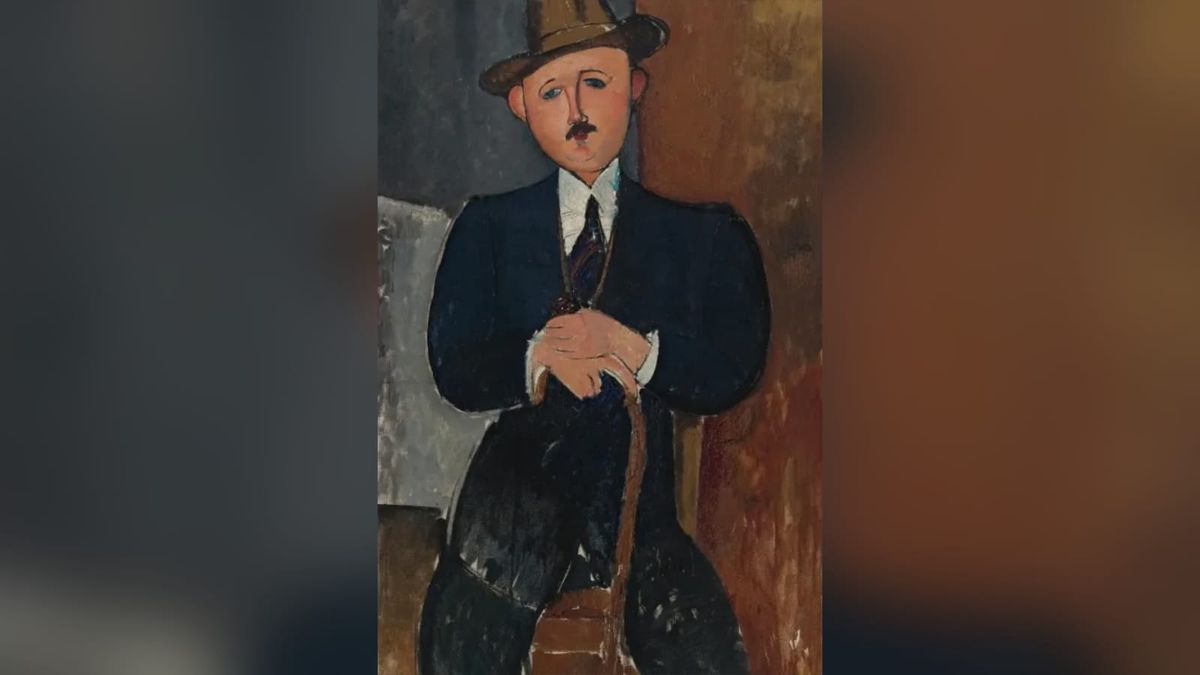
A Manhattan judge ruled that the heirs of a Jewish art dealer whose Modigliani was taken in occupied Paris are entitled to prejudgment interest on the painting's value, a decision the estate says could add more than $23 million to its recovery if upheld.
Justice Joel M. Cohen of New York State Supreme Court’s Commercial Division signed the decision on July 28. It was entered the next day.
Cohen wrote that state law requires the award and that he is bound by an appeals court decision he cannot distinguish from this case. He set a hearing for September 30 to determine the painting's value, which will decide the award size.
He also wrote that if the law gave him a choice, he might cut the award or erase it.
The painting is Amedeo Modigliani’s Seated Man with a Cane, made around 1918. Cohen ruled on April 3 that it belonged to Oscar Stettiner, a Jewish dealer in Paris who left it behind when he fled ahead of the German occupation, and that it was seized and sold at a forced auction in 1944.
The defendants are the collector David Nahmad and International Art Center, a Panama-registered company that bought the work at Christie’s in London on June 25, 1996, for £2 million. Nahmad is himself Jewish, born in Lebanon to a Sephardic family.
Paid subscribers can read the full court documents.
 Adam Schrader
The interest at issue is a standard remedy in New York for people kept from property the court has determined to be theirs. The state sets the rate at 9% a year, and it runs on the value of the thing withheld from the date the owner was determined to have been deprived of it.
Edward W. Greason, who administers Stettiner’s estate, asked for $23,323,562.20, records show. The defendants asked Cohen to deny any award.
Cohen granted the motion in part, writing that he had no discretion to refuse.
“That said, the Court does recognize that application of Reif in these circumstances leads to a harsh result from Defendants’ perspective,” Cohen wrote. “There was no evidence that Defendants were aware of the heirs’ claim to the Painting when they purchased it at auction in 1996.”
The case Cohen referenced is Reif v. Nagy, a 2021 decision from the Appellate Division’s First Department that awarded interest to heirs who recovered artwork lost under Nazi rule. That award came to about $678,000.
Lawyers for Nahmad pointed Cohen to a 2024 decision in which a court declined to award interest to heirs who recovered a drawing and had relied on Reif in seeking 9% on an $8 million appraisal. They also cited three other recovery cases that ended with possession and no interest. Cohen’s decision names none of them.
They argued the estate sought the return of a unique object rather than money, which under state law would leave the interest question to Cohen’s judgment. He rejected that.
Cohen wrote that the estate’s claims for conversion and for return of the painting are both ordinary legal claims, not requests for the court to fashion a fair outcome, and that the statute makes interest automatic in that situation.
He also rejected the argument that the estate would be paid twice, once in the painting and once in cash. The trial court in Reif turned down the same argument, Cohen wrote, and the appeals court did not question that.
Cohen set the clock running on February 27, 2014, the day the case was filed, rather than the December 2011 date the estate requested. This later start date reduces the bill.
What the painting was worth is now the open question, and the two sides are far apart.
Sotheby’s valued it at $18 million to $25 million in 2008, when Nahmad put it up for sale, according to the decision. It did not sell.
The estate submitted two appraisals from GurrJohns, the firm the winning heirs used in Reif, putting the value at $18 million in 2011 and $20 million in 2014. The defendants submitted an appraisal setting it at $6.5 million on both dates.
Phillip C. Landrigan, who represents the estate, commissioned a rebuttal from New York Fine Arts Appraisals. He told Cohen the defense number should be thrown out.
Landrigan pointed to the defense appraisal’s own figures showing total Modigliani painting sales at auction roughly doubled between 2011 and 2014. He argued that an unchanged $6.5 million across those years is not believable.
“The purported lack of comparable sales is similarly self-serving hogwash,” Landrigan wrote.
The interest ruling follows a decision in April in which Cohen found the estate’s evidence unusually strong for a case of its kind, tracing the painting from Stettiner to the Nazi seizure to the 1944 forced sale to Jan Van der Klip, and then to Van der Klip’s heirs, who consigned it to Christie’s 52 years later.
The defendants have argued throughout that the work is not the one taken from Stettiner. In June, Cohen refused to reopen the case on new statements from two relatives of the Van der Klip family who said the painting the family hid was a different Modigliani.
He called those statements secondhand and speculative. He wrote that they helped the estate more than the defense, bolstering the conclusion that the Van der Klip family did “conceal” from public view a Modigliani painting that “had been acquired at a wartime auction of a Jewish person’s possessions.”
Cohen entered a partial judgment on June 16 awarding the estate ownership, title and possession, and ordering the defendants to hand the painting over within 30 days at a reputable and insured storage facility in New York of the estate’s choosing.
That deadline was July 16, according to a letter to the court from defense counsel. The painting has been kept at the Geneva Freeport in Switzerland.
Nahmad filed two notices of appeal on June 17, one from the partial judgment and one from the order refusing to reopen the case. They had already appealed the April ruling.
On June 26, his lawyers asked Cohen to put the handover on hold while those appeals run. They argued that once a unique painting changes hands it is hard to unwind if they win.
They asked Cohen to set any security they must post at a minimum, arguing the painting had sat safely in Switzerland for twelve years with no claim that they damaged, hid, or tried to move it. If he required a custodian instead, they proposed Michael Tempesta, a lawyer who served as a discovery referee in the case, or Sotheby’s, with the painting staying in Geneva either way.
Cohen refused to sign the papers. He wrote by hand on the June 30 document that the defendants could take the request to the appeals court instead.
“The Court declines to sign this Order to Show Cause,” Cohen wrote. “Defendants may seek a stay from the First Department.”
Landrigan had opposed the request the day before, writing that Sotheby’s is not neutral because the defendants had consigned the painting to it, and that the estate cannot be protected by leaving the work in Switzerland.
“Should Defendants fraudulently transfer the Painting in Switzerland, any transferee will likely claim immunity from this Court’s jurisdiction, particularly in a country known for not subjecting its residents to foreign jurisdiction,” Landrigan wrote. “Minimally, the Painting must come to U.S. soil forthwith.”
He wrote that the estate wants to show the work, “perhaps at the Jewish Museum or otherwise to begin to bring to light the horrors of the Holocaust and the accountability of dealers in looted artworks.”
The documents do not show whether the painting has left Switzerland, or whether the defendants took their request to the appeals court.
At a May 19 hearing, before either side briefed the interest question, Cohen told the lawyers the issue bothered him.
“It’s the first case I had where prejudgment interest didn’t make sense to me as an economic matter,” Cohen said. “And I want to understand why that should not be a concern of mine.”
He said interest normally compensates someone for money they could not use, and the logic strains when the withheld item has increased in value.
“So, as I see it, the plaintiffs end up with the painting in its appreciated form and also a judgment in an almost equal amount based on the hypothetical that they might have sold the painting, if they had gotten it, let’s say, in 2011,” Cohen said. “Well, if they had done that, they wouldn’t have the painting now.”
Follow along with other art world litigation at Urgent Matter’s lawsuit tracker, and with returns and disputes at the restitution tracker.