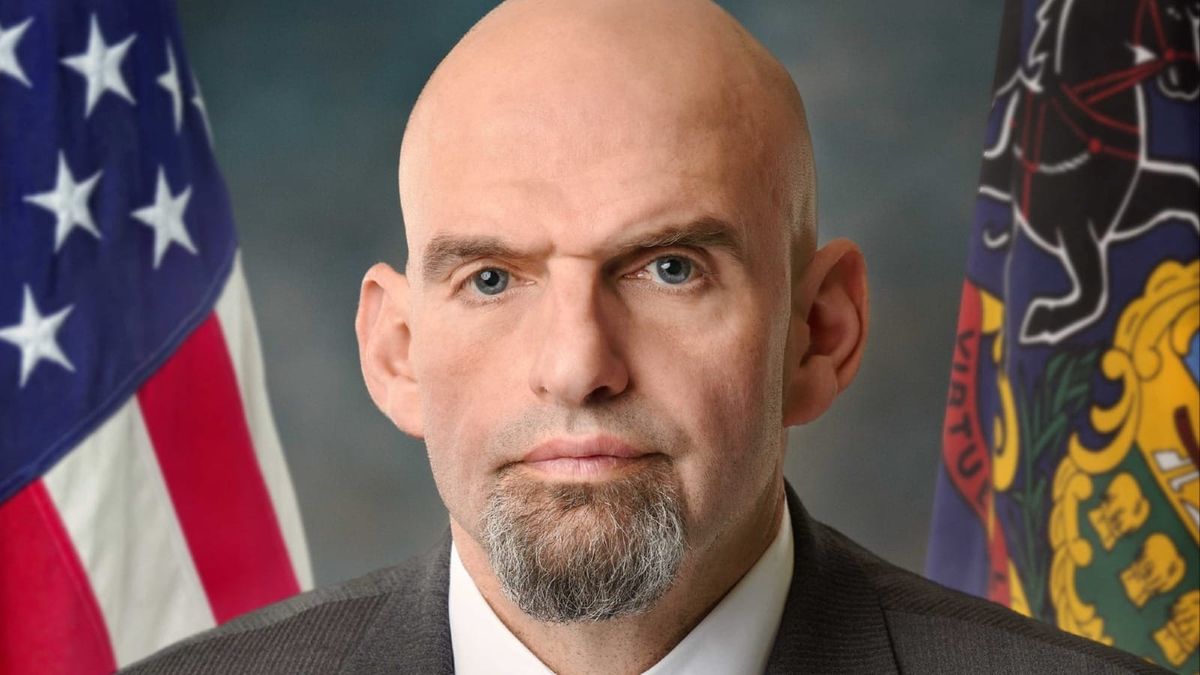
Democratic Sen. John Fetterman urged the Treasury Department to finalize anti-money-laundering rules for antiquities dealers that Congress ordered more than four years ago but that the department never formally proposed and listed as withdrawn last year.

Fetterman, in a June 3 letter to U.S. Treasury Secretary Scott Bessent, called on the Financial Crimes Enforcement Network, or FinCEN, to require antiquities dealers to comply with anti-money-laundering laws, arguing that looted artifacts help fund terrorism, sanctions evasion and criminal cartels.

"I am very concerned that looted antiquities are helping fund the Iranian terrorist regime, as well as criminal enterprises and other sanctioned actors. In 2020, Congress passed bipartisan legislation requiring FinCEN to issue proposed rules for antiquities dealers, but those rules were withdrawn and never finalized," Fetterman wrote.

Congress directed the U.S. Treasury Department to issue proposed rules within 360 days of the Anti-Money Laundering Act of 2020 becoming law, or by December 27, 2021, documents show. The act, part of the fiscal 2021 defense authorization, amended the Bank Secrecy Act to add antiquities dealers to the definition of a financial institution.

But FinCEN took only a preliminary step. On September 24, 2021, it published an advance notice of proposed rulemaking—a request for public comment before a formal proposal—and received 37 comments, records show. It never published the proposed rule the law required.

The U.S. Treasury Department listed the antiquities rulemaking as withdrawn as of April 16, 2025, in its Semiannual Agenda and Regulatory Plan published in the Federal Register on September 22, 2025, a Congressional Research Service report shows.

The same April 16 date marks the withdrawal of two other rulemakings mandated by the 2020 law: a pilot program to share suspicious-activity reports and a process for issuing "no-action" letters.

The withdrawals came during a broader rollback of FinCEN requirements. In March 2025, the agency exempted most U.S. companies from reporting their beneficial owners under the Corporate Transparency Act. In February 2026, it eased customer due-diligence obligations for banks, citing President Trump's January 2025 executive order on deregulation, the report shows.

Because the antiquities provision takes effect only when final rules are issued, antiquities dealers are not currently bound by the Bank Secrecy Act's anti-money-laundering program requirements.

Fetterman's letter points to a recent seizure as evidence of the threat. In February, U.S. Customs and Border Protection in Philadelphia seized 36 copper-alloy short swords and 50 arrowheads dating to between 1600 and 1000 B.C., which an archaeologist traced to the Talish Mountains region of Iran.

The shipment arrived from the United Arab Emirates on October 16, was manifested as "metal decoration articles," and was bound for an address in Jacksonville, Florida, records show. CBP said the antiquities were "suspected to have been derived from illicit excavations of burial sites."

"Customs and Border Protection officers strive to rescue cultural artifacts from the grips of illicit international traders who plunder and exploit another nation's heritage for profit," said Elliot N. Ortiz, CBP's acting area port director in Philadelphia.

CBP's announcement described the seizure as a violation of cultural-property import laws and did not connect it to terrorism, money laundering or the Iranian Revolutionary Guard. Fetterman's letter states that "experts in this field" believe the Iranian Revolutionary Guard and other elements "may be actively looting Iran's cultural heritage." The letter does not name those experts.

The letter also cites Eugene Alexander and Michael Ward, whom Fetterman described as "convicted criminals" who "trafficked looted antiques worth over $31 million on American soil."

That case was prosecuted not by federal authorities under anti-money-laundering law but by the Manhattan District Attorney's Office. Its Antiquities Trafficking Unit convicted Alexander on July 8, 2025, of conspiracy in the fifth degree to commit antiquities trafficking, records show. Ward was convicted in September 2023.

The office said it seized 69 antiquities valued at $32.9 million tied to the conspiracy, a higher figure than Fetterman cited, and that the investigation was conducted with Homeland Security Investigations.

The Treasury Department has separately studied illicit finance in the art market, which it treats apart from antiquities. A February 2022 study mandated by the same 2020 law found some evidence of money-laundering risk in the high-value art market but "little evidence of TF risk," its abbreviation for terror finance.

That study concluded the art market "should not be an immediate focus for the imposition of comprehensive AML/CFT requirements," recommending Treasury first close gaps related to beneficial ownership, real estate, and other sectors. The study examined the art market and expressly excluded antiquities, which the 2020 law treats separately.

Fetterman wrote that he introduced the bipartisan Art Market Integrity Act the previous year to extend anti-money laundering compliance requirements to art dealers, calling the trade "another area of serious concern for illicit finance."

Concern about the art trade and sanctions predates that bill.

A July 2020 report by the Senate Permanent Subcommittee on Investigations, led by Sens. Rob Portman, an Ohio Republican, and Tom Carper, a Delaware Democrat, found intermediaries bought more than $18 million in art through shell companies linked to Russian oligarchs after they were sanctioned in 2014 and recommended that Congress amend the Bank Secrecy Act to cover high-value art.

The subcommittee called the art market "the largest legal, unregulated market in the United States."

Fetterman asked Bessent to respond by July 2.

Urgent Matter is reader-supported. Please consider subscribing to support independent arts journalism.

Share this article
The link has been copied!