Bronx painter Daniel Hauben mounts large-scale show inside renovated historic church
Hauben reflects on decades of painting the Bronx, balancing realism and imagination, and working outside the gallery system.

Hauben reflects on decades of painting the Bronx, balancing realism and imagination, and working outside the gallery system.
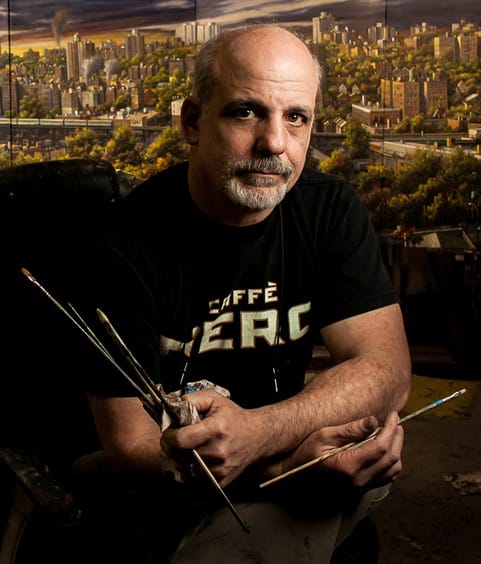
Daniel Hauben, a painter who has lived all but five years of his life in the Bronx, will present a solo exhibition of 18 works at the Kingsbridge Historical Society, a former church with Tiffany glass windows bequeathed to the organization a few years ago and since renovated for public programming.
Hauben said in a video interview with Urgent Matter that the show, running from May 1 through June 30, brings together large works he has rarely exhibited at once. The building's scale, including the former sanctuary, allows installation of paintings up to 21 feet wide.
The exhibition developed from a presentation Hauben gave at the historical society about two years ago, when he showed more than 200 images of his work from the Kingsbridge and Riverdale sections of the Bronx. He said more than 90 people attended, with extra chairs brought up from the basement.
Organizers later proposed an exhibition. Hauben said the building required significant work before it could host a show.
Renovations included electrical upgrades, plumbing work, basement improvements and roof work in the nearly 140-year-old Edgehill building, a landmark structure listed on the National Register of Historic Places.
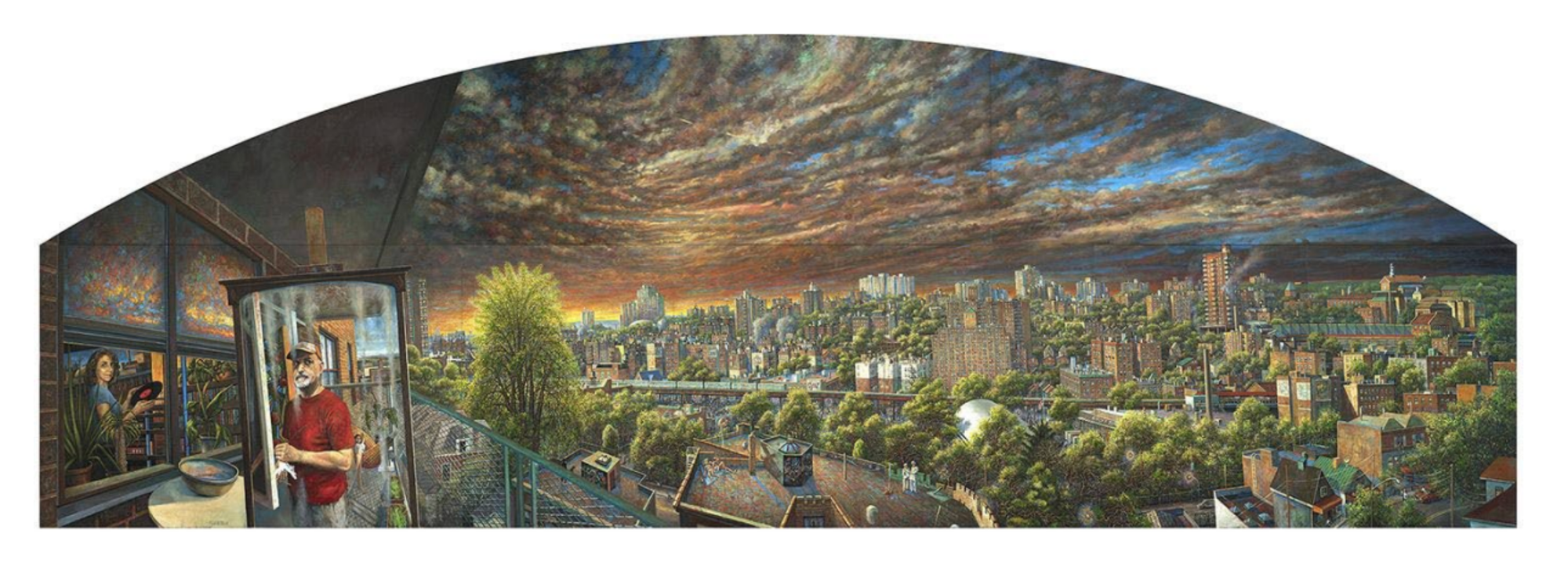
The show will include several of Hauben’s largest paintings, including Emergence, a multi-year studio work developed during the COVID-19 pandemic, and Reflecting on the Familiar, a 21-foot, 10-panel panorama of the Bronx as seen from the terrace of the apartment where he has lived since childhood.
He said Emergence, dated 2026, marks a shift from the outdoor Bronx scenes that have defined much of his career. “For many years, I considered myself a closet surrealist,” Hauben said, adding, “The Bronx is more surreal than anything I could make up in my head.”
The painting, about 9 feet wide and 4½ feet high, began as a single panel and expanded over time into a multi-panel composition developed entirely in the studio.
“This is a painting that I've been working on for six and a half years now,” Hauben said. “It's totally generated from my imagination.”
The work depicts a dreamlike landscape with oversized mushrooms, spiraling fungal tendrils, root-like trees and glowing circular forms. A large nude female figure floats in the upper left, while smaller figures appear throughout the composition.
Hauben said the painting developed during a period when he stopped painting outdoors.
“And then came COVID,” he said. “And I wasn't going to be parking myself on the streets anymore.”
He said the work remains unresolved.
“I better say this quietly,” said Hauben, lowering his voice on camera to escape the ire of his wife, Judy. “I'm not going to say it's done, no.”
He said the painting will remain on hold during the exhibition and might continue afterward.
“People keep asking me, ‘Why do you keep working on the same damn thing?’” he said. “Because it's taking me to places I haven't been before.”
The exhibition will contrast that work with Reflecting on the Familiar. He described the view as the most familiar subject in his work.
“My wife, Judy, and I still live in the apartment that I moved into with my parents when I was 9 years old,” he said. “That is a scene I've painted a hundred times.”
The painting began as a single panel depicting the artist, seen in a mirror, working on the terrace. It later expanded into a larger composition, including the apartment interior, with his wife placing a record on a turntable, and a panoramic view of the Bronx from above.
It was first shown at the Andrew Freedman Home and later as a seven-panel version in the lobby of the Bronx Museum, where it was installed for six months.
Hauben said seeing the work from a distance during that installation led him to expand it further. He added an arc of sky, increasing the painting's size by nearly 40%.
“When you step out on my terrace, the first thing that hits you is the context of the city is within the bigger sense of the land and the planet and all of that,” he said.
The Kingsbridge exhibition will be the first time the full version is shown publicly.
Hauben said the painting attempts to capture the city's scale and density, including the number of buildings and windows visible from the terrace and the sense of activity within them. He described the difficulty of making ordinary structures visually engaging while remaining specific to the location.
“Often, what I'm really going for is more the objective world,” he said, “like, how do you really capture the uniqueness of that particular place?”
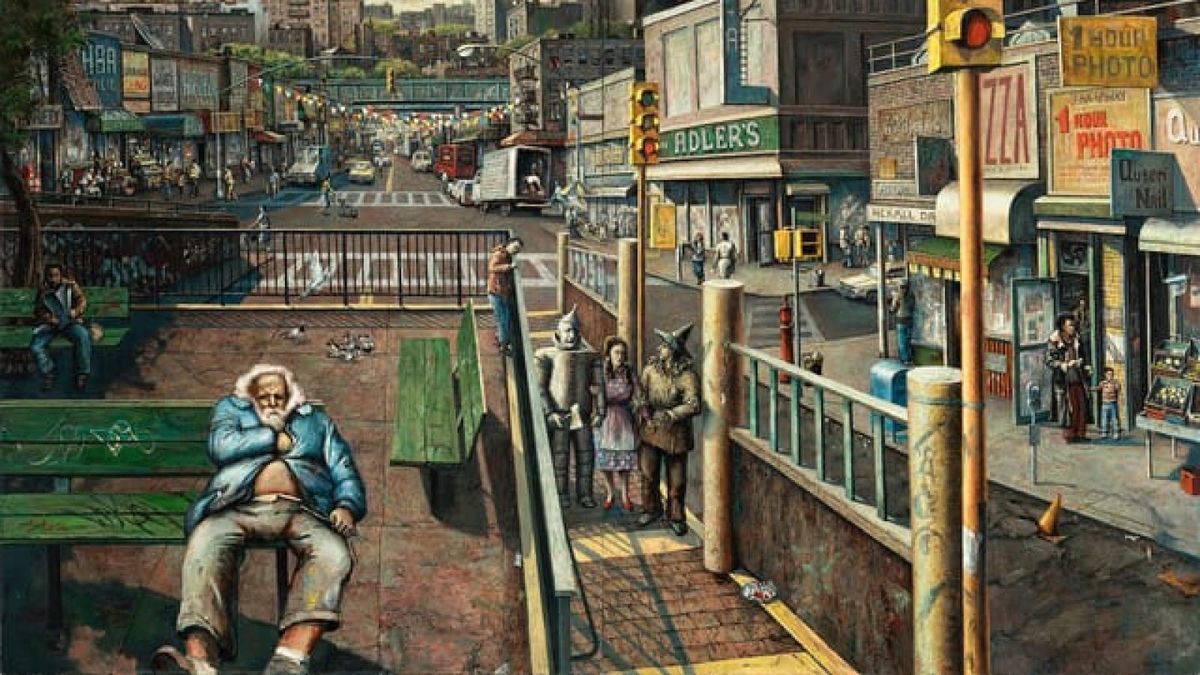
Other large works in the show include No Place Like Home, a 10-by-6-foot painting of a Bronx street scene at 170th Street and the Grand Concourse, looking west toward Jerome Avenue. Hauben said he included figures inspired by characters from “The Wizard of Oz,” such as a Hispanic Dorothy walking through the scene.
“My work never starts out with a real strong concept,” he said. “It sort of evolves and morphs at times.”
Another work, Bronx Vortex, is a five-panel painting about 16 feet across, focusing on the intersection of Fordham Road and the Grand Concourse. Hauben described the location as a major commercial hub and recalled being taken there as a child for shopping at Alexander's.
“My mother dragged me there, kicking and screaming,” he said.
The painting compresses multiple viewpoints into a single image, showing roughly 180 degrees at once.
Hauben said his work often records places that are constantly changing. “Everything I paint is guaranteed to change completely within a short time,” he said. “So it becomes like a historical document.”
He said he is not trying to depict conflict or spectacle in the city, but everyday life.
“For me, the most interesting aspect of city life is really how well people actually get along with each other,” he said.
He said that aspect of his work has connected with organizations such as the Kingsbridge Historical Society and the Bronx County Historical Society.
Hauben has been painting full-time since at least 1980 and has taught since the late 1980s, including 16 years at City College in the architecture department and earlier work in South Bronx high schools. He now teaches adults and seniors, calling them “the greatest population to work with.”
And the artist has managed his own career rather than working with a gallery, which he said lets him work without pressure to repeat earlier work.
“Nobody's dictating to me, ‘Oh, we sold X number of these from your last show, produce more like that, and we'll give you another show,’” he said. “I don't have that pushing me in any given direction.”
The exhibition will also include a time-lapse video of Emergence, condensing more than six years of work into about 15 minutes. Hauben said the video shows repeated changes rather than a single continuous progression. “My process is not linear,” he added.
A screening is scheduled for May 24. A fundraiser for the historical society is planned for June 21, when Hauben will sell prints and other reproductions, with proceeds supporting the organization.
Hauben said he expects many Bronx visitors will recognize locations in the paintings, but said he hopes the work reaches beyond that.
“I hope that people respond to the work as art,” he said. “That's the bottom line.”