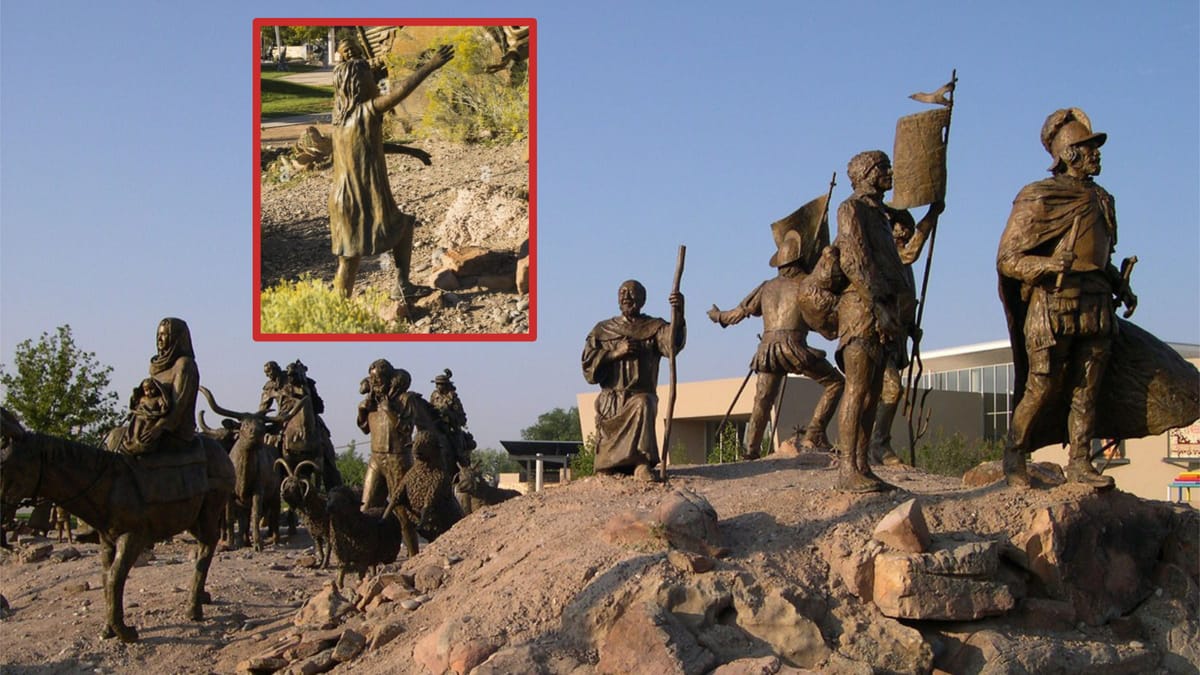
A controversial statue commemorating the arrival of Spanish settlers in what is now New Mexico was stolen from outside the Albuquerque Museum.
The statue depicts a little girl and is part of a larger 33-figure sculptural ensemble called La Jornada, which portrays the expedition of Spanish settlers and their families migrating north from New Spain into what is now New Mexico in 1598 under conquistador Juan de Oñate.
The girl is one of several women-and-children figures sculpted by artist Betty Sabo, who worked with Reynaldo “Sonny” Rivera on the installation as part of Albuquerque’s Cuarto Centenario project in 1998.
Rivera sculpted Oñate, an Indigenous guide, soldiers, cattle, horses, and other elements. The sculptures were installed in 2005.
The Albuquerque Museum said in a statement Tuesday that its staff had discovered the public sculpture missing from its location near the institution and reported the incident to police.
“Public art belongs to the entire community, and we take incidents like this seriously,” the museum said, urging people with information to contact police. “Community awareness and support are essential in helping protect and preserve Albuquerque’s public art for everyone.”
Urgent Matter has reached out to the Albuquerque Police Department for more information and additional comment.
But the sculptural ensemble has long been a point of controversy in the community, so much so that the city created a dedicated web portal for its “Race, History & Healing Project,” launched in June 2020 in response to concerns about the Oñate statue and the broader La Jornada installation.
For many Indigenous groups, especially Pueblo communities, Oñate symbolizes brutal colonial violence. The most cited episode is the 1599 Acoma Massacre, when Spanish forces attacked Acoma Pueblo after a revolt.
Spanish authorities later punished survivors by enslaving residents and amputating one foot from dozens of Acoma men.
Monuments tied to Oñate have been repeatedly targeted in New Mexico, including a statue in Alcalde whose bronze foot was cut off in 1998 in reference to the punishments imposed after the Acoma revolt.
Some critics argue La Jornada frames colonization as a heroic migration by depicting families and settlers traveling north while downplaying the violence and displacement experienced by Indigenous peoples.
Around the time the “Race, History & Healing Project” was launched, the statue was removed from the museum grounds and moved into storage.
The web portal includes more than 1,000 pages of public documents related to Albuquerque’s Cuarto Centenario project, as well as educational videos about the monuments and recordings of public meetings discussing them.
“I think it’s a continuation of the controversy that existed,” city council member Joaquin Baca told local broadcaster KRQE.
“I think that’s something we should fix as well, address that controversy. Because I think until that gets addressed, it’s almost like an open wound. And so, you still do have this idea of like, was it just theft, common theft, or was it something a little bit more.”
Stories like this take time, documents and a commitment to public transparency. Please support independent arts journalism by subscribing to Urgent Matter and supporting our work directly.