Nuclear missile makers are buying naming rights at the Smithsonian
The names of America's nuclear missile makers are now on the Air and Space Museum's planetarium and IMAX theater.

The names of America's nuclear missile makers are now on the Air and Space Museum's planetarium and IMAX theater.
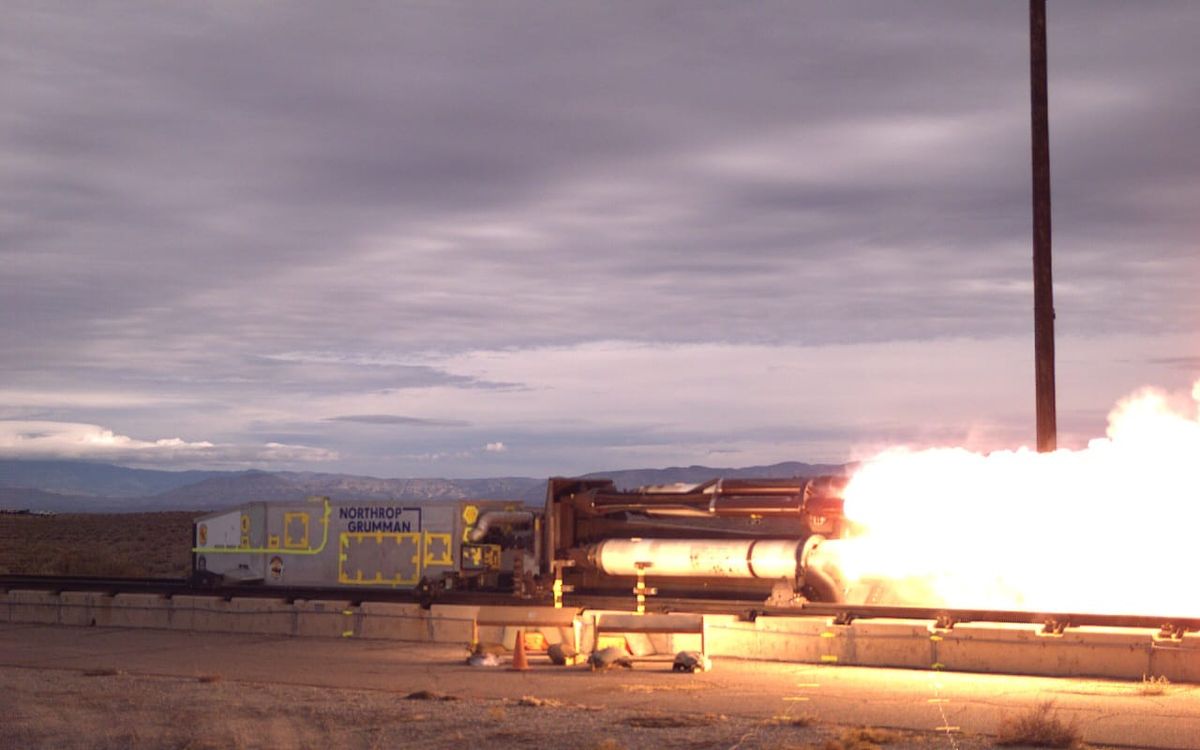
The makers of America's nuclear missiles are helping pay for the Smithsonian's Air and Space Museum, and getting their names on it. Northrop Grumman, the prime contractor for the Sentinel intercontinental ballistic missile, gave $10 million and had the museum's planetarium named for it. Lockheed Martin, which builds the Trident II D5 submarine-launched ballistic missile, holds the naming rights to the museum’s IMAX theater.
The Smithsonian Institution collected $383.9 million in private gifts, pledges and pledge payments in fiscal 2025 and closed its $2.5 billion national fundraising campaign a year early, its annual donor report shows. It still drew 52% of its operating revenue from the federal appropriation, the largest single source.
The report, titled “Gifts to a Nation,” covers October 1, 2024, through September 30, 2025. This fiscal year included the first eight months of Trump’s second term.
This article is provided free with the support of paying subscribers. Not ready for a paid subscription? Sign up for a free account today.
No spam. Unsubscribe anytime.
Jeff Bezos appears in the report’s top giving tier, $10 million or more, after being listed at the $1 million level in both the fiscal 2023 and fiscal 2024 reports. Separately, the Bezos Earth Fund gave $2.5 million or more.
The other donors at $10 million or more were Lilly Endowment, the Mellon Foundation, Northrop Grumman, David M. Rubenstein, the Charles and Lisa Simonyi Fund for Arts and Sciences, and Steven F. Udvar-Hazy and his wife.
Individuals supplied 55% of the $383.9 million, foundations 30% and corporations 12%, the report shows. Secretary Lonnie G. Bunch III wrote that the Smithsonian Campaign for Our Shared Future passed its target ahead of schedule.
“Considering the campaign has met its $2.5 billion goal a year early, it is clear how much our work resonates,” Bunch wrote.
Aerospace and defense contractors have an outsized presence in the annual report. Many are longtime funders of the National Air and Space Museum, but their donation amounts exceed those reported in previous years.
Their contributions come as the National Air and Space Museum celebrated 50 years by opening five new galleries on July 1. Two more, At Home in Space and Modern Military Aviation, are expected to open on October 30 and November 11, respectively.
Those new galleries follow five transformed galleries that opened in 2025. Among them was the Boeing Milestones of Flight Hall. The 2025 annual report listed Boeing as having donated $2.5 million or more for the fiscal year. It gave $500,000 or more in 2024 and $1 million or more in 2023.
Boeing makes the Minuteman III intercontinental ballistic missile.
RTX, formerly Raytheon, was listed in the same tier and has its name on one of the new galleries, RTX Living in the Space Age. It makes the Tomahawk cruise missile, a long-range strike weapon used extensively by the U.S. military in conflicts including Iraq and Afghanistan.
The RTX gallery will also display a five-time-flown New Shepard booster donated by Blue Origin, the space company Jeff Bezos founded. Blue Origin gave the museum the booster and a crew capsule in October 2024, within the fiscal year the report covers.
“There is no better final landing pad for New Shepard than the Smithsonian," Bezos said at the time.
Northrop Grumman, the prime contractor for the Sentinel intercontinental ballistic missile, gave $10 million to the National Air and Space Museum and was honored with a June 2025 press release announcing the donation. It was listed at the $1 million tier in 2024 and $10,000 tier in 2023.
“We are grateful to Northrop Grumman for this generous gift to support the transformation of one of the most popular museums in the world,” museum director Chris Browne said in a statement at the time.
“With this gift, we will be able to continue the work of bringing new artifacts, exhibitions and amenities to visitors from around the world and hope to expand our programming in the Northrop Grumman Planetarium.”
Steven F. Udvar-Hazy, who also donated in the $10 million range, is a Hungarian-American billionaire businessman and the executive chairman of Air Lease Corporation—a major global aircraft leasing company based in Los Angeles. He has the naming rights for the Steven F. Udvar-Hazy Center, a companion facility to the National Air and Space Museum that announced an expansion in 2025.
Lockheed Martin, maker of the Trident II D5 nuclear missile, gave $500,000 or more, the 2025 report shows, and has the naming rights for the museum’s IMAX theater. It gave $10,000 or more in 2024. Airbus and GE Aerospace were also listed at the $1 million tier for 2025.
Noticeably, neither SpaceX or its founder Elon Musk have been listed as donors to the Smithsonian in the 2023, 2024 or 2025 annual reports.
The institution’s finances improved over the year. Net assets rose to $6.509 billion at the close of fiscal 2025, from $6.134 billion a year earlier and $5.690 billion in 2023, the report’s five-year table shows. Total assets reached $7.890 billion, with liabilities of $1.381 billion.
The Smithsonian ran a $9 million operating deficit on $1.760 billion in revenue and $1.769 billion in expenses, narrower than the $53 million deficit the year before. It spent $286 million on property and equipment. KPMG conducted the audit.
The endowment stood at $2.864 billion on September 30, 2025, across 812 individual funds, and returned 12.3% for the year against an 8.3% policy benchmark. Since the Office of Investments was created in 2006, the endowment has received more than $914 million in gifts and distributed over $1.4 billion to programs the federal government does not fund, the report shows.
The report also shows several museums running under acting or interim directors in fiscal 2025. The report does not say why the posts were vacant, and whether they reflected routine turnover or a broader pattern across the institution's leadership was not clear from the document.
Shanita Brackett was acting director of the National Museum of African American History and Culture, and Melanie A. Adams was interim director of the Smithsonian American Women’s History Museum. The National Portrait Gallery had an acting director, Elliot Gruber, and the deputy secretary’s office and Smithsonian Enterprises were led on an acting basis.
The 2025 report reached its final form amid pressure from the White House. Its file metadata shows the 65-page document was created July 15, 2026, and last modified July 24, 2026, weeks after the White House Domestic Policy Council released a report accusing the Smithsonian, and the National Museum of American History in particular, of what it called “ideological capture.”
That report followed the executive order Trump signed in March 2025, “Restoring Truth and Sanity to American History,” which directed the removal of “improper ideology” from Smithsonian museums, research centers and the National Zoo, the White House said.
The order named the National Museum of African American History and Culture, the Smithsonian American Art Museum and the American Women’s History Museum, the Congressional Research Service documented, and gave the vice president, a regent, a role in enforcing it.
Bunch, in his letter attached to the 2025 report, defended the museum the order named first.
“I remember how gratifying it was to get our first large donation for the National Museum of African American History and Culture, giving us legitimacy and causing others to join our mission to explore a more comprehensive American history,” he wrote.
In August 2025, the administration demanded a review of Smithsonian exhibitions and operations to align them with the order and “celebrate American exceptionalism.” Bunch responded last September that the institution controls its own content.
The administration later threatened the institution’s federal funding and set a January deadline for documents it said Bunch had failed to produce.
“In this, the 250th anniversary year of our nation’s founding, it is vital to embrace charitable giving’s role in creating a better Smithsonian, country and world,” Bunch wrote in the latest report.
Urgent Matter is reader-supported. Please consider subscribing to support independent arts journalism.