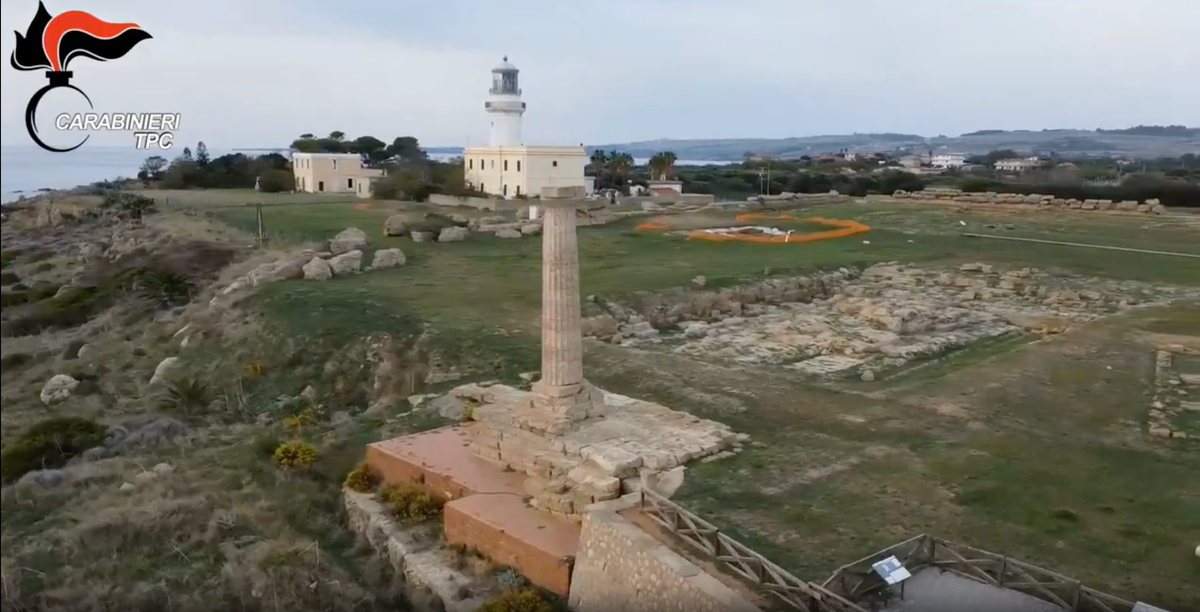
Italian authorities launched helicopter-backed raids before dawn Friday, swooping down on suspected tomb raiders, traffickers and middlemen—some with alleged mafia ties—accused of grave robbing ancient artifacts and funneling them into the international black market.

The raids were carried out in two operations, code-named “Ghenos” and “Scylletium,” across Sicily and Calabria. Helicopter squadrons aided elite ground units in conducting dozens of arrests in one of Italy’s largest recent cases involving archaeological crime. Authorities said the investigation touched as far as the United Kingdom and Germany.

Italy’s Carabinieri police force said in a statement that the two investigations converged when it emerged that a team of Sicilian “grave robbers,” who appeared in the “Ghenos” investigation, operated both in their region of origin and in Calabria, in collaboration with the suspects in the “Scylletium” investigation.

0:00
/2:32

The Sicilian operation: Ghenos

At the center of the Sicilian investigation are 45 suspects accused of forming multiple criminal associations dedicated to illegal excavation, theft, counterfeiting, laundering, and international trafficking of cultural property, among other charges.

The Sicilian raids resulted in nine orders of pre-trial detention and 14 orders of house arrest, with additional suspects placed under nightly curfews or other judicial restrictions. Authorities also ordered the suspension of business activities for the owner of an auction house, which was not named.

In the Ghenos operation, police seized about 10,000 archaeological artifacts, including approximately 7,000 ancient coins. Among them were bronze and gold coins from ancient mints in Syracuse, Katane, Selinunte, Gela, Panormos, Reggio, and Akragas, with some dating as far back as 500 B.C.E. Experts said several specimens were of exceptional historical and scientific value.

Police also seized hundreds of additional artifacts, including clay vessels and fragments, protohistoric fibulae—early metal clothing clasps from the Bronze and Iron Age—bronze rings, weights, rudimentary bronze coins, buckles, and arrowheads, as well as metal detectors and other tools used for illegal excavation.

Authorities estimated the total value of the seized material at nearly $20 million.

In addition to the suspects jailed or placed under house arrest Friday, Carabinieri said earlier phases of the investigation led to six arrests during five targeted enforcement actions.

The investigation began in 2021, after the management of the Agrigento Archaeological Park reported repeated illegal excavations dating back to June 2019 at the coastal site of Eraclea Minoa. Investigators said the probe quickly expanded as evidence mounted of a coordinated looting operation.

Five suspects were caught in the act of illegal excavation in 2022 inside the protected archaeological site of Baucina, while three others were arrested in separate cases while attempting to illegally export archaeological material abroad. Those cases included the seizure of ancient coins in Düsseldorf, carried out with the assistance of German police.

Searches conducted last November uncovered what authorities described as an illegal workshop in the Catania area, used to produce fake ceramic antiquities and counterfeit coins. Investigators said the site was equipped with molds, dies, casting tools, and scales used to work copper and other materials.

Police said the evidence allowed them to map a layered criminal structure typical of what they describe as the archeomafia: teams of tomb raiders using advanced tools to strip archaeological sites, local receivers who aggregated the material and higher-level traffickers capable of placing looted objects on international markets.

The Calabrian operation: Scylletium

The Calabrian investigation was launched separately in October 2022 and later linked to the Sicilian probe after authorities identified overlapping trafficking networks.

In the Calabrian case, authorities accuse 11 suspects of systematically looting major archaeological sites in an operation allegedly designed to benefit the ’Ndrangheta’s Arena clan. Of those suspects, two were placed in pre-trial detention and nine under house arrest, police said.

Investigators said the network targeted some of Calabria’s most significant archaeological sites, including the Scolacium archaeological park in Roccelletta di Borgia, the ancient city of Kaulon in Monasterace, and Capo Colonna in Crotone, as well as additional private land in the province of Crotone.

Authorities said the group operated with a structured division of roles involving grave robbers, intermediaries and receivers, planning excavation expeditions and identifying promising locations using specialized archaeological knowledge.

To avoid detection, suspects allegedly relied on coded language, referring to artifacts as “coffee” or “asparagus” and to metal detectors as “chainsaws,” while keeping phone communications to a minimum.

Prosecutors said the criminal activity was aggravated by its alleged connection to the Arena mafia clan, with illicit profits and territorial control reinforcing the ’Ndrangheta’s influence in and around Isola di Capo Rizzuto.

“This situation has obviously attracted the interest of organized crime,” police said. “In this context, the ’Ndrangheta needs to recruit enthusiasts and experts in order to operate in a specialized sector which, although highly profitable, would otherwise be closed to it.”

“At the top of the criminal group were two individuals, both residents of the province of Crotone, who were archaeology enthusiasts and knowledgeable about the locations where artifacts could be found and illegally introduced onto the black market,” police said. “They were constantly engaged in clandestine searches and permanently connected within the trafficking network.”

Share this article
The link has been copied!