German city keeps Tim Bengel’s devil sculpture after vandals deface it
A petition to remove the bronze has passed 5,800 signatures.

A petition to remove the bronze has passed 5,800 signatures.
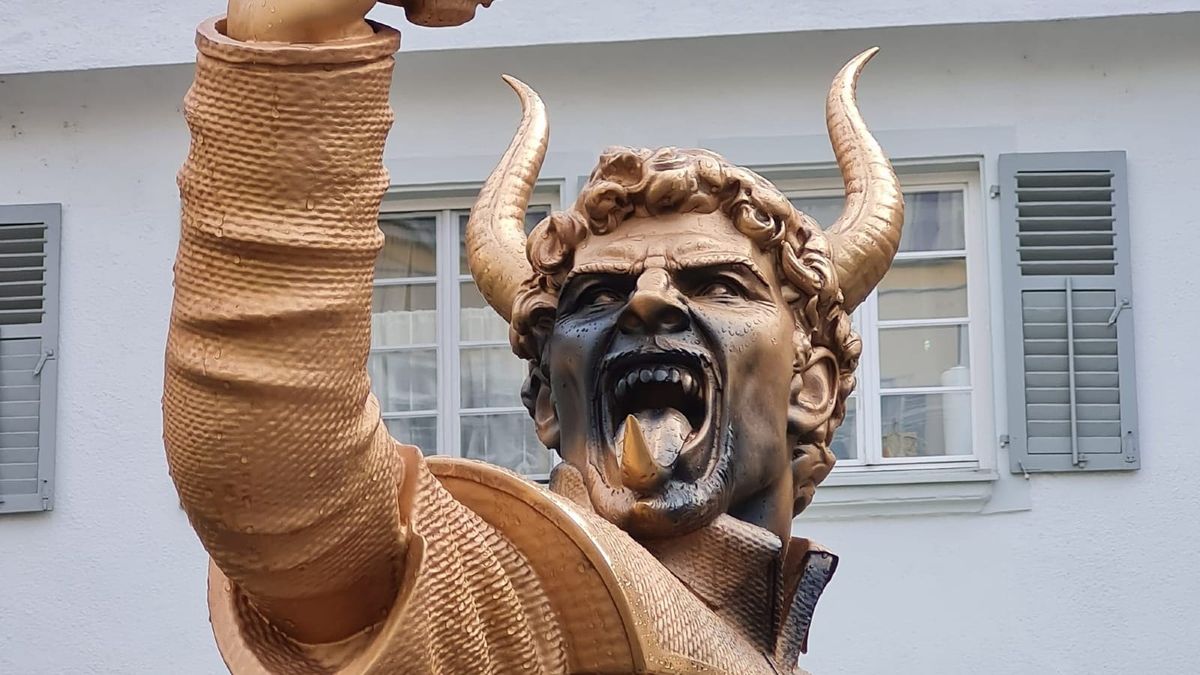
Vandals spray-painted the face and coat of Tim Bengel’s new bronze devil sculpture in Esslingen, Germany, and marked its back with a Christian symbol less than a week after it was unveiled outside the city’s town hall.
Bengel told Urgent Matter in an email that the sculpture was vandalized overnight from October 9 to 10. He learned of it the next morning.
Two patina specialists from the Strassacker foundry removed the black spray paint on the morning of October 12, Bengel said. “The bronze is fully cleaned and shines just as it did before,” he said.
The city of Esslingen, which owns the sculpture, filed police reports over the vandalism and insults and death threats against the mayor, Bengel said. He separately filed several police reports over the worst insults he received online.
In an October 12 statement, the office of Mayor Matthias Klopfer said the city would report every call to commit crimes, every insult and every call for murder to police. The city also said it would consider installing video surveillance at the sculpture site.
“When people call for violence and property damage because of an artwork, when calls for murder are posted and anger is unleashed in actions like this one, a red line has been crossed for us,” the city said in the statement, which Urgent Matter translated from German.
Bengel said the city has confirmed the sculpture will stay.
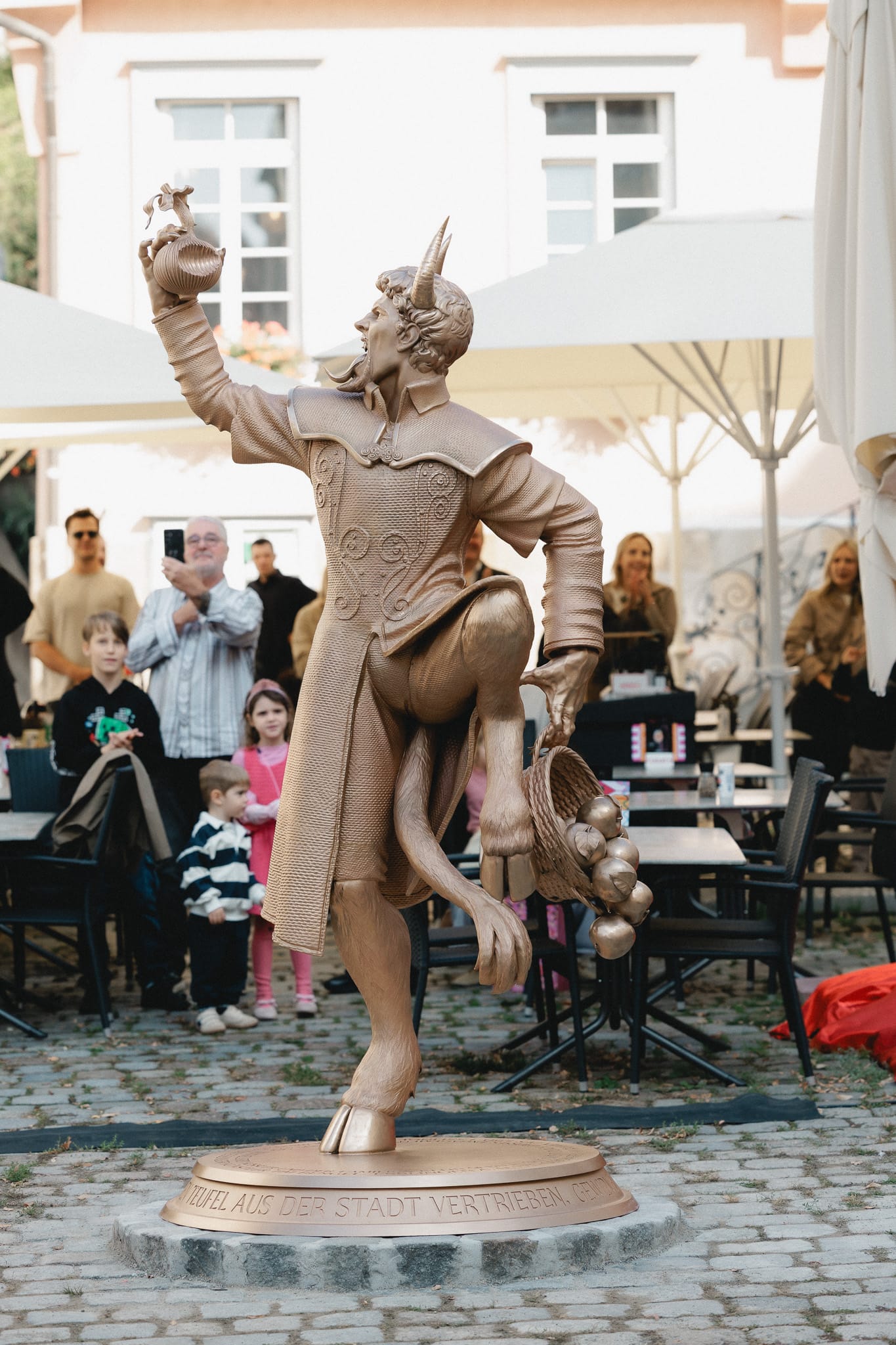
The city said the sculpture, Zwieblinger Teufel, was a gift from the sparkling wine maker Kessler for the company’s 200th anniversary. Kessler and Bengel, whom the city describes as an Esslingen artist, unveiled it on the town hall square on October 4.
At the ceremony, Klopfer said he expected the sculpture to become “a symbol of identity that always reminds us that we people of Esslingen don’t let ourselves be beaten down so easily.”
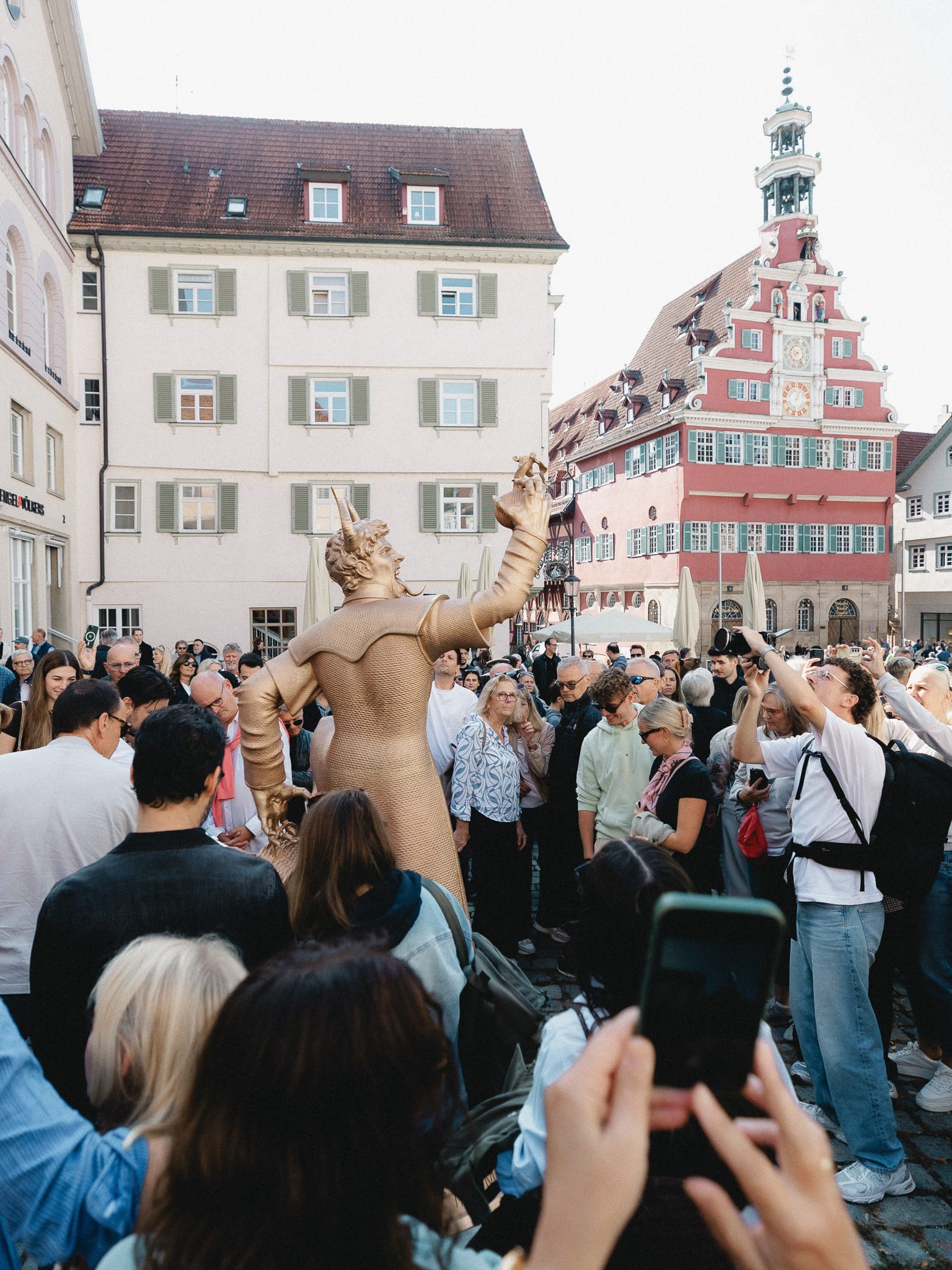
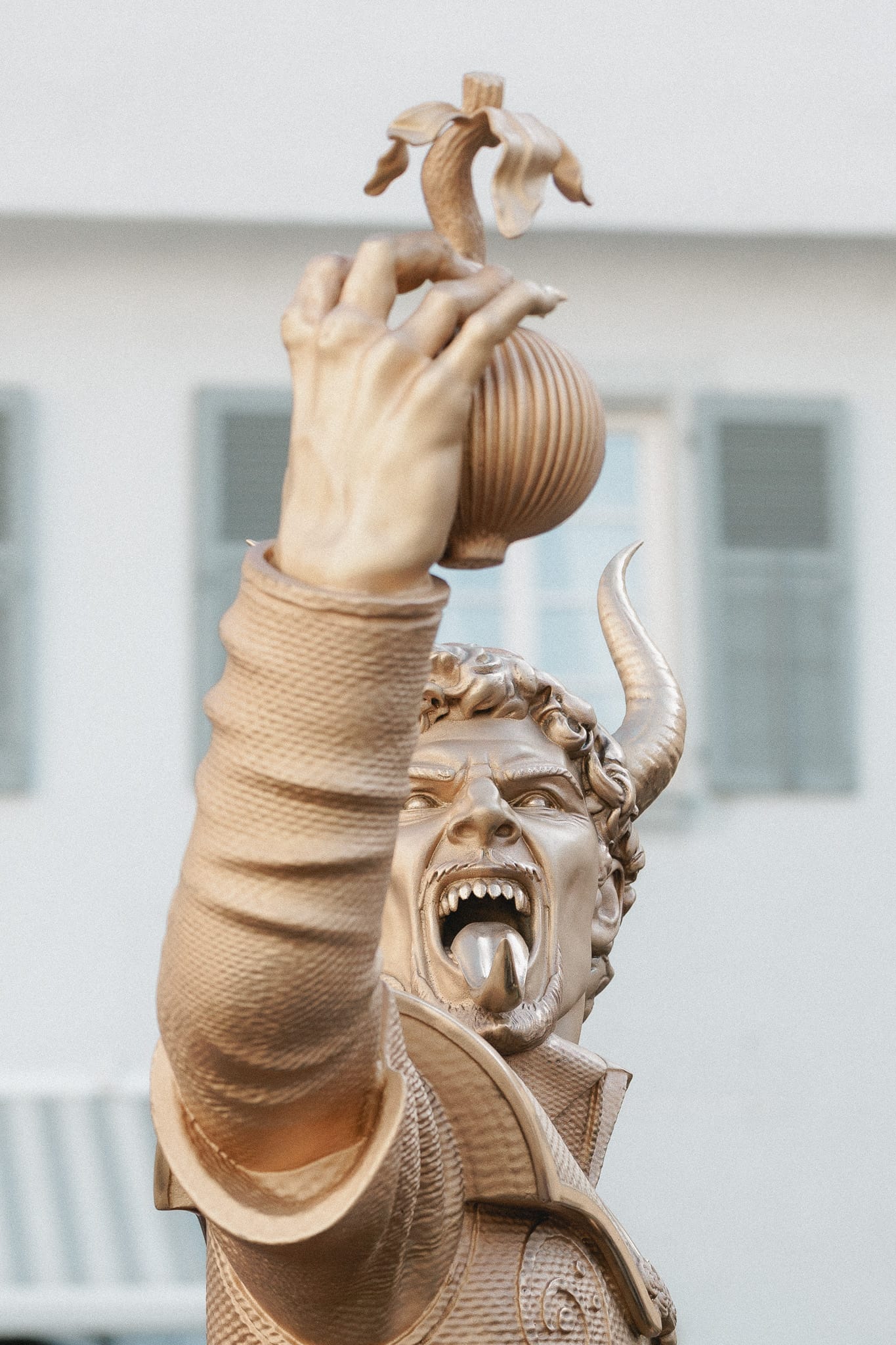
The title refers to “Zwieblinger,” a nickname for Esslingen residents drawn from the German word for onion and from a local legend.
“The legend itself is simple: a clever market woman recognized the devil and put an onion in his basket instead of an apple. When he bit into it, he was so shocked that he fled the city forever,” Bengel said.
A petition on openPetition addressed to Klopfer asks the city to remove the sculpture. It was started October 5 by an account named “Für meine Mitmenschen,” or “For my fellow people,” and had 5,874 signatures as of Tuesday, including 1,338 from Esslingen.
The petition also asks for a sculpture of the market woman and for future public art to be put to broad public discussion before installation. “This central square belongs to all citizens, not to a controversial individual interpretation,” the petition says.
Bengel said he is often asked why he did not depict the market woman.
“I deliberately chose the visually more striking motif, the devil in the very moment of his defeat, because I believed it would reach more people,” he said.
He said residents have described the woman in many ways, from old to young and tall to short. “One woman came up to me and said: ‘Tim, thank you for not depicting the market woman. I have my very own image of her, and I want to keep it in my heart forever,’” Bengel said.
The Evangelical Church in Württemberg, the regional Protestant church, posted statements from three of its theologians on October 13. Andreas Oelze, the church’s commissioner for worldview questions, said only part of the criticism is religious. He said other critics object to the sculpture’s appearance, how the commission was awarded, and the cost—which they consider too high
“One may criticize the statue for various reasons, but there is certainly no need to elevate it spiritually or even to be afraid of it,” Oelze said.
Johannes Koch, the church’s commissioner for art, said religious critics confuse the figure from the folk legend with the biblical Satan. “On the basis of magical thinking and feeling, deep fears seem to be awakening in some people; I can’t explain the aggressive spraying any other way,” Koch said.
Koch also said that, in his view, the figure “lacks pretty much everything that conventionally stands for artistic quality.”
Bengel said Christians do not form a single bloc on the work. “Many Christians love the sculpture because it gives evil a tangible form again and warns against it, as Christian art has done for centuries. Others want it removed,” he said.
“And the debate over whether religious sentiment should outweigh artistic freedom is something I honestly did not expect in 2026,” Bengel said.
Bengel responded to the vandals’ use of a Christian symbol in a German-language Instagram post.
“Just because someone uses a Christian symbol for their vandalism, nothing can be concluded from that about Christians in general,” he wrote. “On the contrary: the Christians I know live their faith as a religion of love for one’s neighbor and of consideration.”
In the same post, Bengel said he spent four hours at the city information office on the market square, as he had announced beforehand, so anyone who wanted to talk could find him.
“None of those who condemn the sculpture in the harshest terms online, tear it out of context and use it for their own reach were there. None of those who send insults and threats through fake profiles were there. And the ones who come at night with a spray can weren’t there either,” he wrote.
He wrote that residents of Esslingen came for the full four hours and that the feedback was “positive without exception.”
“You can argue about art, but not about property damage,” Bengel wrote.
Bengel told Urgent Matter that cafés on the square say they are getting more visitors and that tourists from the United States and Japan have come to see the sculpture and ask for souvenirs. Teachers have brought the legend back into classrooms, and local tattoo artists have already tattooed the devil on customers.
“Public art first has to be noticed. Art that isn’t seen makes itself redundant,” he said.
Bengel said public art may have to pass through a storm of criticism before it becomes a landmark.
“On Lake Constance, not far from here, the Imperia statue, a courtesan holding a naked pope and emperor in her hands, sparked outrage when it was unveiled in the 1990s,” he said. “Today, there is hardly a tourist photo of Konstanz without her.”
Urgent Matter is reader-supported. Please consider subscribing to support independent arts journalism.