Appeals court voids Manhattan DA's seizure of Art Institute of Chicago's Schiele
The unanimous ruling sends the fight over Russian War Prisoner to federal court.

The unanimous ruling sends the fight over Russian War Prisoner to federal court.
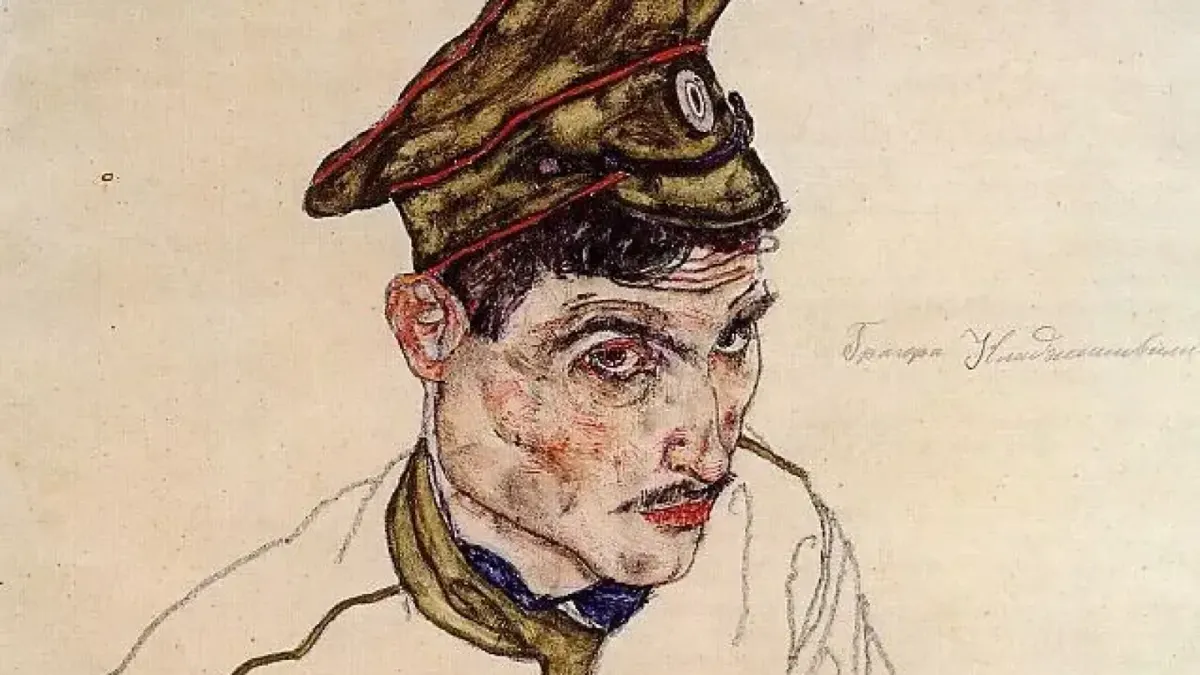
A New York appeals court has thrown out the orders that would have forced the Art Institute of Chicago to hand Egon Schiele's Russian War Prisoner to the heirs of Fritz Grünbaum, a Jewish cabaret performer who died at the Dachau concentration camp.
A five-justice panel of the Appellate Division, First Department, ruled unanimously on September 17 that a state law for returning stolen property cannot settle a sharply contested fight over who owns a work of art.
The panel vacated the April 2025 turnover orders and the 2023 warrant the Manhattan District Attorney's office used to seize the 1916 watercolor, the decision shows. The panel dismissed the museum’s direct appeal because state law does not allow one, but granted its separate petition challenging the lower court’s power.
The panel wrote that Penal Law Section 450.10 offers a quick way to return stolen property to an easily identified owner. The statute "was not designed to address complicated, disputed issues of ownership," the decision said.
The DA's Antiquities Trafficking Unit told the court that Manhattan judges have signed more than 100 turnover orders under the statute in art trafficking cases, returning more than 4,000 antiquities and artworks.
"This decision matters for museums and collectors,” said Harry Sandick, a partner at Patterson Belknap Webb & Tyler and a former federal prosecutor in Manhattan, in comments circulated by the public relations firm Baretz+Brunelle.
“The Manhattan DA's Antiquities Trafficking Unit has for years used Section 450.10, with its limited due process protections, to repatriate and restitute allegedly stolen works—even where title to the work is sharply contested. The First Department's decision provides those seeking to contest title to the allegedly stolen work with their day in court.”
Paid subscribers can read the court's decision and order.
 Adam Schrader
Nicholas O'Donnell, an art lawyer, told The New York Times the ruling "sharply reduces the D.A.'s ability to pursue the seizure of cultural property." Raymond Dowd, a lawyer for one of the Grünbaum heirs, criticized the reasoning and compared the works to drugs or drug money that police are allowed to seize, the Times reported.
The museum told the Times that the court had rejected an unlawful effort to decide a property dispute through criminal proceedings, and that the question belongs in civil court. The DA's office told the paper it was reviewing the ruling and deciding its next steps.
The panel said its ruling "should in no way be construed as a determination as to the rightful owner" of the drawing. It also did not decide whether a conspiracy brought the work to the museum or whether the museum did enough to check its history, and it left the DA's grand jury investigation open.
Ownership should instead be decided in the heirs' lawsuit against the museum in federal court in Manhattan, "where the dispute may be fully litigated," the panel wrote.
Grünbaum was arrested by the Gestapo on March 22, 1938, and sent to Dachau, where he died in 1941. His wife, Elisabeth "Lilly" Grünbaum, was killed at the Maly Trostinec death camp in 1942.
The Nazis seized and inventoried Grünbaum's collection, the court wrote. The list included 81 works by Schiele but did not name Russian War Prisoner.
Grünbaum's Schieles then disappeared from the record until 1956, when works from the collection resurfaced at a Swiss auction house run by dealer Eberhard Kornfeld. Otto Kallir, an Austrian dealer, bought at least 21 of them, including Russian War Prisoner, for his Manhattan gallery, Galerie St. Etienne.
Kallir sold the drawing in 1957 to David Kimball, a Connecticut collector, who sold it to Leo Askew, a collector believed to have lived in Louisiana. The museum bought it in 1966 from B.C. Holland, a Chicago gallery, for $5,500, with money from Illinois donor Dr. Eugene Solow.
The court wrote that the museum had no record of checking the drawing's provenance at the time, though the State Department had repeatedly warned buyers to check the history of art sold after World War II.
Kornfeld later said he had bought Grünbaum's Schieles from Lilly's sister, Mathilde Lukacs, who fled Austria before the war. In a 2019 ruling in another Grünbaum case, Reif v. Nagy, the First Department rejected that account because no document showed a transfer to Lukacs, she did not appear in early sale catalogs and Kornfeld raised the claim decades later.
In 2002, the museum had an intern ask Kornfeld to confirm the Lukacs sale. He answered in a letter.
"We had bought the Grünbaum collection from Mrs. Lukacs, the sister from the widow Grünbaum. The collection of Grünbaum was never seized by Nazi authorities. The widow could keep it and give it to her sister. The sister kept the collection until 1955 and sold it thereafter in different parts," Kornfeld wrote.
The court said there is no record the museum ever tried to verify Kornfeld’s story on its own. In 2006, the heirs asked for the drawing back and sent evidence they said showed Kornfeld forged the Lukacs paperwork. The museum refused.
The museum maintains it owns the drawing. It argues there is no evidence the Nazis ever physically seized the work and that Lukacs sold it to Kornfeld.
"If we had this work unlawfully, we would return it, but that is not the case here," Megan Michienzi, the museum's executive director of public affairs, told Artnet News in February 2024.
The heirs, among them Timothy Reif, a judge on the U.S. Court of International Trade and Grünbaum's great-nephew, asked the DA's office to investigate in 2022. Investigators found 11 Schiele works from the collection in Manhattan or offered for sale there, and a grand jury investigation opened.
In September 2023, Justice Althea Drysdale of the New York State Supreme Court, the state's trial-level court, signed warrants for three works held outside New York. The Carnegie Museum of Art in Pittsburgh and Oberlin College's Allen Memorial Art Museum gave up their drawings. The panel wrote that the Art Institute was the only one to contest the heirs' claim.
Prosecutors told the court in October 2025 that the heirs have recovered the other 10 works: nine through turnover orders under the same statute and one through a private settlement.
Matthew Bogdanos, chief of the Antiquities Trafficking Unit, filed a 160-page application in February 2024 seeking to return the drawing to the heirs, Artnet News reported. Investigators let the work stay at the museum under court order, an arrangement known as seizure in place.
Drysdale ruled on April 23, 2025, that the drawing had been stolen from Grünbaum and remained stolen. She also found the museum had not reasonably checked its provenance. She heard more than 10 hours of argument but did not hold an evidentiary hearing, saying it would serve no purpose because every witness with firsthand knowledge had died.
The appeals panel faulted that process. It wrote that the proceeding lacked pleadings, meaningful discovery, clearly defined burdens of proof, and a route to a direct appeal. The panel said the case involved the constitutional right not to lose property without due process.
In an October 2025 answer to the museum's petition, the DA's office argued the museum had agreed to the seizure. Assistant District Attorney Cecelia Chang wrote that the museum waived the need for a separate Illinois warrant, joined seven requests to extend the seizure and promised to hand the drawing to a Homeland Security Investigations agent within 10 days if it lost.
If any error occurred, Chang wrote, it "would stem not from unjustified jurisdictional overreach by Justice Drysdale but rather from confusion induced by AIC's own representations to the court and failure to timely contest the New York warrant."
The office also told the court in that filing that the museum remained a target of the grand jury investigation. Prosecutors have not charged the museum with any crime connected to the drawing, the panel wrote.
The DA's office argued the museum waited more than 21 months after learning of the warrant before it asked the appeals court to step in. The panel disagreed, finding the museum filed within four months of Drysdale's ruling and had reserved its right from the start to challenge the court's power over the drawing.
The heirs sued the museum in New York state court in December 2022, and the museum moved the case to federal court. U.S. District Judge John Koeltl dismissed it as filed too late in November 2023 and declined to reconsider in February 2024, Artnet News reported.
The U.S. Court of Appeals for the Second Circuit revived the suit on March 11, 2025, calling the museum a "sophisticated purchaser" with expertise in researching the provenance of Nazi-looted art. Koeltl paused the case in June 2025 to wait for the state appeals court.
The Association of Art Museum Directors and the American Alliance of Museums filed a joint brief supporting the museum, and the panel accepted it.
The panel stayed enforcement of its order for 30 days.
Urgent Matter is reader-supported. Please consider subscribing to support independent arts journalism.