George Petrides sues Chicago’s National Hellenic Museum over damaged sculptures
The allegations include repeated movement during events and documentation gaps.

The allegations include repeated movement during events and documentation gaps.
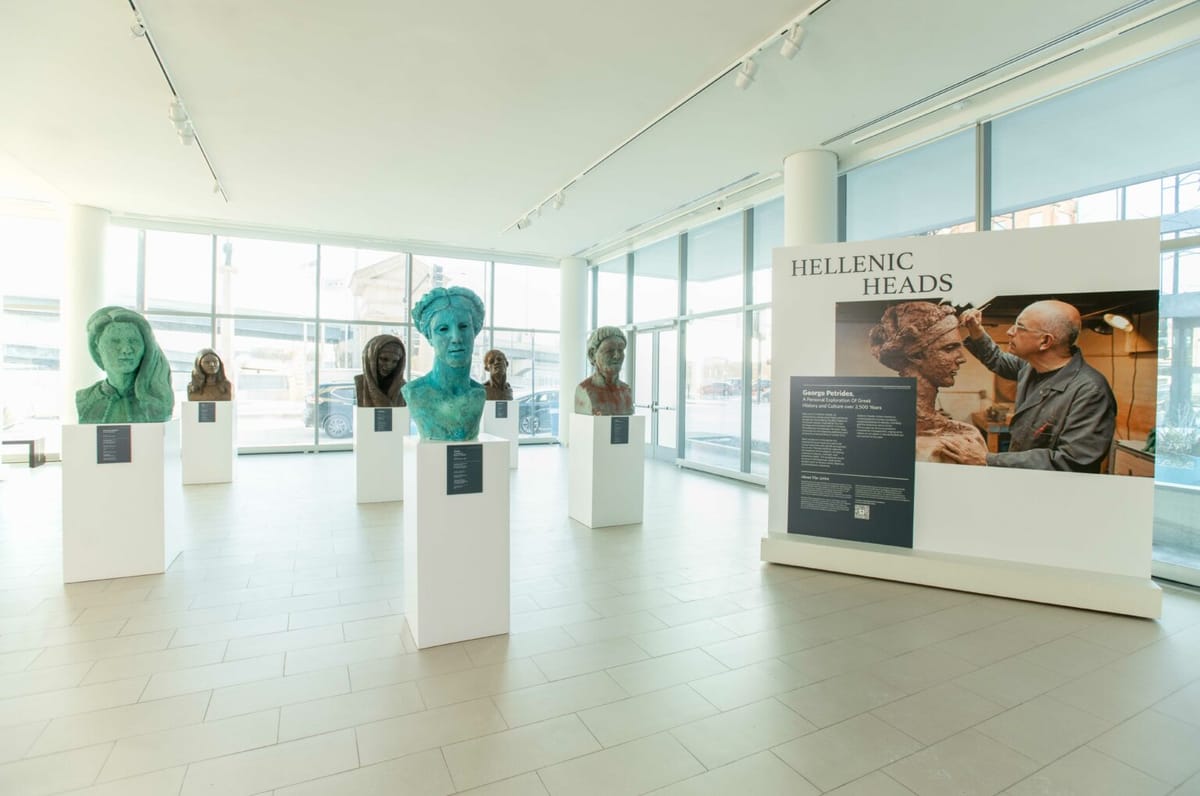
The Greek artist George Petrides filed a federal lawsuit against Chicago’s National Hellenic Museum, accusing it of improperly handling his sculptures to host events that left his sculptures damaged.
The traveling show, short-titled “Hellenic Heads,” was first shown in May 2022 at the Greek Embassy in Washington, D.C. and went on view in the first-floor Calamos Great Hall of the Chicago institution in 2023.
It includes six monumental portrait heads modeled after members of Petrides’ family, with each representing a distinct stylistic era—from Ancient Greece to modern times. Each of th sculptures was insured at a value of $75,000, a value he said represented an agreed-upon minimum for insurance purposes, with five of them referenced in the lawsuit.
The show was such a success for the National Hellenic Museum that it was extended three times for a full run of eight months, Petrides said in his lawsuit, according to court documents obtained by Urgent Matter.
Paid subscribers can read the full document.
 Adam Schrader
But during the run of the show, the museum allegedly hosted multiple events including weddings and corporate events in the Calamos Great Hall, which required repeatedly moving the sculptures.
As proof, Petrides provided a screenshot of a June 2024 Facebook post from the museum advertising its event hosting which showed the sculptures moved from their proper locations within the venue.
Petrides said the sculptures were subjected to “repeated physical handling without professional art-handling protocols and suffered varying levels of damage and destruction” to accommodate the events.
“Defendant’s repeated physical handling, lifting, and relocation of the works—without any or sufficient conservator oversight, without custom crating, and without the protective measures required for mixed media sculpture of this fragility—caused incremental chipping, spalling, abrasion, and edge loss,” he said.
He criticized the museum for allegedly not being accredited with the American Alliance of Museums, which requires member institutions to follow set professional standards for the handling and conservation of artworks.
Under the terms of the exhibition agreement, the National Hellenic Museum was to provide an initial condition report and photographs to the artist upon receiving the artworks but allegedly failed to do so.
The complaint also alleges the artist repeatedly warned the museum over a period of two years that movement of the works was causing damage.
When Petrides received the museum’s own final condition reports upon the conclusion of the show, they identified damage to the sculptures that “goes beyond any ordinary wear that might occur over time,” he said. But he alleged the reports failed to identify “all damage and destruction” to the artworks.
After Petrides was notified of the damage at the conclusion of the show in March 2024, he alleged that the museum prevented him from accessing the artworks to photograph and document the damage.
The complaint also alleges the museum continued to display the damaged works under Petrides’s name and derive financial and reputational benefits from them and claimed that he was not paid a standard participation fee or exhibition rental fee for the hosting of the exhibition.
The lawsuit appears to include an error. In the document, lawyers for Petrides wrote that the artist didn’t receive the initial intake photos documenting the condition of the artworks when they were received by the institution until March 30, 2026. The lawsuit was reviewed by Urgent Matter on March 27, 2026.
Petrides in his lawsuit asserts three claims under the Visual Artists Rights Act, along with claims of negligence, unjust enrichment, conversion and breach of the exhibition agreement. He has demanded a jury trial.
The museum said at the time of the exhibition that it was “proud” to present the works by Petrides. Urgent Matter has reached out to the museum for more information and additional comment.
Stories like this take time, documents and a commitment to public transparency. Please support independent arts journalism by subscribing to Urgent Matter and supporting our work directly.