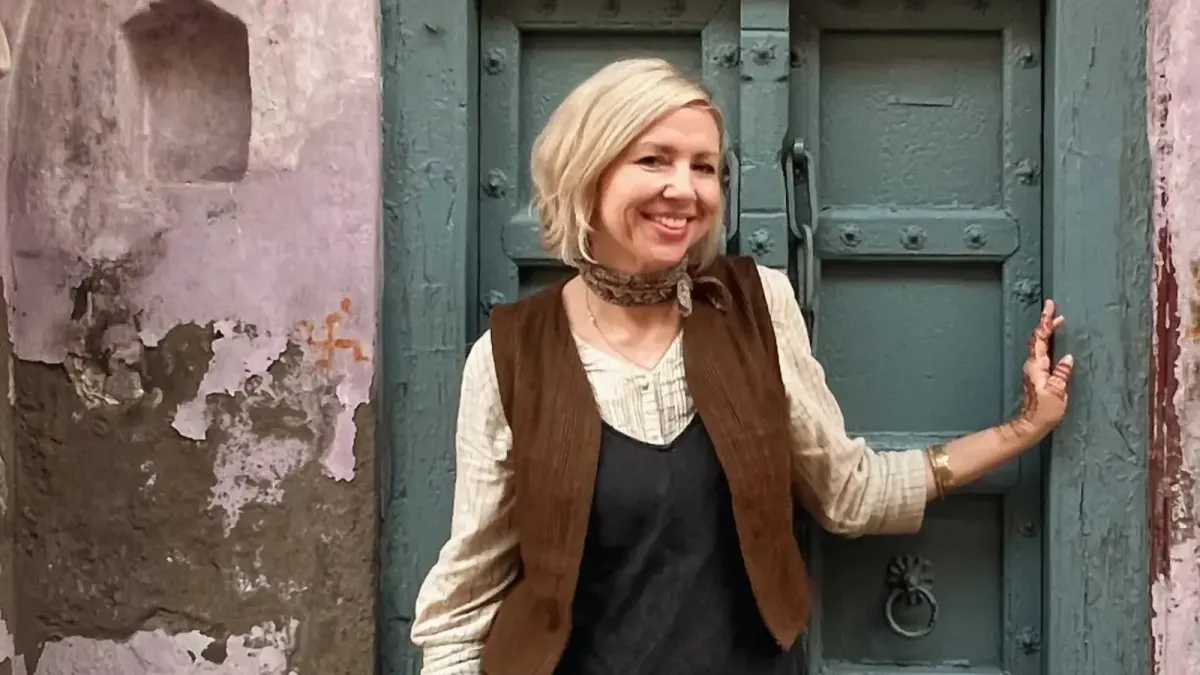
When a handmade rug sells in Morocco, the artisan who wove it earns under 4% of the sale price, said Kirsten Dickerson, founder of the craft-travel company Artist & Nomad.
“That’s how bad that is. Most tourists aren’t aware of that,” Dickerson said in an interview with Urgent Matter.
Dickerson runs craft and culture tours to Morocco, India, Kenya, Mexico and other countries, pairing travelers with artisans in their homes and workshops. She said she will move the business fully under a nonprofit at the end of 2026 so tour profits fund its nonprofit arm.
"It makes it easier to be clear about what we do and where the money goes," she said. She is forming a board of directors to complete the transition by year-end.
The change comes as Dickerson tours Handmade Future, a documentary she directed about artisans and the craft economy and her first feature to direct and produce. She said proceeds from screenings, ticket sales and donations will go into a fund that artisans can apply to for grants.
The grants will pay for apprenticeships, “direct market access opportunities” and improvements to artisans’ studios, she said.
The artisan sector is the second-largest employer in the developing world after agriculture and is worth more than $32 billion a year, most of it driven by women, the Aspen Institute’s Artisan Alliance estimated in 2025.
Makers rarely receive the full value of their work sold abroad because every link in the supply chain adds cost and profit, the research network WIEGO found in a 2024 study of artisan value chains.
Much of what tourists spend on handicrafts goes to middlemen rather than makers, Dickerson said. In Marrakesh, most rugs on offer are sold through middleman shops.
"The majority of those rugs you see for sale all over the place are sold in middleman shops. The artisans are deeply exploited," she said, adding that buyers "innocently buy something” because it’s said to be handmade without knowing the maker was paid little.
Dickerson described a calculation she and a film crew made inside a marble inlay workshop in India. A master artisan featured in the documentary was making a table inlaid with 5,000 gemstones. She said the piece takes months and a full team to complete.
They asked the shop what the table sold for and what its maker earned. “$3,300, and that master artisan made $60,” she said.
"Why can’t he sell it for that $3,300? Why is he only making $60? And why does he keep doing it?" she said. "Because he loves the craft and this is his heritage, but that’s why it’s disappearing. He’s a master and he will not stop."
The artisan, whom Dickerson named as Ifran, has not passed the craft to his son, she said. “He’s one of the last masters,” she said.
The United Nations treats traditional craftsmanship as intangible cultural heritage worth protecting, and UNESCO maintains a List of Intangible Cultural Heritage in Need of Urgent Safeguarding for living practices at risk of vanishing.
A 2025 study in Heritage Science that cataloged threats to such heritage listed the effects of mass tourism, industrialization and the failure to pass skills to younger generations among the main drivers of decline.
Dickerson pointed to organized tourist shopping as part of the problem. Guides in India steer visitors to emporiums to buy marble inlay near the Taj Mahal, she said.
"That tourist guide on that traditional big bus makes 50% of whatever sale, and the markup is huge. So the artisan who made it, like Ifran, makes nothing," she said. "Everybody’s making money but the artisan."
She said she wants to empower and educate people to understand how things operate behind the scenes.
Dickerson was one of several tour operators featured in a recent Condé Nast Traveler piece on craft-focused travel. Asked whether such cultural travel is new or simply growing, she said she has led trips in some form for about 20 years, dating to her time running an ethical fashion company, but began formally curating them in 2019.
She said there were few craft-specific tours then and that the field "is really growing" now. Another operator, Molly Berry of Luna Zorro, is based in Guatemala and runs tours there.
Dickerson tries to prevent her trips from repeating the exploitation she describes. She works with a local guide everywhere she goes rather than presenting herself as an authority on another culture.
“I want people to learn from someone from that culture,” she said. “I’m there as a host, but I have local partners I lean on to be the actual local guide.”
On each tour, she and her local contacts identify where travelers can shop to reach makers directly, she said. She briefs travelers on the ethics of buying before they go out. On a tour, "we’re putting money in local businesses, local nonprofits, local craftspeople," she said. "It’s not all going to corporate things."
In Morocco, the tours partner with the Anou Cooperative, which works with about 90 women’s cooperatives, and she said she spends three days of a roughly 10-day trip with the group.
She said she now spends less time in Marrakesh because it is overcrowded and has "changed drastically in the last 20 years." She moves groups out of the city after a short stay.
International tourist arrivals globally reached 1.4 billion in 2024, a full recovery to pre-pandemic levels, UN Tourism reported in January 2025, and tourism exports reached a record $1.9 trillion that year. The agency defines overtourism as the point at which visitors begin to harm residents’ daily lives and the travel experience itself.
In Agra, Dickerson said her tours spend a day with marble inlay artisans and eat in the home of a family whose lineage traces to the building of the Taj Mahal before visiting the monument at sunrise.
"It’s a different way of seeing it," she said. "People want to see it, they’ve come all the way to India, but I want them to see it, appreciate it, and know what they’re looking at—not just check it off."
Dickerson said she made the documentary in the places where she runs her tours, drawing on relationships built over years. She is married to filmmaker Brandon Dickerson and has worked as an art director on commercials, music videos and a feature, she said, but this is her first film to direct and produce.
She screened it for one of the communities in the film, the Taita basket weavers in rural Kenya, renting a projector from a local church. The women had never been to a movie theater and did not have televisions at home, she said. She used translators to ensure the whole community understood the project and agreed to it.
Dickerson described the tours and the film as "regenerative." "It’s not just sustaining something but making things better," she said. She called the film "an invitation to slow down."
Dickerson said she adds destinations as she trains local partners to lead trips. She is launching a France tour next year covering Paris and Burgundy, brought Oaxaca back this year for the first time since before the COVID-19 pandemic, and is running her first Kenya tour "in a long time" this summer.
She said she is weighing a craft-focused Portugal tour for 2028 but is wary of the country’s tourism pressures.
“Portugal is facing that tension of overtourism, and it’s one of those countries where craft is disappearing very fast," she said.
The tours draw mostly women ranging in age from 20 to 80, Dickerson said, and she keeps some of them women-only by design.
"There’s a level of trust and connection that happens," she said. "I just create the space for that to happen. That’s not something I can manufacture, but it just happens."
Urgent Matter is reader-supported. Please consider subscribing to support independent arts journalism.