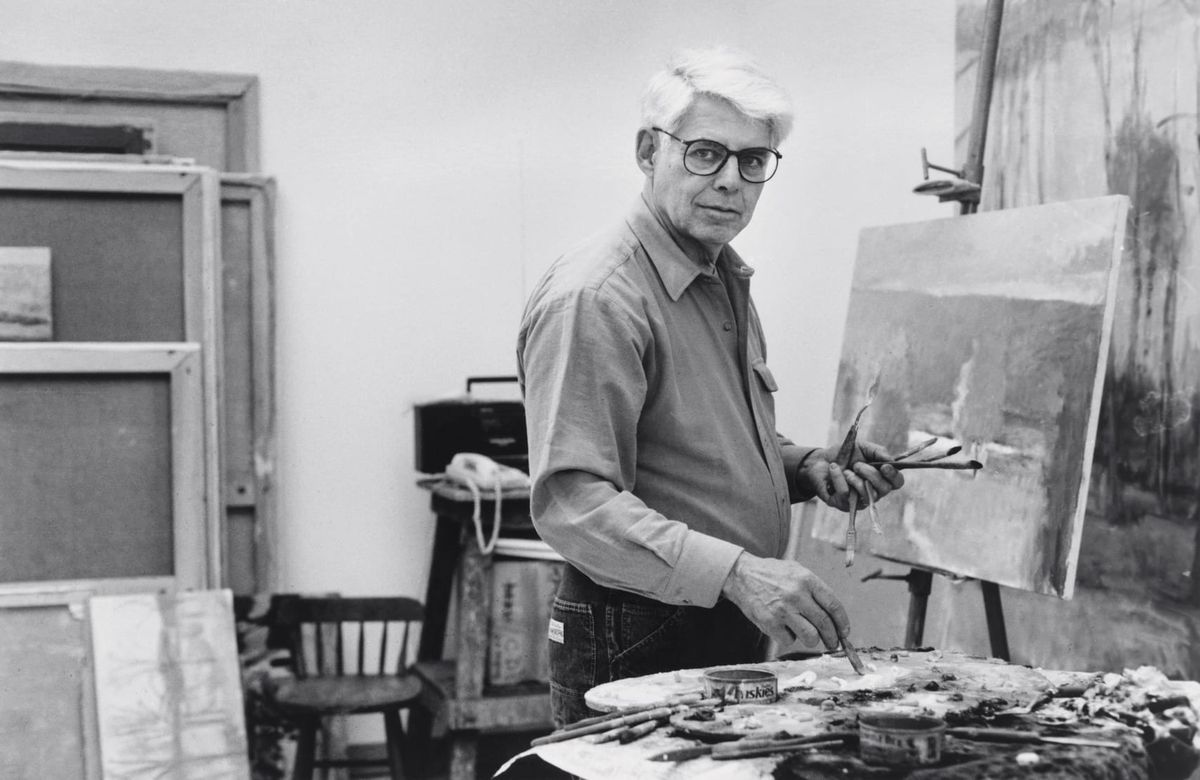
The Wolf Kahn Foundation has opened a permanent headquarters and archive in Manhattan devoted to the late painter, a year before his 2027 centennial.
The offices at 134 W. 26th St., Suite 1150, in Chelsea are open to artists, students and researchers by appointment. They hold Kahn’s letters, lectures, publications, photographs and other media, president Ellen McCulloch-Lovell told Urgent Matter in written responses.
The Wolf Kahn Foundation shares its building with its sister organization, the Emily Mason and Alice Trumbull Mason Foundation. The latter is dedicated to the legacy of painter Mason—Kahn’s wife—and her mother, a founding member of the American Abstract Artists group.
McCulloch-Lovell said the two share information and that Mason’s foundation will mark her centennial in 2032.
“Emily is a part of Wolf’s history to be celebrated, along with him,” McCulloch-Lovell said.
Kahn, who lived from 1927 to 2020, was a second-generation New York School painter who, in McCulloch-Lovell’s words, focused on landscape and brought it “to the point of abstraction.”
The new offices sit in the Manhattan neighborhood where the couple lived and kept studios, a few blocks from Kahn’s gallery, Miles McEnery Gallery, McCulloch-Lovell said. Kahn graduated from New York’s High School of Music and Art. He took classes at the New School and enrolled in the Hans Hofmann School, where he helped organize the Hansa Gallery in shows that first drew critical notice.
“New York City is where Wolf developed his artistic practice,” she said.
In announcing the opening, McCulloch-Lovell described Kahn’s arrival in the country as a child.
“Arriving in the U.S. as a refugee from Nazi Germany at age twelve, Wolf Kahn built his community and developed his artistic practice in New York City,” she said in a statement.
The foundation is funded “by returns from investments and art sales,” McCulloch-Lovell said.
Its 2023 tax return, the most recent year available on the IRS website, documents both. The foundation reported $944,722 in total revenue that year, including $198,453 in dividends and interest and a $744,024 net gain on asset sales.
It sold nearly $1.9 million in artwork during 2023, part of $3.1 million in total asset sales, the filing shows. The works were donated to the foundation in January 2021.
At the end of 2023, the foundation valued its holdings of Kahn’s artwork at $14.5 million and reported $22.8 million in total assets.
The 2023 return lists a mailing address in Brattleboro, Vermont, near the hill farm where Kahn and his wife, the painter Emily Mason, spent part of each year.
The Wolf Kahn Foundation space also serves as the central resource for the foundation’s catalog raisonné, a comprehensive archive of the works accepted as his.
The catalog raisonné has drawn 252 submissions, of which 222 works have been accepted as Kahn’s, McCulloch-Lovell said.
“Kahn was very prolific and this is a long-term project,” she said. “The foundation may begin to publish the CR by sections in the next few years.”
A four-member committee reviews each submission: Karen Wilkin; Mara Williams, the foundation’s chair and a curator; Cecily Kahn, a daughter of the artist and a painter; and Michael Rubenstein, an architect, collector and longtime friend of Kahn.
“This review includes an evaluation of the artwork’s provenance, exhibition history, literature, and any supporting documentation provided,” McCulloch-Lovell said.
The foundation paid $207,600 in grants in 2023, records show. Recipients included the Smithsonian Institution, the Solomon R. Guggenheim Museum, the Phillips Collection, the Bruce Museum, the Farnsworth Art Museum and the Fine Arts Work Center in Provincetown. The largest grant, $15,500, went to the Brattleboro Museum and Art Center.
McCulloch-Lovell, who works 20 hours a week as president, received $46,024 in 2023, the only officer the foundation paid, records show. The foundation paid two employees more than $50,000 that year: collections manager Linda Stewart at $59,206 and grant coordinator Jennifer Burris at $56,443.
McCulloch-Lovell pointed to the novelist John Updike, who wrote in the introduction to “Wolf Kahn’s America” that the painter brought “the hot, pure color of Abstract Expressionism” to a tranquil, witty vision of landscape.
She said Kahn never held a faculty position but taught workshops around the country, and that his influence shows in today’s landscape painters and in artists who experiment with color.
The opening marks the start of a multi-year centennial celebration, McCulloch-Lovell said. The foundation plans a media preview on October 27 to lay out those plans and introduce its leadership, and has said it will work with museums and cultural institutions worldwide on exhibitions and programs during the anniversary year.
Urgent Matter is reader-supported. Please consider subscribing to support independent arts journalism.