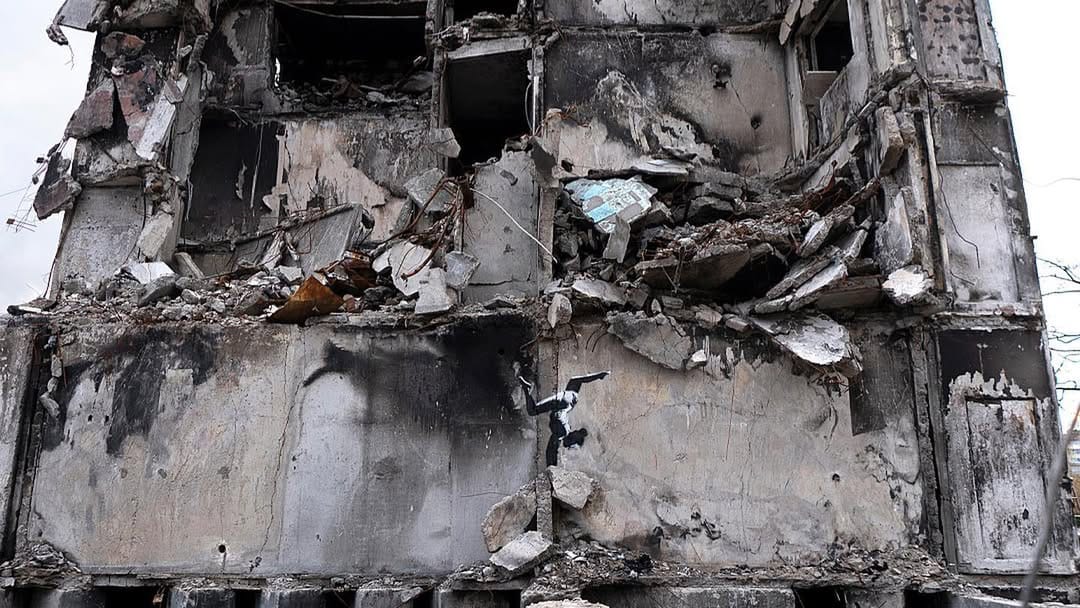
An artwork by Banksy in Borodyanka, Ukraine. Photo by Banksy/Instagram
For more than two decades, the mystery surrounding Banksy has been part of the artwork itself. The anonymous street artist’s stenciled images appear overnight on walls and checkpoints around the world, leaving the public to debate the message rather than the author.
A Reuters investigation published last week that traced decades of records, interviews and geographic analyses said it had definitively identified Banksy as Robin Gunningham, a British man who has long been suspected of being behind the pseudonym.
Reuters said it published the findings because Banksy’s works have generated hundreds of millions of dollars in art sales and influenced politics, tourism and the global art market. The news organization said these factors made the artist’s identity a matter of public interest.
However, the real question is not just whether Banksy’s identity has been uncovered, but whether revealing it actually served the public interest.
Influence and market value alone do not justify exposing a private individual who has maintained anonymity for decades. Unless the identity reveals wrongdoing, deception or harm to the public, arguing that financial scale overrides an artist’s deliberate anonymity feels like poor justification.
First, Reuters fails to understand the roles anonymity plays in art. Street art emerged from illegal or semi-legal practices such as graffiti, unsanctioned murals, and unauthorized interventions in public space. For street artists, anonymity is rarely just for personal protection—it is often central to the work itself.
When the artist’s identity is unknown, the artwork stands on its own, separate from the person’s background, education, or reputation. For political art, anonymity helps protect the work from being overly explained or tied to the artist’s personal story. Banksy’s entire approach is based on this idea.
There is also the question of what the reveal actually adds to the public’s understanding of Banksy’s art. Knowing that Banksy may be a man from Bristol does little to change how viewers interpret his work. The meaning of those works has always been carried by their placement, timing and imagery, not by the biography of the person who made them.
There are also practical risks to consider.
Banksy has repeatedly worked in politically sensitive environments. In 2017, he opened the Walled Off Hotel in Bethlehem, an installation and functioning hotel located directly beside the Israeli separation barrier in the occupied West Bank. The project, which includes murals and installations addressing the Israeli-Palestinian conflict, was conceived as both satire and protest.
In 2015, the artist entered the Gaza Strip and painted several murals on buildings damaged during the war between Israel and Hamas, including an image of a Greek goddess Niobe weeping amid rubble and a kitten painted on the remains of a destroyed house. The works were accompanied by a short video released by Banksy that described Gaza as the “world’s largest open-air prison.”
And, he has repeatedly worked in politically sensitive locations in Europe. In 2015, he created murals around the migrant encampments in Calais, France—then known as “the Jungle”—including a stencil depicting Apple co-founder Steve Jobs carrying a sack and an early Apple computer. The image referenced Jobs’s father, a Syrian immigrant, and was intended as commentary on the refugee crisis in Europe.
Working in these situations often requires staying unnoticed. By tracking the artist's movements through active war zones like Ukraine, Reuters turned humanitarian art into a paper trail. And making the artist’s legal identity public could make travel more difficult, increase the risk of harassment or retaliation, and make it harder to do the kind of guerrilla work that defines street art.
Supporters of unmasking often frame the issue as one of accountability. Banksy’s works are frequently unauthorized and sometimes technically illegal. His pieces can dramatically raise the value of buildings or neighborhoods, creating a secondary market that benefits collectors and property owners.
However, the accountability argument is more complicated than it seems.
Authorities likely already know who Banksy is and have ways to investigate vandalism or other concerns. If government agencies thought a crime had happened or laws were broken, they would not need a news story to take action.
In the art world, Banksy’s identity has been an open secret for a long time. Some dealers are said to know or suspect who he is. Still, most people in the art community have respected the line between guessing and confirming his identity.
Journalists often consider whether revealing someone’s identity is worth the possible harm it could cause. In many situations, such as with whistleblowers or crime victims, news organizations choose to protect people’s anonymity to keep them safe.
If media outlets set a precedent of aggressively unmasking anonymous artists, the biggest impact may not be on someone as famous and wealthy as Banksy.
Instead, it could put lesser-known artists at risk, especially those working under authoritarian governments or in unstable regions, where staying anonymous is often their only protection from arrest or violence.
In the end, Reuters hasn’t provided a public service. It has simply traded a global symbol of resistance to the commercialization and celebrity culture of the art world for a trivia answer.
Share this article
The link has been copied!
Members Discussion
Your link has expired. Please request a new one.
Your link has expired. Please request a new one.
Your link has expired. Please request a new one.
Great! You've successfully signed up.
Great! You've successfully signed up.
Welcome back! You've successfully signed in.
Success! You now have access to additional content.