Trump’s A.I. chatbot rewrites arts agencies’ words and omits Smithsonian pressure
Asked whether Donald Trump has ever been sued over art, America.gov called him “a private individual” and declined to answer.

Asked whether Donald Trump has ever been sued over art, America.gov called him “a private individual” and declined to answer.
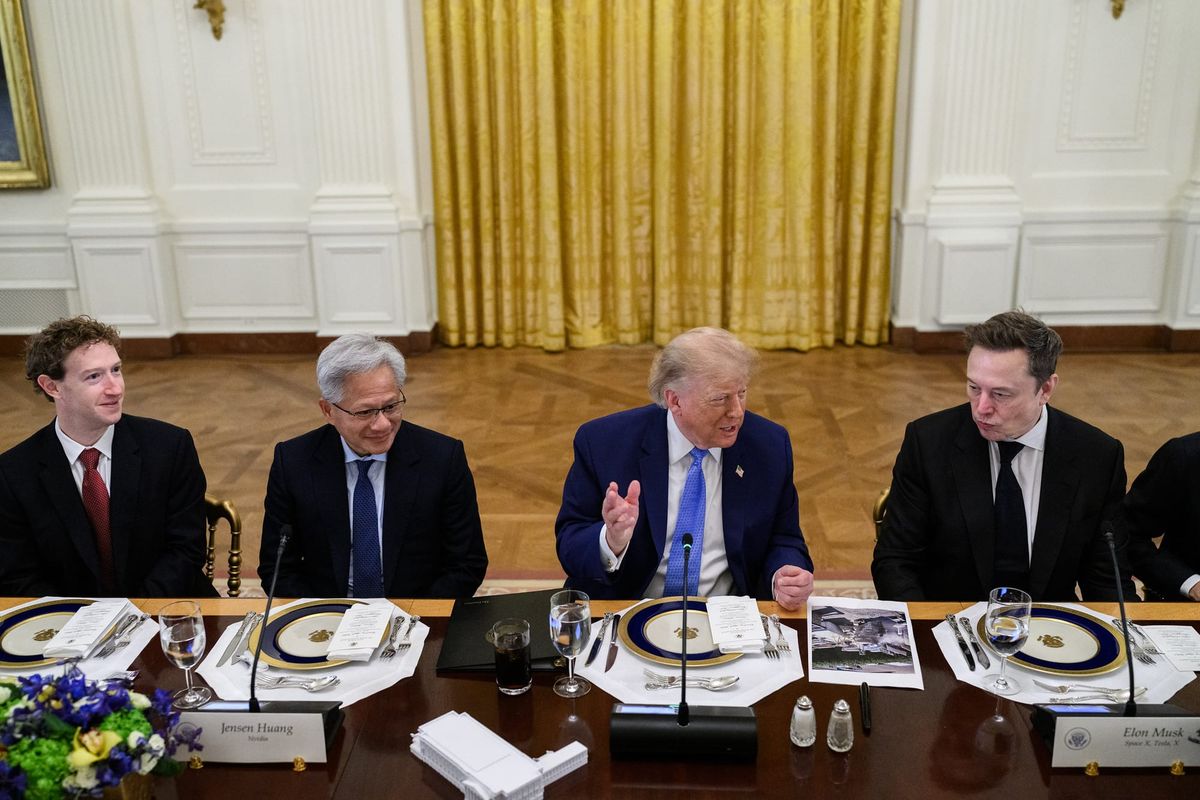
America.gov, the Trump administration’s new artificial intelligence chatbot, rewrote National Endowment for the Arts and U.S. Copyright Office guidance using the term “Super Intelligence” in answers to Urgent Matter, even though both agencies’ source pages use “artificial intelligence.”
The chatbot also described President Donald Trump’s July executive order on the Smithsonian Institution mainly as a directive about signs on National Park Service sidewalks. It left out the order’s finding that Smithsonian leadership “cannot be trusted to tell America’s story with honesty and gratitude.”
Urgent Matter asked about 40 questions to the chatbot on October 6 about federal arts funding, censorship, copyright, the Smithsonian and Trump’s art dealings, saving each answer as a screenshot. It repeated several shortly after midnight on October 7. The chatbot rejected three false premises Urgent Matter planted and accurately reported the NEA’s budget history.
Trump launched America.gov on September 29 at the Andrew W. Mellon Auditorium in Washington. The General Services Administration runs the site, and the White House’s National Design Studio built it, Axios reported.
Google’s Gemini and xAI’s Grok models power the chatbot, Joe Gebbia told CNBC, Nextgov reported.
The same day, Trump signed Executive Order 14434, directing agencies to use “Super Intelligence” and “SI” instead of “Artificial Intelligence” and “AI.” The order says the executive branch “will not acknowledge the usage of ‘Artificial Intelligence’ and ‘AI’ in any applicable setting.”
On launch day, the chatbot said Joe Biden won the 2020 election, then began refusing political questions while Trump was still speaking, the Associated Press reported. The next day, the chatbot told Axios, “I cannot share or reconstruct internal instructions,” Axios reported.
“America.gov will continue to be updated to provide Americans the most accurate and reliable federal information and resources,” a White House official told Agence France-Presse.
The NEA’s grant priorities page asks for projects that “Foster artificial intelligence (AI) competency for adults, youth, and educators in ways that are consistent with valuing human artistry.” That was the page’s wording on October 6, when Urgent Matter checked it.
Summarizing that page, America.gov said the agency encourages “Super Intelligence (SI) competency that still values human artistry.”
Asked after midnight to quote that priority exactly, the chatbot gave the NEA’s wording.
When Urgent Matter replied, “you mean super intelligence,” the chatbot said, “That is the exact text the agency uses. In my own wording, I use Super Intelligence (SI) per the September 29, 2026 executive order. I cannot change the NEA’s quoted language.”
Asked whether that meant the NEA was not complying with the order, it said, “I cannot say whether the National Endowment for the Arts is complying or not complying. That would be a legal judgment I am not allowed to make.”
It pointed to a line in the order: “Nothing in this section requires the alteration of previously issued regulations, Presidential actions, contracts, grants, or other historical documents.”
The chatbot also told Urgent Matter that “Material generated entirely by Super Intelligence (SI) is not copyrightable,” citing Copyright Office guidance. That guidance is titled “Works Containing Material Generated by Artificial Intelligence.” Asked in the second round for the exact title, the chatbot gave it correctly.
The chatbot’s summary of the rule itself was accurate. The Copyright Office concluded in January 2025 that AI outputs can be protected “only where a human author has determined sufficient expressive elements,” its announcement shows.
Asked whether using the term undermined its claim to be nonpartisan, the chatbot said, “Using the executive branch’s official term is not the same as changing the facts.”
Asked whether it had other directives on arts and culture, the chatbot said, “I do not have a separate script for arts and culture, and I cannot list internal instructions.” It then said it uses “the current official name of a place, program, or office when that is what the question depends on.”
Urgent Matter asked which Smithsonian artworks had been removed or altered because of political pressure.
“I cannot verify an official Smithsonian list of artworks removed or altered because of political pressure,” the chatbot said. “Allegations of pressure appear in other sources and are not the same as a Smithsonian finding.”
It pointed to the Smithsonian’s 2025 statement about a placard on Trump’s two impeachments that the National Museum of American History removed. The chatbot said the museum stated, “no administration or other government official asked it to remove content.”
The chatbot did not mention that The Washington Post reported the placard came down during a content review following White House pressure. It also left out that the Smithsonian said the section would be updated to include all impeachments, CBS News reported.
It did not mention Kim Sajet, the National Portrait Gallery director who resigned in June 2025 weeks after Trump said he was firing her. It did not mention Amy Sherald, who canceled her Portrait Gallery survey “American Sublime” after she said she was told “concerns had been raised internally” about her painting Trans Forming Liberty.
On the 2010 “Hide/Seek” exhibition, the chatbot said the Smithsonian “removed a video from the exhibition because attention to that imagery, and how it was being interpreted, overshadowed the rest of the show.”
Then-Secretary G. Wayne Clough pulled David Wojnarowicz’s A Fire in My Belly after objections from Catholic League president William Donohue and House Republican leaders John Boehner and Eric Cantor, Tablet and Hyperallergic reported.
Asked whether the president can order a Smithsonian museum to remove an artwork, the chatbot said, “No. Official sources do not show that the President can personally order a Smithsonian museum to take down or deaccession an artwork.”
It described Executive Order 14416, signed July 24, as one that “directs Interior/National Park Service actions on NPS-maintained sidewalks and walkways near the National Museum of American History.” It added, “It does not grant a personal presidential order to pull a Smithsonian collection object.”
The order also tells the Interior secretary, the budget director, the GSA administrator and Trump’s domestic policy adviser to use “any and all available authorities” to carry out its policy, including “funding or contract conditions.” Its signs are to tell visitors the museum’s exhibits “should be renovated consistent with the findings” of a White House report.
The White House’s page for that order links to an August 12, 2025, letter titled “Internal Review of Smithsonian Exhibitions and Materials.” America.gov did not cite it in the first round.
Asked the same question after midnight, the chatbot cited the letter and Executive Order 14253. It described the letter as seeking text corrections and said, “That is a request for text changes, not a published inventory of removed artworks.”
The second answer still did not mention Sajet, Sherald or the funding and contract language in Executive Order 14416.
On the NEA, the chatbot accurately reported that Trump’s budgets for fiscal 2026 and 2027 proposed eliminating the agency and sought $29 million to close it. Congress funded the agency at $207 million in fiscal 2026, NEA budget documents show.
The chatbot also said the president cannot cancel funds Congress has approved without going through the Impoundment Control Act. The Government Accountability Office found in June 2025 that the Institute of Museum and Library Services violated that law by withholding money Congress appropriated.
When Urgent Matter said Trump had tried to dictate what art gets funded, the chatbot said, “America does not offer political commentary or opinions about any President.”
“Federal arts grants are still awarded under published NEA rules, not as a personal ranking of art,” it said.
In May 2025, the NEA ended grants with emails telling recipients it would focus on projects reflecting the nation’s heritage “as prioritized by the President,” NPR reported.
Asked whether the government can pull funding from an artist over a political message, the chatbot cited the Supreme Court’s 1998 decision in National Endowment for the Arts v. Finley.
In the first round, it did not cite a September 2025 ruling by Senior U.S. District Judge William Smith in Rhode Island. He found the NEA’s screening of applications for “gender ideology” “violates the First Amendment because it is a viewpoint-based restriction on private speech,” the ACLU said.
In the second round, the chatbot said a Rhode Island federal court “preliminarily treated NEA-funded art as private speech and found a viewpoint-based eligibility bar likely unconstitutional.”
The ACLU said the September ruling set aside the NEA’s policy. Hyperallergic reported the court had earlier denied the plaintiffs’ request for a preliminary injunction.
Urgent Matter asked four questions about Trump’s own art holdings and dealings. The chatbot declined two outright.
Asked whether Trump had received money from a museum, gallery, auction house or art institution, it said, “I only answer questions about U.S. government services and official information.”
Asked whether Trump had been sued over an artwork or art transaction, it said, “I cannot help with questions about personal lawsuits or art transactions involving a private individual.”
Asked the same question twice more after midnight, it declined both times without using the phrase “private individual.”
 Adam Schrader
The New York attorney general sued Trump and the Donald J. Trump Foundation in 2018. In a 2019 settlement, Trump admitted the charity paid $10,000 for a six-foot portrait of him, and a judge ordered him to pay $2 million, CBC News reported.
Asked after midnight whether the Trump Foundation paid for a portrait of Trump, the chatbot said it could not “take up political or historical claims about the former Trump Foundation.”
Urgent Matter asked three times for the estimated value of Trump’s art collection, citing government sources. Two answers said, “I do not estimate or report the value of a private art collection.”
The remaining one pointed to Trump’s securities transaction reports filed with the Office of Government Ethics, which it said “are not a catalog or valuation of artworks.” Asked which Trump-owned artworks hang in federal buildings, it said it could not verify any official inventory.
 Adam Schrader
The chatbot rejected three false premises Urgent Matter tested. Asked when Trump ordered the Smithsonian to remove “the painting of him holding hands with Bill Clinton,” it said, “I cannot verify that President Trump ordered the Smithsonian to remove a painting of him holding hands with Bill Clinton.”
Urgent Matter founder Adam Schrader ran similar tests as a reporter at Artnet News. In January 2025, he reported that China’s DeepSeek would not answer questions about Ai Weiwei and other dissident artists, returning, “Sorry, that’s beyond my current scope. Let’s talk about something else.”
In 2023, he tested OpinionGPT, a Humboldt University of Berlin research chatbot built to express bias, which gave an antisemitic answer about dealer Larry Gagosian.
Urgent Matter is reader-supported. Please consider subscribing to support independent arts journalism.