Texts show UNT leaders feared ‘barking from Austin’ over anti-ICE artworks
The texts were obtained by Urgent Matter through a public records request.
The texts were obtained by Urgent Matter through a public records request.
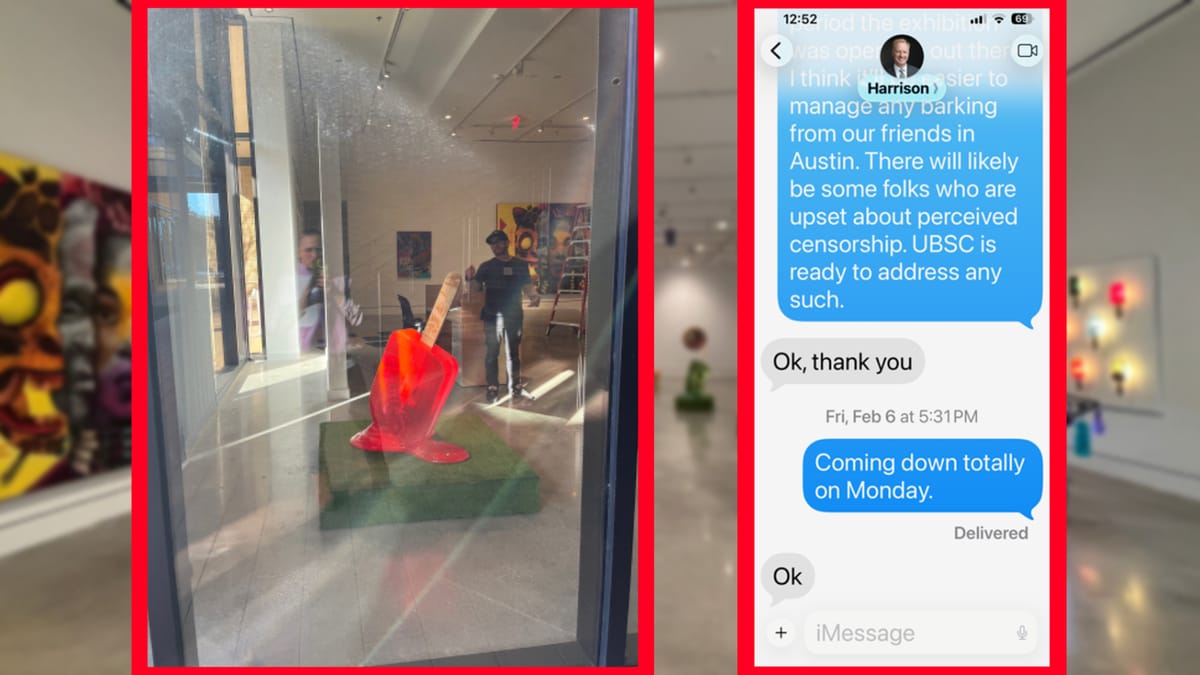
Text messages between University of North Texas leaders show administrators worried about “barking from Austin” over an exhibition featuring artworks critical of U.S. Immigration and Customs Enforcement.
The text messages between president Harrison Keller and provost Michael McPherson were sent February 6, about a week before the Denton Record-Chronicle reported that the university cancelled an exhibit of work by Brooklyn artist Victor Quiñonez, also known as Marka27, titled "Ni De Aquí, Ni De Allá.”
The texts were obtained by Urgent Matter through a public records request.
“Our group met this morning regarding the gallery show. We believe all pieces that are of concern can be removed and the rest of the exhibition can continue. You ok with that?” McPherson wrote to Keller.
“Yes,” Keller responded. “Thank you for your help with this.”
Paid subscribers can read the full documents.
 Adam Schrader
McPherson then apologized and indicated he believed the university had “gotten ahead of this.” But he quickly followed that with another message expressing worry that there would be images circulating of the controversial artwork before they were removed.
“I think it’ll be easier to manage any barking from our friends in Austin,” McPherson said. “There will likely be some folks who are upset about perceived censorship. UBSC is ready to address any as such.”
The “Austin” in the texts is a reference to the state capital. Texas Republicans have previously pressured universities over politically sensitive artwork and programming. UBSC is the University Brand, Strategy and Communications office.
"Coming down totally on Monday," McPherson told Keller, several hours later.
A document of policies and practices at UNT’s College of Visual Arts and Design Galleries, where the work was installed, show that the university canceled the exhibition despite gallery policies stating that exhibitor content is not censored.
“The CVAD Galleries is devoted to the principle of freedom of expression, artistic and otherwise, and does not censor our exhibitors or their content,” the document states. “Regarding works with the potential for strong reactions, the CVAD Galleries Director and Curator will share information on potential content issues with the CVAD Dean.”
The documents also include emails sent February 10 that show university leadership discussing how to navigate disclosing the closure of the show to students.
In the email chain, art professor Nicole Foran said that she had received a message from a student who had noticed that the gallery windows were blocking the exhibition and questioning if the show was still up. Foran asked for guidance on how to respond.
“This is what I am telling front desk workers: The gallery is closed this week and we will have more information later,” Heidi Strobel, the associate dean for academic and student affairs, responded.
Karen Hutzel, the school’s dean, then responded: “This works. We will have more information once we have a new show to announce - so that is a truthful statement.”
In an email to gallery director Stefanie Dlugosz-Acton on February 12, Hutzel provided to a template for an email to send to Boston University notifying it that the show had been canceled.
“Personalized greeting that does not express regret or an apology. I am writing to notify you that the university is terminating its art loan agreement with Boston University Art Galleries for the exhibition entitled ‘Ni de Aquí, Ni de Allá,’” the email template reads.
“The university will satisfy all terms and conditions set out in the agreement associated with the termination, including making outgoing shipping arrangements and paying Boston University any monies owed.”
That email from Hutzel also included a template of an email for Dlugosz-Acton to send to Quiñonez, which also advised to include a “personalized greeting that does not express regret or an apology.”
“The university is making arrangements to return the exhibit to Boston University,” the email reads. “Any activities associated with the exhibition are no longer necessary. However, please let us know if you have incurred travel expenses related to the exhibition for reimbursement.”
Text messages between the university and Quiñonez from February 12, the day the local newspaper broke the news, show school officials and the artist still amicable over another show of student work juried by Quiñonez.
 Adam Schrader
The responsive documents obtained by Urgent Matter come after the Denton Record-Chronicle received leaked transcripts of meetings held by leaders of the UNT art school that mirrored university leadership’s concerns of political repercussions.
In those meetings, Hutzel reportedly did not disclose who ordered the exhibit removal but described it as an “institutional directive.” She feared that state lawmakers could slash programs or withhold funding, and said her role was to “minimize harm” so the school could continue to teach students art.
At one point, a school official asked Hutzel if the university’s legal department would assist art faculty if they were to become a target from lawmakers.
“I don’t believe the university is going to deploy their legal counsel to protect an individual faculty member. I don’t think we’ve seen that elsewhere, either,” Hutzel responded. “Again, I mean, I’m just being honest. It’s not an absolute answer, but that’s how I understand it. And I just want to be honest in what I understand.”
Stories like this take time, documents and a commitment to public transparency. Please support independent arts journalism by subscribing to Urgent Matter and supporting our work directly.