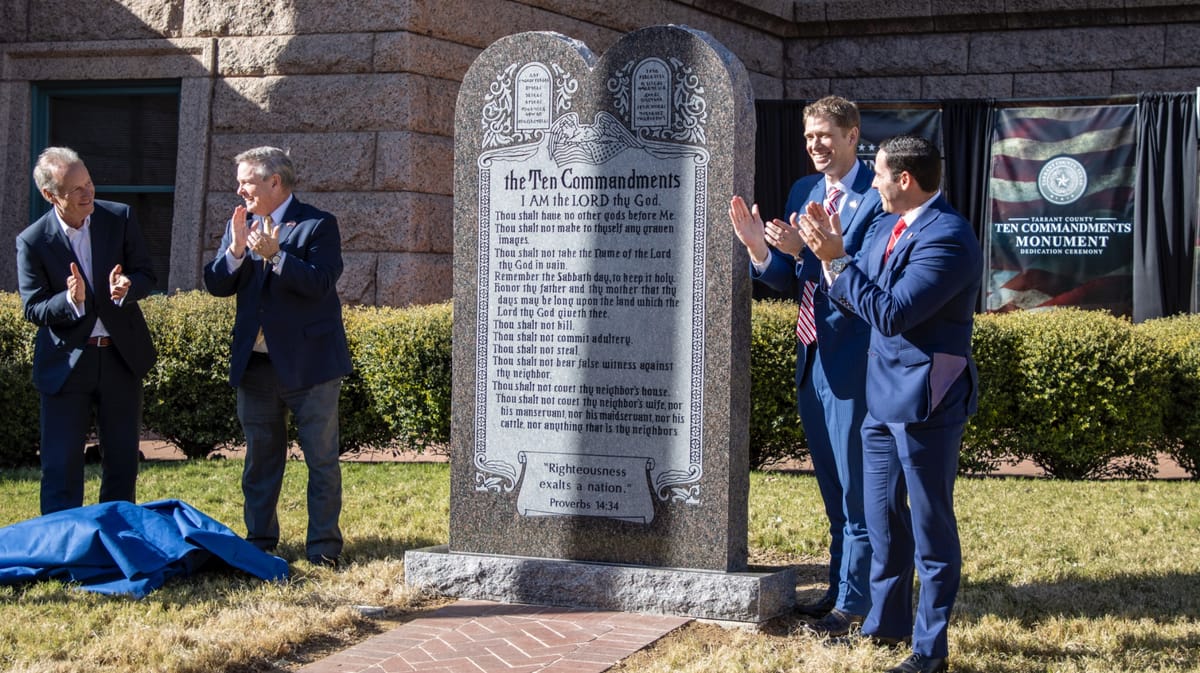
A Ten Commandments monument has been unveiled at the Tarrant County Courthouse in Fort Worth, Texas. Photo: Commissioner Matt Krause/X
A large sculpture of the biblical Ten Commandments has been unveiled at the Tarrant County Courthouse in Fort Worth, Texas, prompting concerns over the use of cultural monuments to spread partisan politics and religious messaging at a government building.
The Tarrant County Courthouse, which does house actual courts, is also the home of the county’s “commissioner’s court” — the local governing body for some 2.2 million people in Fort Worth and its suburbs.
Last April, the five-member Tarrant County Commissioners’ Court voted 3-1, with one absence, to approve the Ten Commandments monument itself and to accept a donation of funds for its installation from the American History & Heritage Foundation, according to the minutes from the meeting.
The AHHF previously sponsored the 2017 installation of a Ten Commandments monument on the grounds of the Arkansas State Capitol, which was destroyed shortly afterward and later replaced through fundraising efforts.
Commissioner Alisa Simmons, the lone vote against the installation of the monument, cited the constitutionally protected legal doctrine of the separation of church and state. She also blasted her peers on the panel at that April 2025 meeting, stating that “this body does not even adhere to the Ten Commandments in its governance of county business.”
“The Ten Commandments provides a moral framework that emphasizes the importance of caring for the vulnerable and upholding justice. Why would we, this commissioner's court, put a monument to the very things we do not uphold on this court?” she said.
Simmons said that displaying the Ten Commandments on taxpayer property excludes residents of other faiths and is “disrespectful” and “discrimination.”
“Christian leaders and organizations have consistently advocated for the protection of social programs that serve the most vulnerable, highlighting that such support aligns with core Christian values,” she said.
“This court has reduced assistance to those in need. … So, I'm not sure that this body or the Ten Commandments best represents this body.”
Sign up for Urgent Matter
A paid subscription to Urgent Matter helps fund independent reporting rooted in First Amendment protections.
No spam. Unsubscribe anytime.
The monument was unveiled Friday in a ceremony hosted by Commissioner Matt Krause, who had proposed the measure to approve the monument last year, according to local NPR-affiliate KERA. Commissioner Manny Ramirez, who voted in favor of the monument, and County Judge Tim O’ Hare, the county executive, also attended.
Kelly Shackelford, the head of the First Liberty Institute and member of President Donald Trump’s Religious Liberty Commission, attended Friday’s ceremony and released a statement afterward.
The First Liberty Institute is a conservative Christian legal advocacy organization that focuses on expanding the presence of evangelical Christianity inside government institutions, public schools, the military and public spaces.
“The Ten Commandments are a symbol of law and moral conduct with both religious and secular significance for all Americans,” Shackelford said. “Those who want to ban such displays are wrong—both under our Constitution and history. A country that doesn’t understand it’s moral and religious traditions and background doesn’t know who it is.”
But a group called the Faith and Justice Coalition of Tarrant County released an open letter signed by more than 20 faith leaders opposing the monument ahead of the Friday ceremony.
A review of the signatories shows the critics are drawn primarily from mainline Protestant denominations, including the Episcopal Church, United Methodist Church, Disciples of Christ and Baptist congregations. At least 14 of the signers are ordained ministers, several of them senior or retired clergy, and one is a seminary president.
The opposition is notable for what it is not. None of the listed critics represent atheist organizations, national advocacy groups or political parties. Instead, the signers are predominantly affiliated with local Christian congregations and institutions.
“A courthouse—an institution entrusted with justice and equal treatment under the law—must serve all members of the community without religious preference or endorsement,” the faith leaders said in the letter.
They noted that the Fort Worth region has large populations of various religious groups, including Jews, Muslims, Hindus, Buddhists, Sikhs, Indigenous spiritual communities, humanists, atheists and others.
Jewish leaders from Makom Shelanu Congregation and Beth-El Congregation were among the signatories to the letter, highlighting concerns from religious minorities about government-sponsored religious displays.
Judaism includes the Ten Commandments, known in Hebrew as the Aseret haDibrot, but Jewish leaders often note that public monuments typically reflect Christian numbering, translation, and presentation rather than Jewish tradition. The signatories noted the Fort Worth monument bears a Ten Commandments interpretation from the King James Bible.
“This is not only a legal concern—it is a moral one. Sacred texts are holy because they are studied, interpreted, and lived within faith communities, not because they are displayed or endorsed by government authority,” the group said in the letter.
“When the state appropriates religious symbols, it risks diminishing their spiritual meaning and turning them into tools of exclusion rather than sources of wisdom and moral guidance.”
Stories like this take time, documents and a commitment to public transparency. Please support independent arts journalism by subscribing to Urgent Matter and supporting our work directly.
Share this article
The link has been copied!
Members Discussion
Your link has expired. Please request a new one.
Your link has expired. Please request a new one.
Your link has expired. Please request a new one.
Great! You've successfully signed up.
Great! You've successfully signed up.
Welcome back! You've successfully signed in.
Success! You now have access to additional content.